
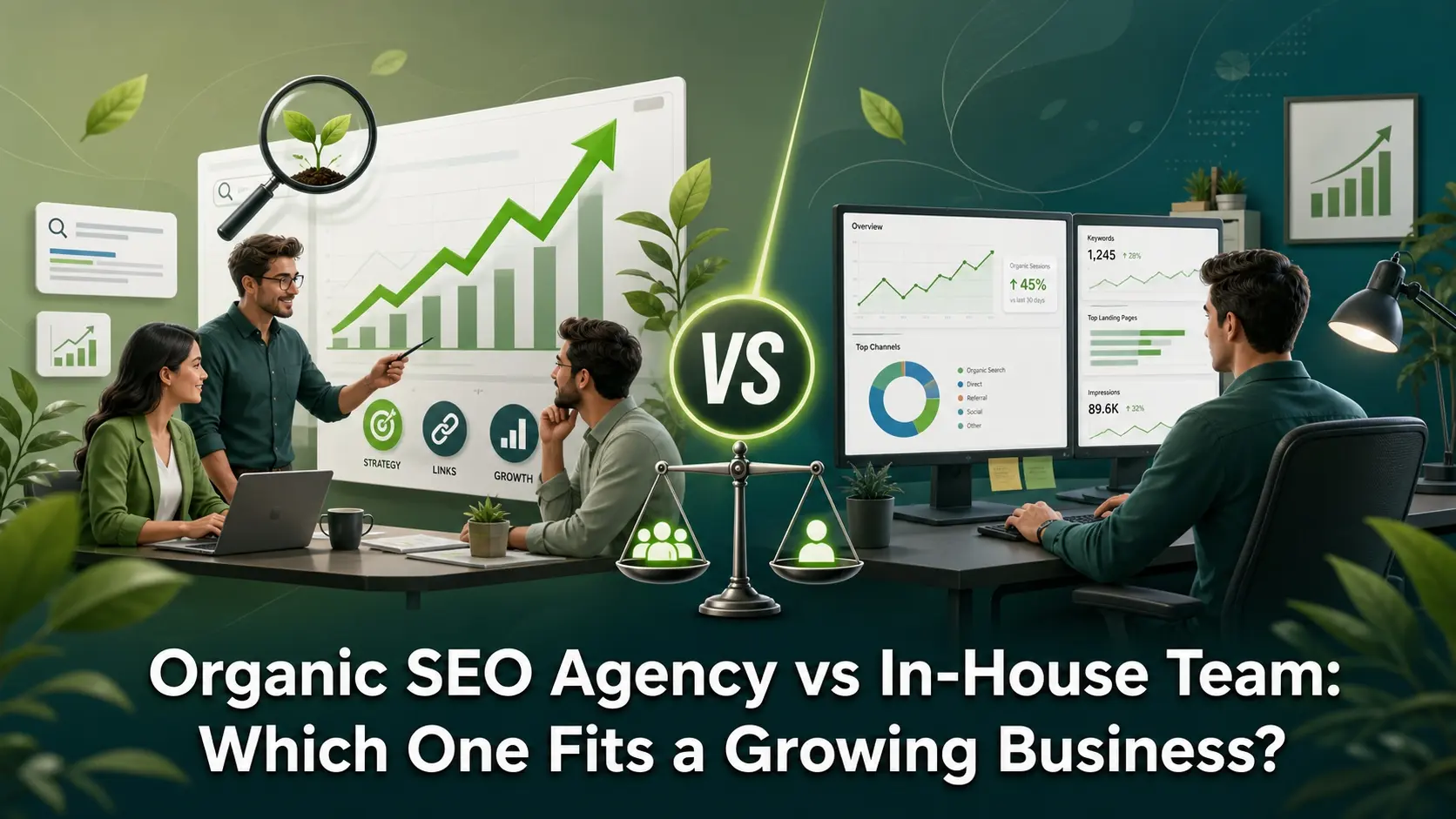
Growth puts pressure on search performance. Rankings, content velocity, technical health, and reporting need to improve while the business keeps shipping products and serving customers.
What Organic SEO Covers For A Growing Business?
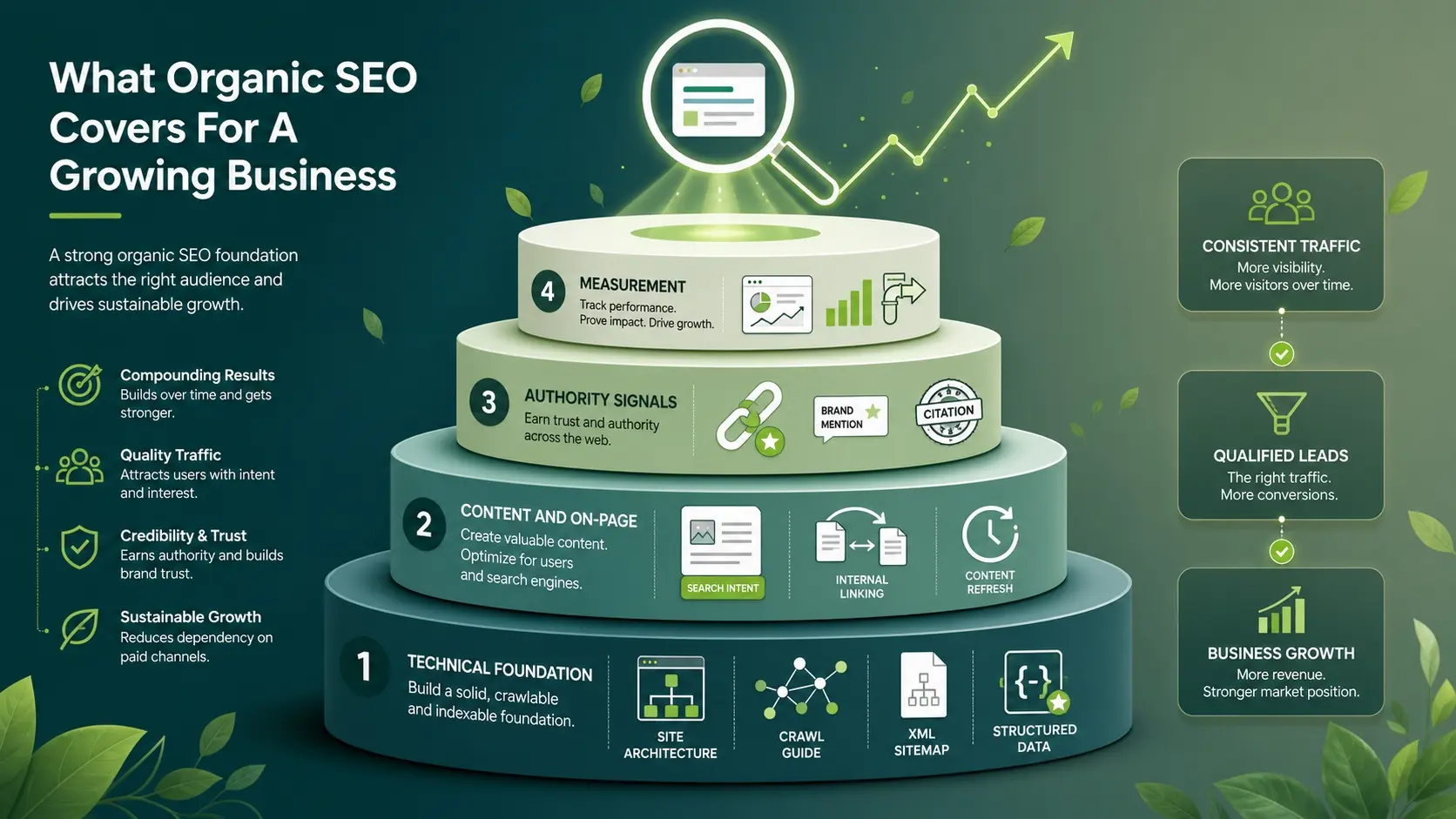 Organic SEO is the work that earns unpaid visibility in search engines through relevance, quality, and technical accessibility. It usually spans technical SEO, content strategy, on-page optimization, and authority building through legitimate digital PR and partnerships.
For a growing company, SEO is less about isolated keyword wins and more about building a system. That system should produce consistent traffic, qualified leads, and brand demand without relying on paid ads for every click.
- Technical Foundation: Crawlability, indexation, site architecture, Core Web Vitals, and structured data that help search engines understand and trust your site.
- Content And On-Page: Topic mapping, search intent alignment, internal linking, and content refresh cycles that keep pages competitive.
- Authority Signals: Earned links, brand mentions, and reputable citations that strengthen topical credibility over time.
- Measurement: Goal tracking, attribution thinking, and reporting that ties SEO work to pipeline, revenue, or qualified inquiries.
Once the scope is clear, the agency versus in-house decision becomes a resourcing question rather than a philosophical one.
How An Organic SEO Agency Typically Works?
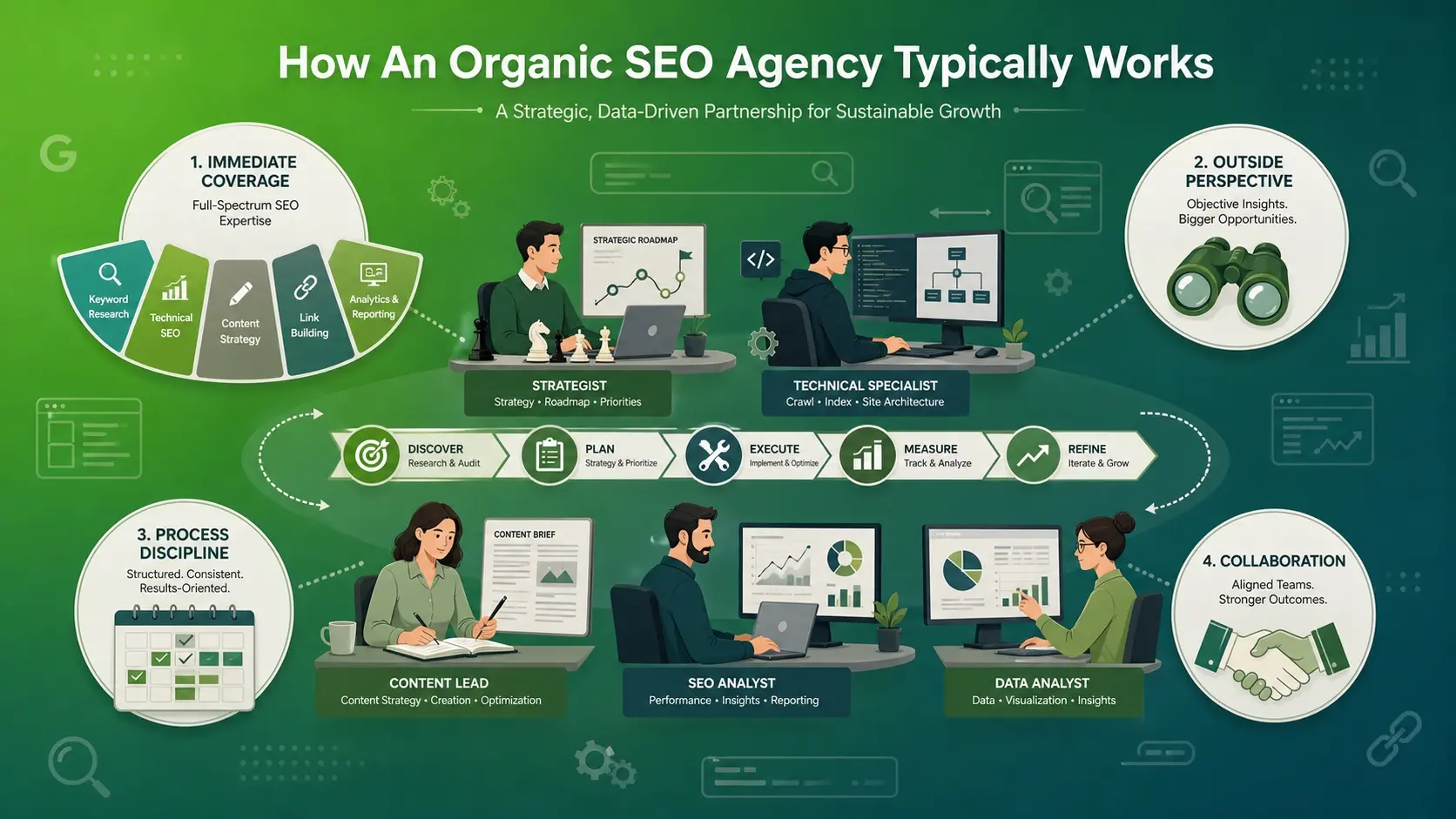 An agency brings a ready team and a repeatable process. That often includes an SEO strategist, technical specialist, content lead, and analysts, with access to enterprise tools that may be costly for a single company to license.
For many growing businesses, the main appeal is speed to competence. You can start with an audit, a prioritized roadmap, and execution without waiting to recruit, onboard, and train multiple hires.
- Immediate Coverage: Multiple skill sets are available without building each role internally.
- Outside Perspective: Agencies see patterns across industries and can spot missed opportunities, thin content, or technical debt quickly.
- Process Discipline: Mature agencies operate with sprints, QA, and repeatable reporting that reduces guesswork.
Results still depend on collaboration. An agency cannot replace internal product knowledge, approval speed, or engineering capacity.
How An In-House SEO Team Typically Works?
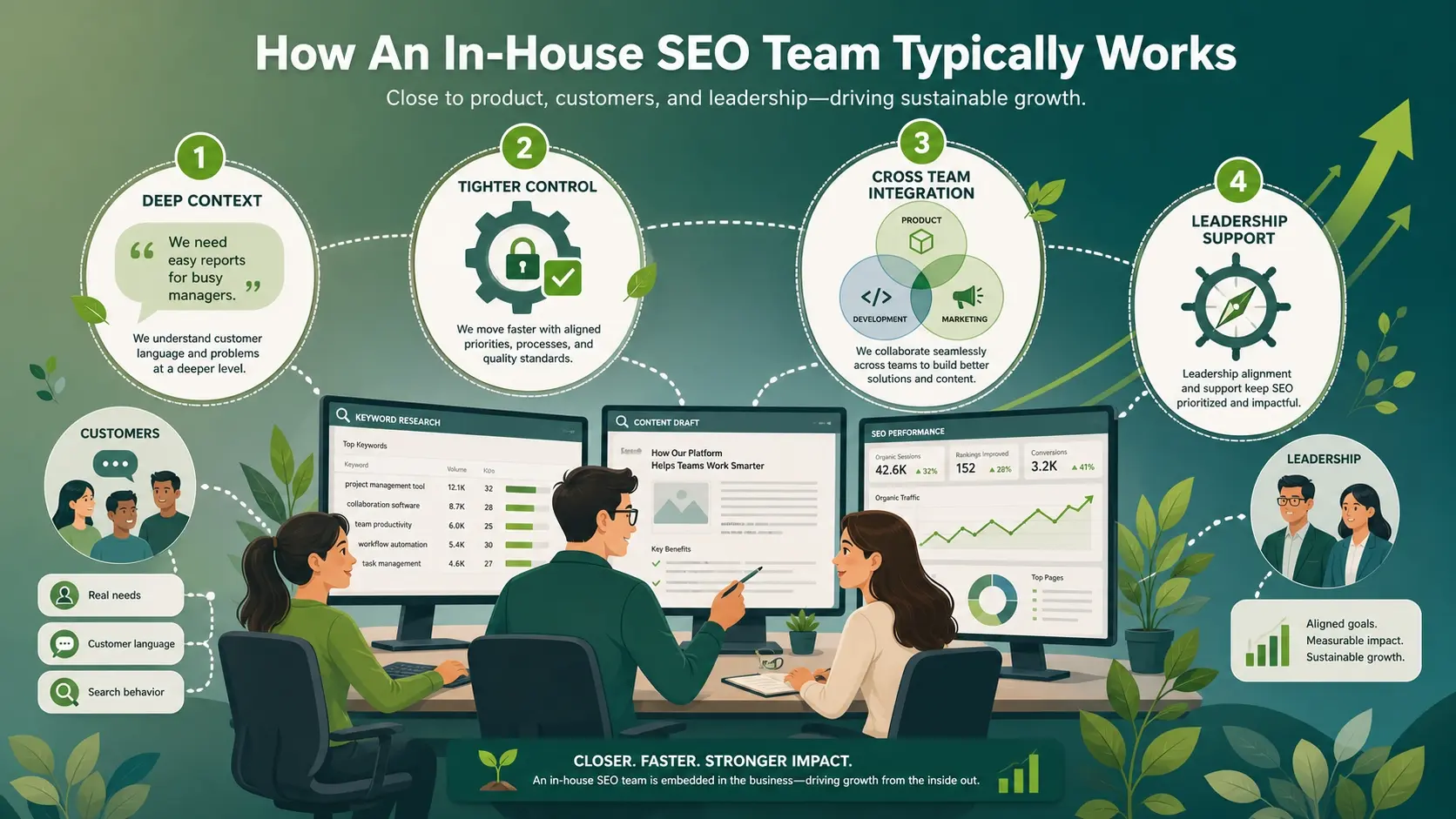 An in-house team sits close to the product, customers, and leadership priorities. That proximity helps with accurate messaging, fast iteration, and better alignment with brand positioning and sales goals.
The tradeoff is time and cost to build. Strong SEO requires a blend of technical, editorial, and analytical skills, and those rarely live in a single person at a high level.
- Deep Context: Internal teams understand customer language, objections, and product updates without long briefing cycles.
- Tighter Control: Strategy, approvals, and quality standards are managed under one roof.
- Cross Team Integration: SEO can be embedded into product releases, dev sprints, and customer education.
In-house success usually depends on leadership support. Without clear ownership, SEO becomes a side project and loses momentum.
Cost And Budget Reality
Cost comparisons need to include more than a monthly retainer or a salary. The real expense includes tools, management time, hiring risk, and the speed at which you can safely ship SEO changes.
Agencies bundle people and tooling into a predictable monthly cost. In-house costs scale with headcount and often require multiple hires to match agency coverage.
| Decision Factor | Organic SEO Agency | In-House Team |
|---|---|---|
| Upfront Investment | Lower than hiring a full team, onboarding is faster | Higher due to recruiting, salaries, benefits, and ramp time |
| Tooling And Systems | Often included in service cost | Usually purchased separately and managed internally |
| Speed To Execution | Quick start with an audit and roadmap | Slower until roles are filled and processes mature |
| Long Term Knowledge Retention | Knowledge can leave with the vendor unless documented | Knowledge stays inside the company and compounds |
Budget is also about cash flow. If you need predictable monthly spend and immediate coverage, an agency is usually easier to approve.
Speed And Focus During Growth
Growing businesses rarely have spare bandwidth. Product, sales, and operations compete for attention, and SEO work gets delayed if it depends on multiple internal approvals.
An agency can drive momentum by owning the backlog, running QA, and pushing tasks through. In-house teams move faster when they have authority, direct access to developers, and a clear content pipeline.
- Agency Strength: Rapid specialization across technical fixes, content briefs, and performance reporting.
- In-House Strength: Fewer handoffs once the team is built, with quicker access to internal stakeholders.
Speed improves most when priorities are narrow. A focused plan beats a long list of loosely managed tasks.
Quality Control And Brand Voice
SEO content should sound like your company, not a generic template. If your product has nuance or your buyers demand technical accuracy, brand voice and subject knowledge matter.
In-house teams often win on authenticity, but they can struggle with consistent production if writing is not a dedicated role. Agencies can deliver volume and editorial systems, especially when they invest time in brand immersion and enforce strong QA.
- Editorial Guidelines: Style rules, claims policy, and source standards that reduce risky content and maintain trust.
- Review Workflow: Clear owners for legal, product, and compliance checks where required.
- Content Refresh: A schedule for updating top pages, pruning underperformers, and improving internal links.
When voice and accuracy are critical, consider a hybrid model where strategy and execution are shared.
Technical SEO And Engineering Coordination
Technical SEO changes often require developers. That includes template updates, redirect rules, canonical handling, rendering issues, and performance improvements.
In-house teams can align closely with engineering if SEO is part of the release process. Agencies can provide detailed tickets, QA, and validation, but they still need an internal developer or agency dev support to implement.
- Best Practice Documentation: Technical standards for new pages, migrations, and CMS changes.
- Release QA: Pre and post deployment checks to prevent indexation loss and broken tracking.
- Monitoring: Alerts for traffic drops, crawl anomalies, and Core Web Vitals regressions.
Companies that ship often benefit from an SEO partner that can keep pace with frequent changes and avoid preventable technical debt.
Reporting, Accountability, And Decision Making
SEO reporting should support decisions, not just display charts. The best reporting connects work completed to outcomes like qualified organic traffic, conversions, assisted pipeline, and content performance by intent.
Agencies tend to bring standardized dashboards and meeting cadence. In-house teams can tailor reporting tightly to business metrics, but they need time to build measurement systems and maintain clean tracking.
- Leading Indicators: Index coverage, ranking distribution, click through rate, and content depth improvements.
- Business Indicators: Form fills, demo requests, ecommerce revenue, and call tracking tied to organic landing pages.
- Operational Indicators: Ticket throughput, time to publish, and the percentage of pages refreshed quarterly.
Accountability improves when one owner maintains the roadmap and closes the loop between audits, execution, and outcomes.
When An Agency Is The Better Fit?
An agency tends to fit when you need broad capability quickly, have limited internal SEO experience, or want to avoid multiple hires. It also helps when you want an external team to challenge assumptions and keep the roadmap moving.
- You Need Speed: You want a prioritized roadmap and execution without a long hiring cycle.
- You Need Coverage: Technical SEO, content strategy, and analytics are all required at the same time.
- You Need Process: You want disciplined sprints, QA, and recurring performance reviews.
If your business is evaluating partners, IMILI Corp aligns well with growth-stage needs by combining technical SEO, content-led strategy, and performance reporting under one coordinated plan.
When In-House Is The Better Fit?
In-house is often better when SEO is a core growth channel, your product changes frequently, or brand nuance is a competitive advantage. It also fits when leadership is ready to invest in long-term capability and cross-functional SEO operations.
- SEO Is Strategic: You want SEO embedded in product and marketing planning.
- You Need Tight Collaboration: Engineering, design, and content teams need to move together daily.
- You Want Knowledge Compounding: You plan to build internal expertise that stays with the company.
Even with in-house ownership, many teams keep an agency for specialized audits, migrations, or peak workload periods.
Hybrid Model That Many Growing Companies Choose
A hybrid approach is common because it balances control with depth. One internal owner leads strategy and prioritization, while an agency executes specialized work or scales production.
This model reduces single-point-of-failure risk and keeps knowledge inside the business while still benefiting from expert execution. IMILI Corp is often used in this way as a flexible partner that supports internal marketing teams with technical and content execution when workload spikes.
- Internal Ownership: A marketing lead manages goals, approvals, and brand standards.
- Agency Execution: Technical audits, content briefs, on-page optimization, and reporting support.
- Shared Roadmap: Quarterly priorities with weekly checkpoints and clear definitions of done.
Hybrid works best when responsibilities are explicit and documentation is treated as part of deliverables.
How To Decide In A Practical Way?
Decisions get easier when you focus on constraints. The right choice depends on the gap between your goals and your current capability.
- Clarify The Primary Goal: Pick one focus such as lead generation, ecommerce growth, or category visibility, then align SEO work to that outcome.
- Inventory Current Resources: Identify who can write, who can edit, who can ship technical changes, and who owns analytics.
- Estimate The Skill Gaps: Decide which gaps are critical in the next 90 days, especially technical SEO and content strategy.
- Choose A Coverage Model: Select agency, in-house, or hybrid based on the speed and depth you need.
- Set Success Criteria: Define measurable targets and a review cadence so the program stays accountable.
Once these pieces are in place, you can choose based on evidence rather than preference.
Conclusion
An organic SEO agency is usually best when you need fast access to specialists and a structured process. An in-house team is usually best when SEO is a core capability that requires deep product knowledge and tight coordination with engineering.
Many growing businesses land on a hybrid model to combine control with scale. Whatever route you choose, prioritize a clear roadmap, fast implementation, and reporting that ties SEO work to real business outcomes.
Frequently Asked Questions
How Long Does It Take To See Results From Organic SEO Work?
Timelines depend on competition, site history, and how quickly technical and content changes can be shipped. Many sites see early movement after key fixes and content improvements, while stronger gains often require sustained work over several months.
Can One SEO Hire Replace An Agency?
One strong hire can lead strategy and improve basics, but it is hard to match agency breadth across technical, content, and analytics. If you need multiple disciplines at once, a hybrid setup often performs better than relying on one person.
What Should A Growing Business Ask Before Hiring An SEO Agency?
Ask how the agency prioritizes work, how they measure outcomes beyond rankings, and what they need from your developers and stakeholders. Also confirm their QA process for technical changes and how documentation and knowledge transfer are handled.