

Advertising gets expensive when a brand is unclear. Strong positioning makes ads easier to understand, faster to trust, and more likely to convert, which lowers cost per click, cost per lead, and cost per acquisition. This article explains how to tighten brand strategy before buying more media so every dollar works harder.
Why Ad Costs Rise When Positioning Is Weak?
Ad platforms reward relevance and performance. When the offer feels generic or confusing, people scroll past, click less, and convert less, which pushes costs up.
Weak positioning also creates internal confusion. Teams argue about audiences, benefits, and priorities, then campaigns launch with mixed messages that split learning and dilute results.
- Low Click-Through Rate: Broad claims fail to earn attention, so the platform charges more to reach the same outcomes.
- Low Conversion Rate: If visitors do not quickly understand why the brand fits their needs, traffic becomes expensive noise.
- High Bounce And Drop-Off: A mismatch between ad promise and landing page message reduces quality signals and wastes budget.
- Longer Learning Phase: Too many angles, audiences, and offers slow optimization and keep costs elevated.
When positioning is clear, creative choices narrow and performance improves sooner. That is the fastest path to lower ad costs without cutting reach.
What Better Positioning Really Means?
 Positioning is a decision about who the brand is for, what problem it solves best, and why it is the most credible choice. It is not a slogan, a logo refresh, or a list of values.
Good positioning creates sharp edges. It makes the brand easier to remember and easier to choose, even when competitors spend more.
- Specific Audience: A defined segment with a shared need, context, and buying trigger.
- Focused Value: One primary outcome the brand can prove, supported by a few secondary benefits.
- Clear Differentiation: A real reason to choose the brand over alternatives, not a generic promise.
- Credibility Proof: Evidence such as expertise, process, data, or track record that reduces perceived risk.
Once those elements are stable, ads become a multiplier rather than a repair tool. That shift is where cost efficiency shows up.
How Positioning Lowers Cost Per Click And Cost Per Acquisition?
Better positioning improves ad economics through two levers. It increases the rate of qualified engagement and increases the rate of qualified conversion.
When both move upward, platforms often lower the effective price needed to reach goals. Even when auction prices stay high, the brand buys outcomes more efficiently.
- Higher Relevance Signals: Clear message match improves engagement quality and helps the algorithm find the right people faster.
- Stronger Offer Clarity: Visitors know what they get and why it matters, which reduces hesitation and friction.
- Better Landing Page Alignment: Consistent promise across ad and page lifts conversion and reduces wasted clicks.
- Improved Brand Recall: Recognizable positioning increases direct and branded response, which is typically cheaper to convert.
Cost reduction is usually the side effect. The primary win is that the business buys more qualified demand with the same spend.
Core Brand Strategy Inputs Before You Scale Ads
Brand strategy does not need to be slow or theoretical. It needs to be specific enough to drive creative, targeting, landing pages, and sales conversations.
These inputs should be written, shared, and enforced before increasing budget.
- Audience And Buying Context: Define the segment, job to be done, and the moment that triggers the search for a solution.
- Primary Promise: State the main outcome in plain language with minimal qualifiers.
- Reasons To Believe: List proof points that support the promise, such as methodology, certifications, benchmarks, or performance data.
- Competitive Frame: Clarify what alternatives customers compare you against and where you win.
- Voice And Message Guardrails: Decide tone, key terms, and claims you will not make to avoid confusing the market.
With these in place, campaign planning becomes more disciplined. That discipline shows up as fewer wasted tests and clearer insights.
Messaging That Converts Without Inflating Spend
Messaging connects positioning to performance. It turns strategy into phrases that earn attention and build trust quickly.
Strong messaging stays consistent across ads, landing pages, email, and sales calls. Consistency reduces cognitive load and increases conversion rate.
- Lead With The Outcome: Put the main benefit first so the right people self-select quickly.
- Use Specific Language: Concrete terms create clarity and reduce skepticism compared to vague superlatives.
- Address Objections Early: Remove common doubts with brief proof and risk reducers, not long explanations.
- Match The Customer Words: Align to how buyers describe their problem to improve relevance and response.
Once messaging is stable, creative testing becomes more meaningful. You test execution and emphasis, not the brand identity every week.
Positioning And Creative Alignment
Creative performance is often blamed on design or copy quality. More often, it is a strategy problem showing up in the ad unit.
Positioning gives creative a clear job. It dictates what to highlight, what to omit, and what the viewer should believe in three seconds.
- One Angle Per Ad: Each ad should express one clear promise tied to the positioning.
- Distinct Visual Cues: Repeated elements improve recognition and reduce the cost of reintroducing the brand.
- Proof In The Creative: Add credibility signals where possible, such as results language, process, or authority markers.
Alignment also helps the algorithm. When engagement improves, delivery and learning typically improve with it.
Landing Pages That Support Lower Costs
Ads rarely fail alone. Many campaigns suffer because the landing page does not carry the same promise and structure as the ad.
A positioning-led page makes the decision easier. It confirms the visitor is in the right place and guides them to the next action without distractions.
- Message Match: Repeat the core promise and audience language used in the ad.
- Proof Above The Fold: Add trust signals early so visitors do not need to search for reassurance.
- Reduced Choice: One primary call to action keeps the path simple and supports conversion.
- Friction Control: Short forms, clear expectations, and fast load times reduce drop-off.
Higher conversion rate reduces acquisition cost even if traffic prices stay the same. That is why positioning work belongs in landing page structure, not only in brand decks.
How To Audit Your Positioning Before Increasing Budget?
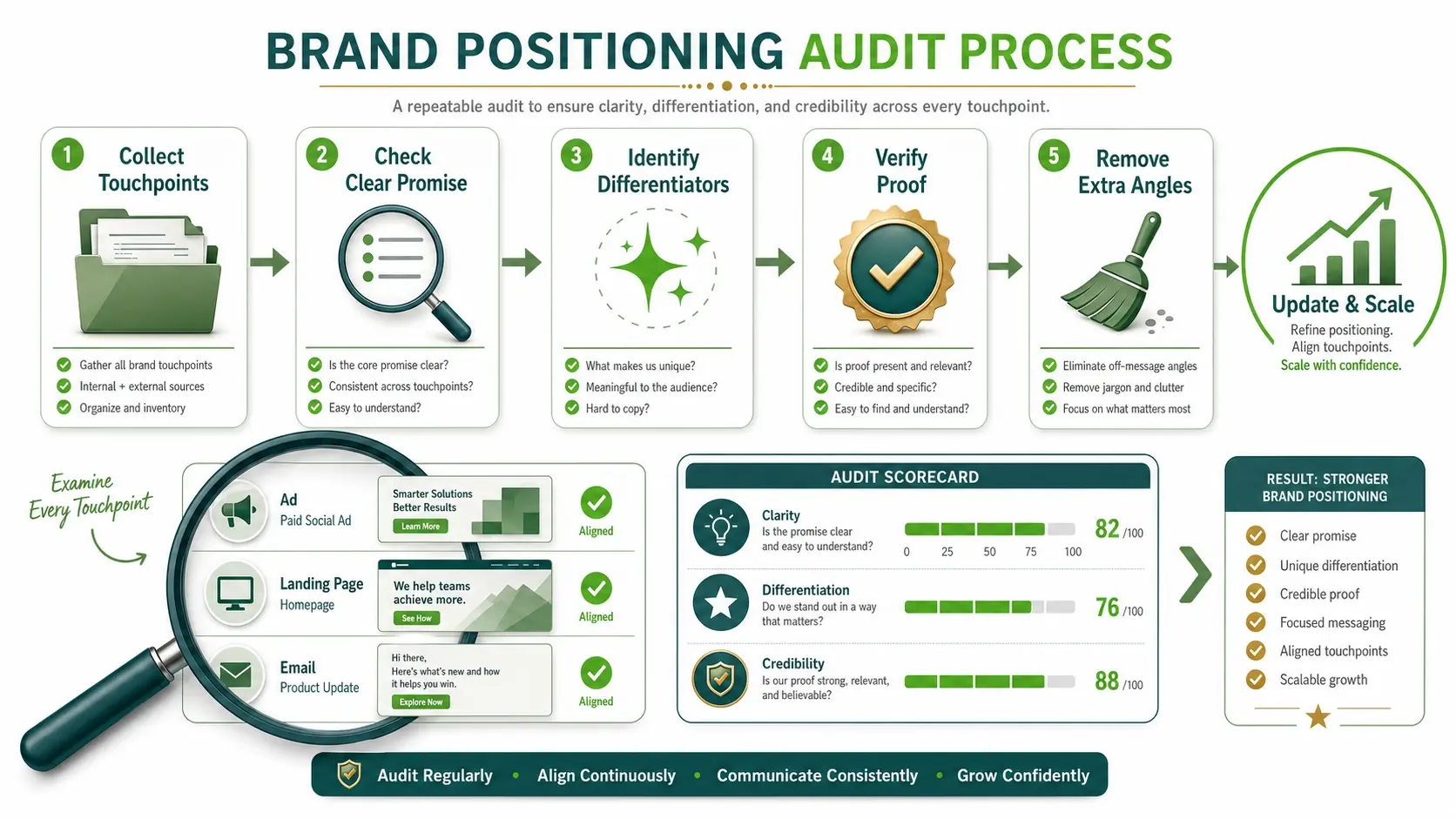 A quick audit can reveal why ads feel expensive. The goal is to find gaps between what you claim, what you prove, and what customers need to hear.
Review one campaign at a time and score clarity, differentiation, and credibility.
- Collect Key Touchpoints: Pull top ads, the landing page, and the first follow-up message after conversion.
- Check For One Clear Promise: Verify that each touchpoint leads with the same main outcome.
- Identify Differentiators: Highlight any claim that competitors could not copy in a week.
- Verify Proof: Ensure each major claim has a supporting reason to believe.
- Remove Extra Angles: Cut secondary messages that distract from the core positioning.
After the audit, update the message hierarchy and creative brief. Then scale spend only after early results confirm improved conversion efficiency.
Common Positioning Mistakes That Drive Up Ad Spend?
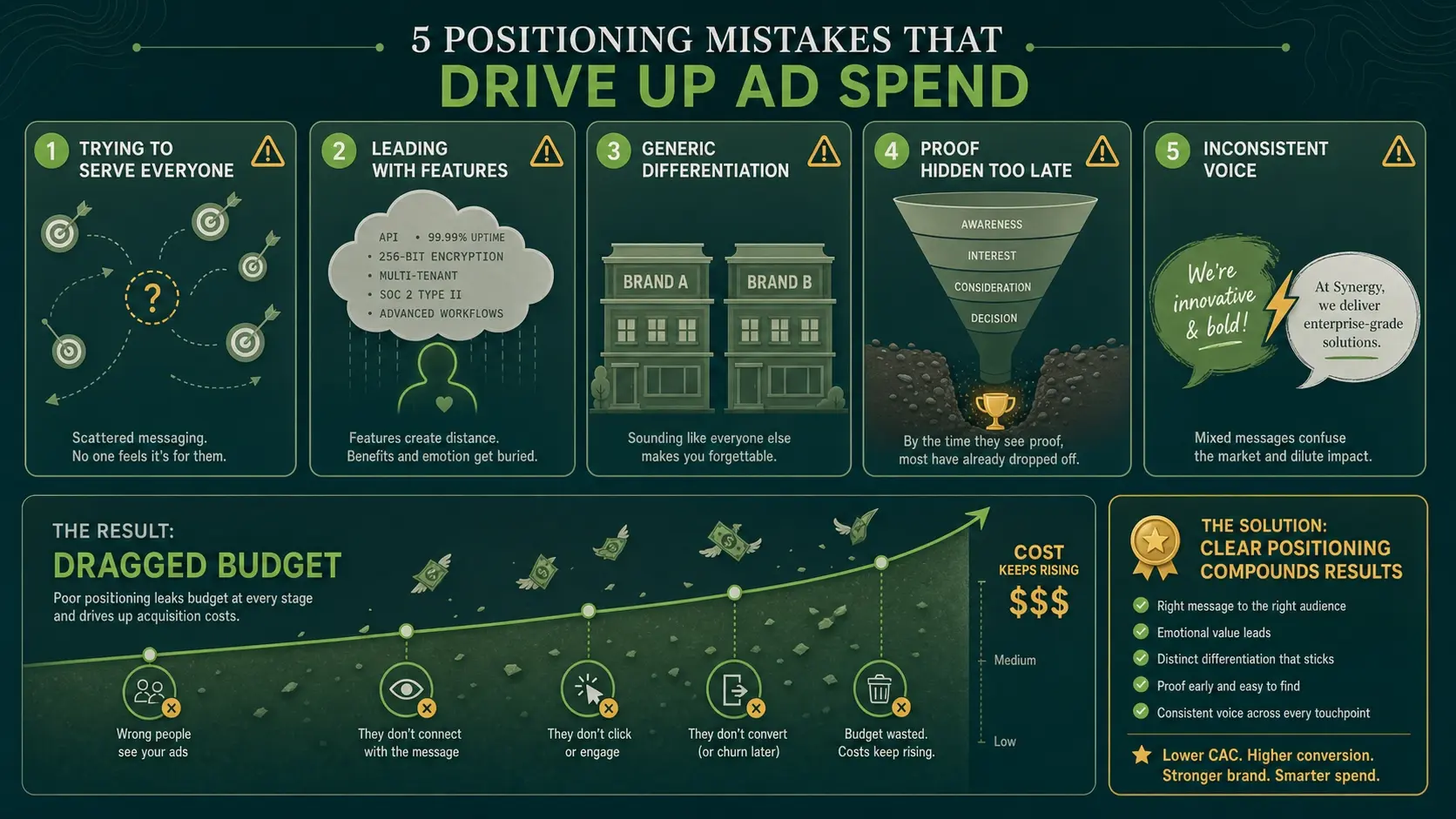 Some issues look small but create constant performance drag. Fixing them often lowers costs faster than adding more creative variations.
- Trying To Serve Everyone: Broad targeting and broad messaging usually produce low relevance and low conversion.
- Leading With Features: Features matter after interest is earned, not before.
- Generic Differentiation: Claims like quality, innovation, and great service do not help buyers choose.
- Proof Hidden Too Late: If credibility appears only at the bottom of the page, many visitors leave first.
- Inconsistent Voice: A different tone in ads, pages, and sales creates doubt and lowers trust.
Removing these issues simplifies campaigns. Simpler campaigns usually learn faster and waste less spend.
Brand Strategy And Advertising Metrics That Matter
Positioning improvements should show up in both platform metrics and business metrics. Track a small set consistently so you can connect strategy changes to outcomes.
| Metric | What It Signals | How Positioning Helps |
|---|---|---|
| Click Through Rate | Ad relevance and interest | Clear promise increases qualified clicks and reduces wasted impressions |
| Conversion Rate | Message clarity and page fit | Aligned claims and proof reduce hesitation and lift completion |
| Cost Per Acquisition | Efficiency of the full funnel | Better match and higher trust lower the cost to win a customer |
| Lead Quality Rate | Fit of audience and offer | Sharper targeting and messaging attract buyers who meet criteria |
Watch trends over time rather than day-to-day swings. Positioning work compounds as the market learns what your brand stands for.
Where Expert Help Fits?
Many teams run ads while still debating who they are and what they offer best. A strategic reset can align leadership, marketing, and sales around one message system before scaling spend.
Imili Corp supports organizations that want stronger brand foundations and clearer messaging that carries into performance marketing. The most useful engagement typically combines positioning, messaging, and conversion-focused execution so advertising amplifies a coherent strategy.
Conclusion
Brand strategy before advertising is not a delay. It is the work that prevents paying premium prices for unclear messages.
Better positioning clarifies audience, promise, proof, and differentiation. When those are aligned across creative and landing pages, ad platforms reward performance and your cost per acquisition drops.
Frequently Asked Questions
How long should positioning work take before running ads?
It can be done quickly if you focus on decisions, not lengthy documentation. A practical cycle sets a clear audience, promise, proof, and message guardrails, then applies them to ads and landing pages. Ads can run during this work, but scaling is best reserved for after alignment.
Can better positioning help even if ad auction prices are high?
Yes. Positioning mainly improves conversion efficiency, which lowers the cost to acquire a customer even when click prices rise. It also improves relevance and engagement signals that can support better delivery over time.
What is the first sign that positioning is improving ad performance?
The earliest signal is usually higher click through rate from the right audience and fewer low-intent clicks. Next, landing page conversion rate rises as visitors understand the offer faster. Over a few optimization cycles, cost per acquisition becomes more stable and predictable.