
AI search changes how local businesses are discovered, compared and recommended, but it does not replace traditional SEO. Businesses still need accurate local listings, accessible websites, useful service pages and a trustworthy online reputation. What changes is the importance of making business information sufficiently clear, specific and consistent to support AI-generated answers to customer questions.
Instead of optimizing exclusively for searches such as “plumber near me,” businesses should also address more detailed questions, such as whether a plumber offers emergency weekend appointments, serves a particular neighborhood or handles a specific type of repair.
The objective is not simply to appear in an AI-generated answer. It is to help potential customers discover the business, understand whether it meets their requirements and take the next appropriate action.
What is AI Search for Local Businesses?
AI search uses artificial intelligence to interpret questions and generate responses using relevant information. Examples include Google’s AI Overviews and AI Mode, as well as web-enabled search experiences in ChatGPT.
Unlike a conventional search experience that primarily presents links and business listings, an AI search experience can summarize information, address multiple customer requirements and provide supporting sources within a response.
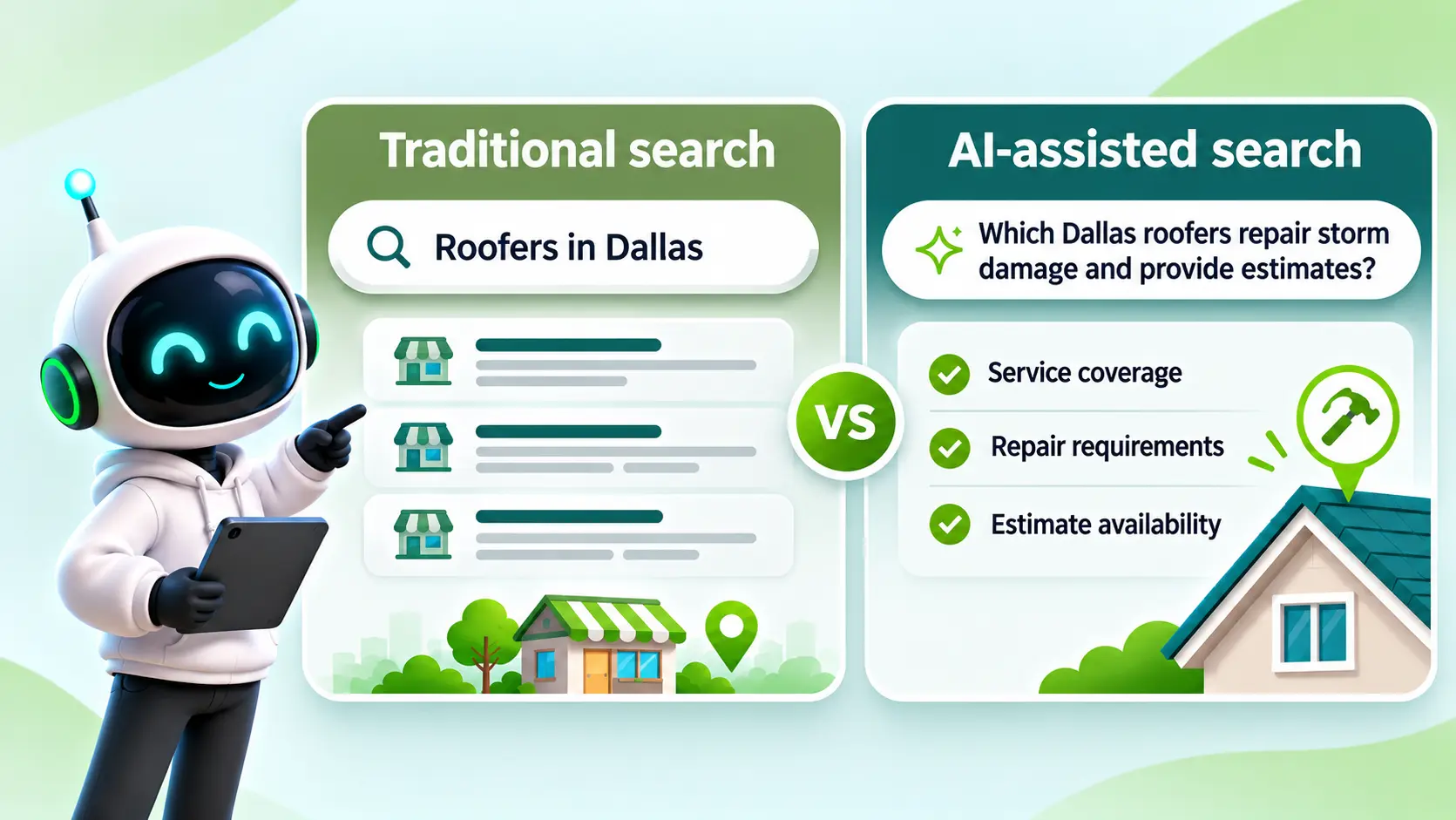
For example, consider someone searching for a roofing contractor in Dallas.
- Traditional search: Roofing contractors in Dallas.
- AI-assisted search: Which roofing contractors in Dallas repair storm damage, serve residential properties and provide written estimates?
The second question requires more detailed business information. A generic homepage stating that a company provides roofing services may not answer all the customer’s requirements.
However, traditional search engines can also handle detailed questions, and AI responses do not necessarily replace maps, business listings or conventional website results. These discovery experiences can coexist.
What Changes for Local SEO With AI Search?
The most important change is the need to optimize business information for complete customer questions rather than treating individual keywords as the entire search strategy.
Google’s guide to optimizing for generative AI features confirms that established SEO practices remain relevant to its AI search experiences. These experiences build on Google’s existing search infrastructure and ranking systems.
| SEO Area | Traditional Local SEO Focus | Additional AI Search Consideration |
|---|---|---|
| Search intent | Relevant services and location searches | Detailed questions containing multiple customer requirements |
| Business listings | Accurate business details and categories | Clear information that supports specific customer questions |
| Website content | Relevant service and location pages | Explicit explanations of services, limitations and eligibility |
| Online reputation | Genuine reviews and business credibility | Reliable, publicly available information that helps customers evaluate a business |
| Performance measurement | Search impressions, clicks and customer actions | AI search visibility, identifiable referrals and qualified customer inquiries |
These additional considerations are practical optimization priorities, not a confirmed list of universal AI ranking factors. Different search platforms can use different information sources and selection systems.
What Remains Important in Traditional Local SEO?
Local businesses should not abandon their established SEO activities to pursue AI visibility. The fundamentals of organic SEO for lead generation remain important because customers still need relevant business information and a clear path to contact a provider.
Google Business Profile Accuracy
A verified and accurately maintained Google Business Profile helps customers find relevant business information through Google Search and Maps.
According to Google’s local ranking guidance, relevance, distance and prominence are central considerations in determining local search results.
Businesses should maintain accurate categories, operating hours, contact details, service information and location details appropriate to their business model.
AI search does not eliminate geographic relevance. A company cannot reasonably expect to become a suitable local recommendation for every city simply by publishing additional location keywords.
Technical SEO and Website Accessibility
Important service information should be available on accessible, indexable website pages. Broken links, inaccessible content and unintended indexing restrictions can prevent search engines from discovering useful business information.
For Google’s generative search experiences, website pages must satisfy the relevant search eligibility requirements. Eligibility does not guarantee selection or visibility.
Reviews and Business Reputation
Authentic customer reviews help prospective buyers evaluate a company’s reliability and service quality. Businesses should encourage honest feedback and respond professionally to customer concerns.
Reviews should not be manufactured or rewritten to contain artificial combinations of service and location keywords. Nor should businesses assume that a particular number of reviews guarantees an AI recommendation.
How to Optimize a Local Business for AI Search?
1. Make Business Information Consistent
Begin by identifying the public sources customers use to verify your business, including your website, Google Business Profile and relevant business directories.
Check whether these sources consistently describe your business name, contact details, operating hours, services and geographic coverage. Correct outdated information and remove misleading descriptions.
Prioritize factual agreement across relevant platforms rather than submitting your business to hundreds of low-quality directories.
2. Build Service Pages Around Real Customer Requirements
Each important service page should explain what the business provides, who the service is intended for and any meaningful restrictions.
For a local HVAC company, useful information might include the types of systems it repairs, the neighborhoods it serves, whether emergency appointments are available and how customers can request an estimate.
Only include details that accurately represent the business. Do not claim round-the-clock availability, professional certifications or same-day appointments unless they can be substantiated.
3. Answer Questions Customers Ask Before Contacting You
Use genuine customer questions from phone inquiries, sales conversations, support requests and available search data to identify missing website information.
A local service business could address questions such as:
- Do you serve my neighborhood?
- Which types of repairs or installations do you provide?
- Are appointments available outside normal business hours?
- What information is needed to request an estimate?
- Are there any service restrictions or minimum requirements?
Answer these questions where they naturally belong on relevant service pages. Publishing hundreds of repetitive FAQ pages is not necessary.
4. Use Structured Data Where Appropriate
Structured data can help search systems interpret information about a website and its business. Where appropriate, local businesses can use supported business-related markup that accurately reflects visible page content.
However, there is no requirement to invent special AI-specific schema or add artificial content solely to gain visibility in Google’s generative search features.
Structured data should support accurate communication of business information, not serve as a substitute for useful content.
5. Review Visibility Beyond Google
AI search is not a single platform. Businesses should consider the discovery channels their customers actually use rather than assuming that improving visibility on one platform automatically improves visibility everywhere.
OpenAI’s ChatGPT search documentation explains that web search can provide current information and location-aware results.
Businesses that want their website content to be eligible for ChatGPT search should review OpenAI’s published crawler-access requirements. Allowing appropriate search crawler access does not guarantee inclusion, citation or recommendation.
A Practical AI Search Audit for Local Businesses
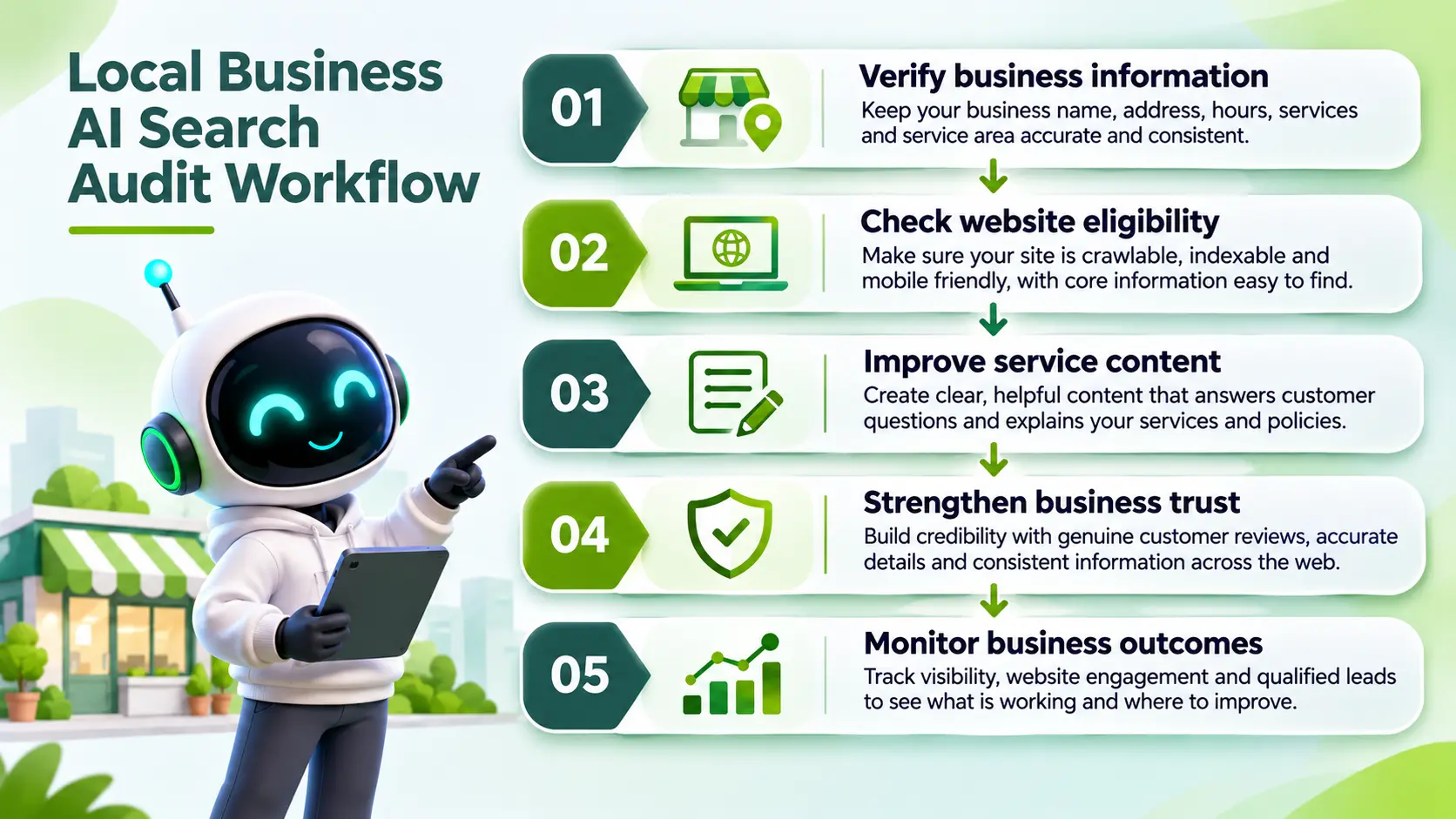
Before investing in additional AI search optimization services, determine whether your business already provides the information customers need to make a decision.
The following audit is a recommended prioritization framework, not an official search-engine ranking checklist.
| Audit Area | What to Check | Priority |
|---|---|---|
| Business accuracy | Correct hours, phone number, location and services | Critical |
| Website eligibility | Important service pages are accessible and eligible for indexing | Critical |
| Service information | Clear descriptions, coverage areas and restrictions | High |
| Customer questions | Useful answers to common purchase and booking questions | High |
| Reputation | Authentic reviews and accurate public business references | High |
| Measurement | Search visibility, website actions and inquiry tracking | High |
| AI monitoring | Sample relevant AI responses and investigate incorrect business information | Ongoing |
Correct critical information and accessibility problems first. Then improve the content customers need to compare providers before expanding into ongoing AI search monitoring.
How to Measure Local SEO Performance in AI Search?
AI visibility should be evaluated separately from website traffic and actual business outcomes. Appearing in a generated answer does not necessarily produce a website visit or customer inquiry.
Monitor Google Search Visibility
Google provides a dedicated Generative AI performance report in Search Console for measuring website visibility in supported generative search experiences.
Use the report, when available for your property, alongside conventional search performance data. The report focuses on impressions, which should not be interpreted as website visits, leads or revenue.
Track Website Actions and Qualified Leads
Use website analytics and customer inquiry records to understand what happens after customers discover your business. Depending on your business model and measurement setup, relevant actions may include completed contact forms, appointment requests and phone inquiries.
Where AI referral traffic can be identified, evaluate its contribution separately. Some customer journeys may involve AI-assisted discovery without a measurable AI referral, so attribution will remain incomplete.
Conduct Repeatable AI Search Checks
Select a small set of realistic customer questions related to your services and geographic market. Record the platform, question, date, location context, business mentions and any inaccurate information returned.
Repeat these checks periodically using comparable conditions. Because AI responses can vary, individual results should be treated as observations rather than fixed rankings or representative measures of all customer searches.
Common AI Search Optimization Mistakes
Local businesses should avoid replacing useful SEO work with tactics that have no established connection to customer value.
- Creating dozens of nearly identical city pages without meaningful local information.
- Inventing business qualifications, customer testimonials or service availability.
- Publishing repetitive AI-generated articles solely to increase content volume.
- Buying artificial reviews or irrelevant directory mentions.
- Treating AI mentions as proof of customer acquisition.
- Paying for guaranteed AI recommendations without credible supporting evidence.
The strongest practical approach is to improve the quality, accuracy and accessibility of business information while maintaining realistic expectations about search visibility.
Should Local Businesses Invest in AI Search Optimization?
Local businesses should incorporate AI search considerations into their existing SEO strategy rather than automatically purchasing a separate optimization program.
If your website has incomplete service pages, inaccurate listings or indexing problems, addressing those issues is a more defensible starting point. Businesses with established SEO foundations can extend their efforts through customer-question research, clearer service descriptions and AI visibility monitoring.
When evaluating an SEO service provider, ask how it will assess business accuracy, website accessibility, local search intent and meaningful customer outcomes. Request clearly defined deliverables rather than promises of guaranteed AI citations.
AI search introduces additional ways for customers to discover and evaluate local businesses. The lasting SEO opportunity is to make your business easier to find, understand, verify and contact, regardless of the search experience a customer chooses.