
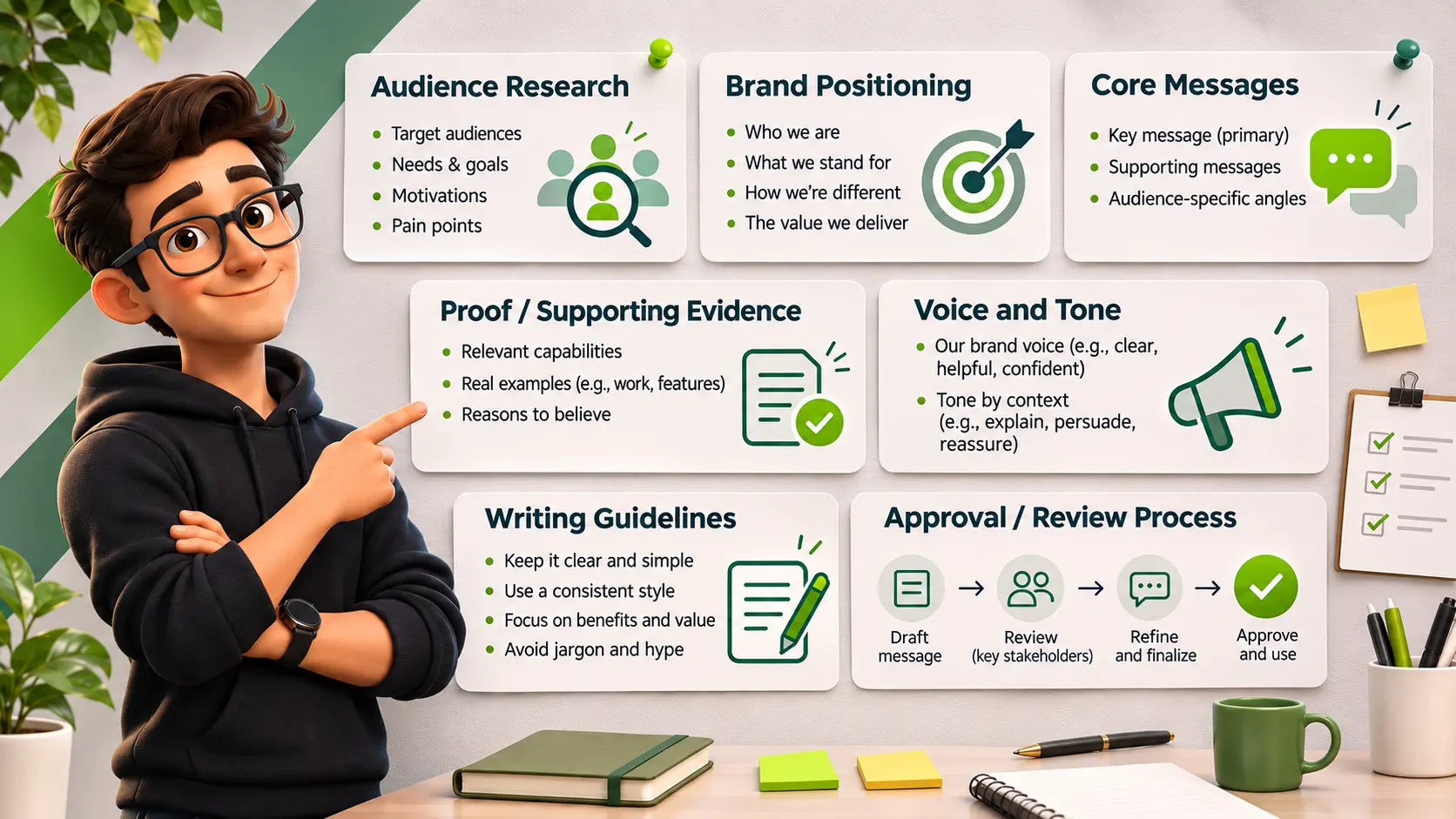
A brand messaging guide should explain who your business serves, what it offers, why customers should consider it, what evidence supports its promises, and how those messages should appear across different channels. It should also establish brand voice, approved language, claim restrictions, and responsibility for keeping the information accurate.
The most useful guide is not a collection of slogans or personality adjectives. It is a working reference that helps marketing, sales, leadership, and external creative teams communicate the same business value without making identical statements everywhere.
Define the Buyer and the Decision Your Message Must Support
Start with the customer decision rather than the words you want to publish. A useful messaging guide identifies the priority audience, the problem that brings that audience into the market, the outcome they want, and the alternatives they might consider.
For a business selling services to other companies, distinguish the person experiencing the problem from the person approving the purchase. An office manager might evaluate a service while a business owner approves the budget. Both may need different information, but the underlying service promise must remain accurate.
Document the buying situation in practical terms. What happened before the customer started looking? What would they use if your business did not exist? What concerns could prevent them from choosing you? Avoid treating assumptions about customer preferences as established research findings.
The U.S. Small Business Administration’s market research guidance distinguishes broader market information from direct research with customers. Both can inform positioning, but they answer different questions. If your audience is still unclear, begin with ImiliCorp’s guide to finding your real target audience before writing the messaging document.
Record Your Brand Positioning Before Writing Public Copy
Brand positioning defines the place your business intends to occupy in a customer’s decision. It connects a particular audience, a category of products or services, an important customer need, and a defensible reason to consider your offer.
Your messaging guide should contain an internal positioning statement that answers four questions: Who is this for? What does the business provide? Which alternatives might the buyer consider? What meaningful difference can the business demonstrate?
Keep this statement separate from the public headline or tagline. A positioning statement helps teams make decisions, while customer-facing messaging translates those decisions into language that makes sense to buyers.
If the only distinction is that your business is professional, innovative, or customer-focused, investigate what those descriptions actually mean. ImiliCorp’s article on differentiating your business from similar competitors provides a related approach to comparing customer needs and supportable promises.
Build a Message Hierarchy With Evidence Behind Every Promise
A messaging hierarchy organizes what the audience should understand first, what supporting ideas explain the promise, and which facts make those ideas credible. This prevents every campaign or writer from inventing a different explanation of the business.
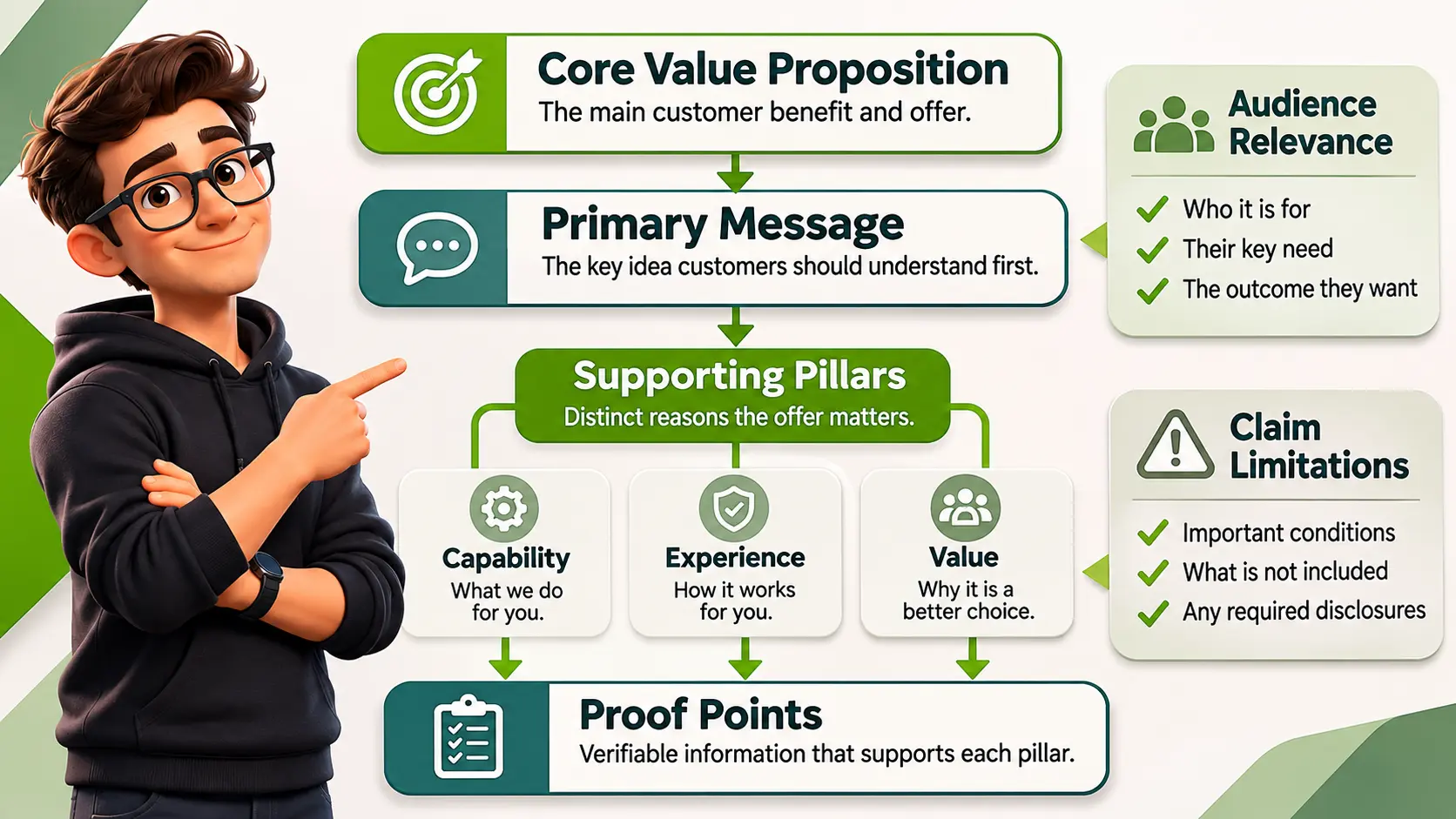
The guide should include the following connected elements:
- Core value proposition: A clear statement of the customer benefit and the offer that creates it.
- Primary message: The main idea a buyer should understand before exploring further details.
- Supporting message pillars: Distinct reasons the offer may matter, such as a specific process, capability, or customer experience.
- Proof points: Verifiable service details, documented processes, authorized customer evidence, or other information directly supporting each claim.
- Audience-specific explanations: Adaptations that address different buying concerns without changing the factual promise.
- Limitations and objections: Important conditions, exclusions, and customer questions that marketing materials must not hide.
Each message pillar should lead to evidence rather than another adjective. If a business promotes transparent project communication, its guide might identify the actual reporting process, customer access arrangements, and contract limitations supporting that description.
When supporting evidence is missing, mark the proposed statement for verification or rewrite it as a narrower factual description. A promise does not become trustworthy simply because multiple teams repeat it.
Document Brand Voice, Tone, and Approved Writing Examples
Positioning explains what your business wants customers to understand. Brand voice determines the consistent character of its communication. Tone adapts that character to a particular situation, audience, or channel.
Instead of recording only words such as friendly, confident, or professional, explain the writing behaviors those words require. A clear voice might use familiar terms, explain technical language, and describe capabilities without exaggerated promises. A calm tone might be appropriate when responding to a service problem, while a more energetic tone may suit a product announcement.
Include short approved examples showing how to introduce the company, describe important services, answer common objections, and explain the next customer action. Add preferred terminology, correct product names, expressions to avoid, and examples of unacceptable wording.
A voice guide should support the broader messaging strategy, not replace it. Teams using automated writing tools can also consult ImiliCorp’s guide to setting up consistent brand voice for AI-assisted content. Whatever creates the draft, a responsible reviewer must still verify factual claims.
See What a Working Brand Messaging Guide Looks Like
Consider a fictional U.S. company providing outsourced IT help-desk services. The following example is a demonstration of how a guide could organize decisions. It does not describe an actual company, verified customer research, or a tested marketing campaign.
| Guide Field | Illustrative Entry | Approval Question |
|---|---|---|
| Primary audience | Office managers at U.S. businesses responsible for recurring employee IT support requests. | Does customer research support prioritizing this group? |
| Buyer alternatives | Ad hoc internal support or another outsourced IT provider. | Are these realistic alternatives for the intended buyers? |
| Positioning | Outsourced help-desk support with a documented process for submitting and tracking requests. | Does the actual service include this process? |
| Core message | Submit employee IT requests through a documented ticket process and check their status. | Can customers see request status as described? |
| Message pillar and proof | Request visibility, supported by an authorized example of the ticket-status process. | Is the example accurate, representative, and permitted for publication? |
| Voice and tone | Plain, direct explanations, with a more reassuring tone during service disruptions. | Do approved writing examples demonstrate these behaviors? |
| Claim restriction | Do not promise around-the-clock support without evidence of service coverage. | Have contractual terms and operating hours been confirmed? |
The important feature of this example is the relationship between each message and its approval question. The business should replace every illustrative entry with information supported by its own research, operations, and current commitments.
Control Claims Before They Reach Customers
A complete messaging guide needs rules for deciding which statements the business may publish. This matters when marketers describe performance, guarantees, service availability, qualifications, customer outcomes, or advantages over competitors.
Separate potential claims into three practical groups:
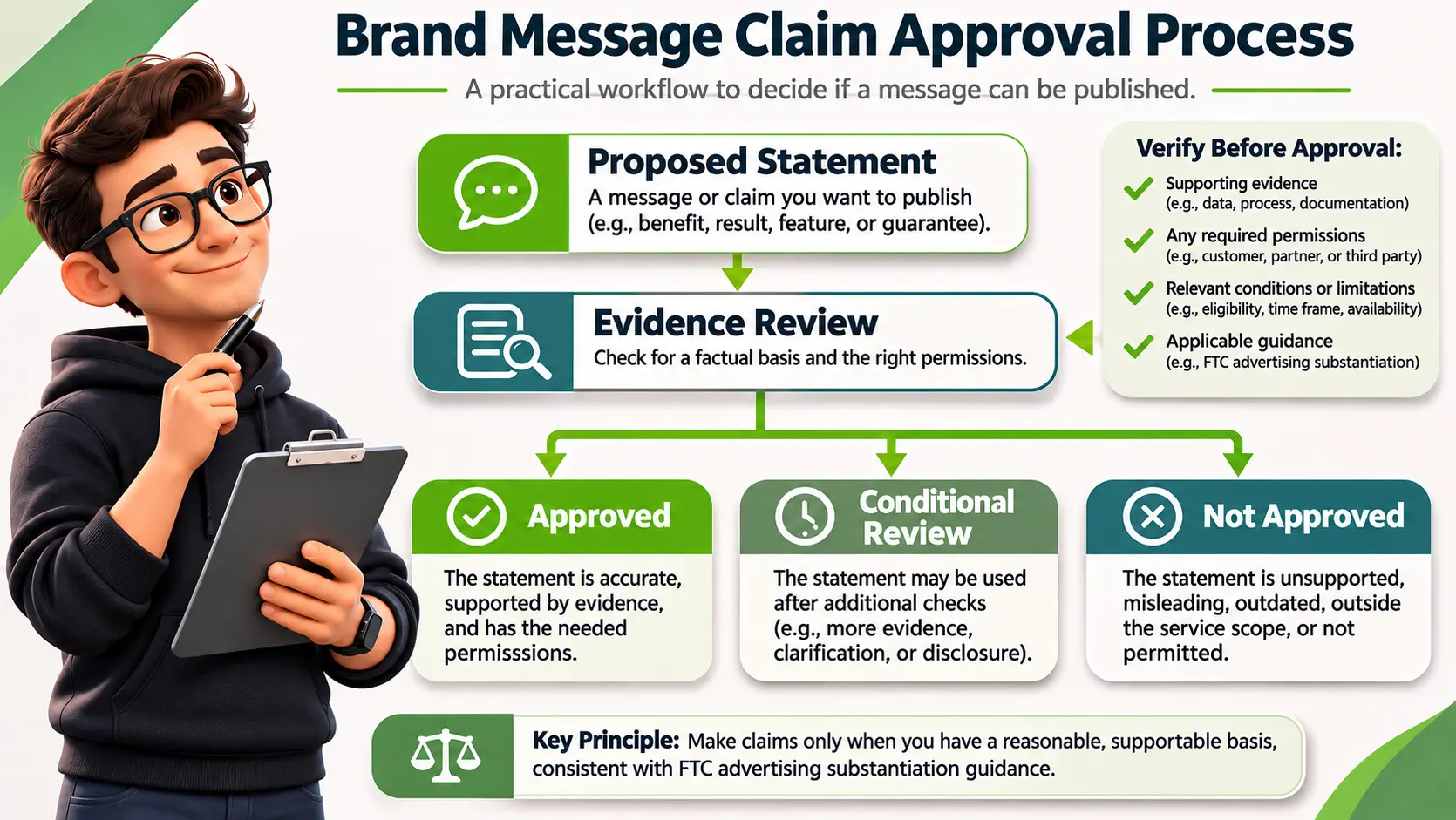
- Approved: The statement accurately describes a current capability or benefit, and the necessary supporting evidence and permissions are available.
- Conditional: The statement may be usable after checking evidence, limitations, dates, required disclosures, or approval from the responsible team.
- Not approved: The statement is unsupported, misleading, outdated, outside the actual service scope, or prohibited by an applicable requirement.
For example, a company should not promote guaranteed response times simply because its team usually replies quickly. The wording must reflect the real service terms, qualifying conditions, and evidence available.
For advertising in the United States, the Federal Trade Commission’s advertising substantiation policy explains that advertisers need an appropriate basis for objective claims before communicating them. Express and reasonably implied claims both matter. Specific industries and jurisdictions may impose additional requirements.
Maintain a claim record identifying the approved wording, supporting source, applicable conditions, evidence owner, and date of review. When an offer or operating process changes, check the affected statements before reusing them.
Make the Guide Usable Across Marketing and Sales Channels
A messaging guide should tell teams what must remain consistent and what they may adapt. The core promise, actual capabilities, and important limitations should not change between a homepage, advertisement, sales proposal, and customer email.
The emphasis and level of detail can change. A homepage may introduce the service and primary benefit. A service page can explain deliverables and conditions. A sales proposal can address buyer-specific requirements and supporting evidence. A customer email may focus on the next practical action.
Give writers an assignment brief that identifies the intended audience, communication goal, approved message, evidence to use, channel, desired customer action, and any restrictions. This is more actionable than asking every contributor to follow the brand personality.
Before rolling out the guide across the business, review a small selection of important customer-facing materials. Flag contradictory claims, unclear benefits, outdated offers, and content that changes the meaning of the approved message.
Check Whether the Messaging Guide Actually Works
A complete document is not automatically an effective one. Its first test is whether people can use it to create accurate, understandable communication without repeatedly asking leadership to explain the brand.
Ask relevant team members to prepare short descriptions for different channels using the same approved guide. Review whether the audience, core promise, supporting evidence, and restrictions remain consistent.
Then show selected messages to appropriate prospective buyers without explaining the intended meaning in advance. Ask what they think the company offers, who it serves, which benefit matters, and what information they still need. Small informal reviews can reveal confusion, but they do not establish how the broader market will respond.
If the business has suitable analytics and sufficient data, it may also examine relevant inquiry quality, sales objections, and engagement with important service pages. Define each measure and record other changes before drawing conclusions. More clicks or inquiries alone do not prove that a messaging revision caused additional sales.
Assign Ownership and Keep the Guide Current
A useful guide needs a document owner, an approval process, and a record of meaningful changes. Otherwise, different departments can continue using outdated promises even after the original strategy has changed.
Record who approves positioning, who verifies operational claims, where the latest approved guide is stored, and which teams should be notified after an update. Review it when the audience changes, services are introduced or discontinued, customer research reveals a material misunderstanding, or relevant offers and policies change.
If your business needs outside support connecting brand storytelling with marketing execution, ImiliCorp describes this relationship on its performance branding service page. Before engaging a provider, confirm whether the proposed work specifically includes audience research, messaging documentation, claim verification, and team handoff.
Start with one priority audience, one supportable promise, a clear message hierarchy, and evidence for the statements your business makes. Add practical writing examples and approval rules, then use the guide on real customer-facing materials. A brand messaging guide succeeds when it helps people communicate clearly and accurately, not merely when it looks complete.