

Yes, AI can help keep your brand voice consistent across website pages, emails, social media, and marketing campaigns. But it cannot decide what your business should stand for, which promises are true, or how customers should understand your brand. Those decisions must come from your business before AI starts writing.
The most reliable approach is to give AI a clear brand voice guide, approved writing examples, factual boundaries, and a repeatable review process. Without these foundations, AI may produce polished writing that sounds professional but feels interchangeable with your competitors.
AI is most useful as a drafting and editing assistant, not as the final authority on your company’s identity. OpenAI’s guidance on writing with ChatGPT recommends providing context and constraints, then reviewing the output rather than treating it as final.
Understand What AI Needs to Keep Consistent?
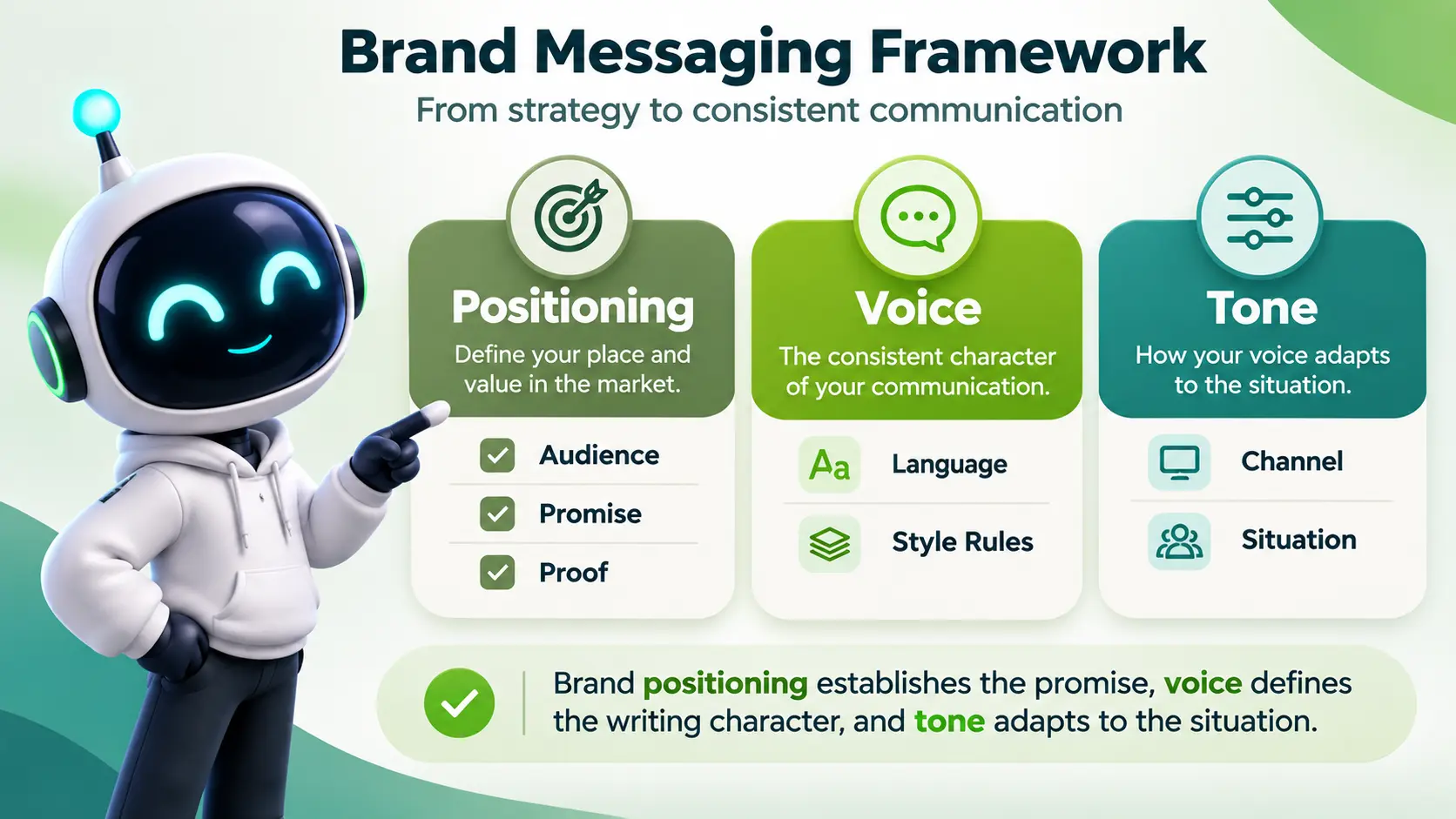
Before setting up an AI writing tool, separate three connected parts of your brand: positioning, voice, and tone. They influence each other, but they are not interchangeable.
- Brand positioning: Defines who your business serves, which problem matters to those customers, what alternatives they consider, and why your approach deserves attention. Your claims must reflect what the business can actually deliver.
- Brand voice: Describes the recognizable character of your communication. It includes vocabulary, sentence structure, level of formality, attitude, and how you explain unfamiliar ideas.
- Brand tone: Changes with the situation. A company can sound friendly in a social post, calm in a complaint response, and direct in a proposal without abandoning its underlying voice.
For example, a business that values practical advice may consistently use plain language, specific explanations, and measured claims. Its tone can become more reassuring when responding to a problem, while its core communication principles remain unchanged.
If your team has not agreed on whom you serve or what makes your offer relevant, AI cannot resolve that strategy problem by choosing better adjectives. ImiliCorp’s guide on how to stand out when competitors sound the same explains how to establish a defensible message before extending it across channels.
Create a Brand Voice Guide Before Using AI
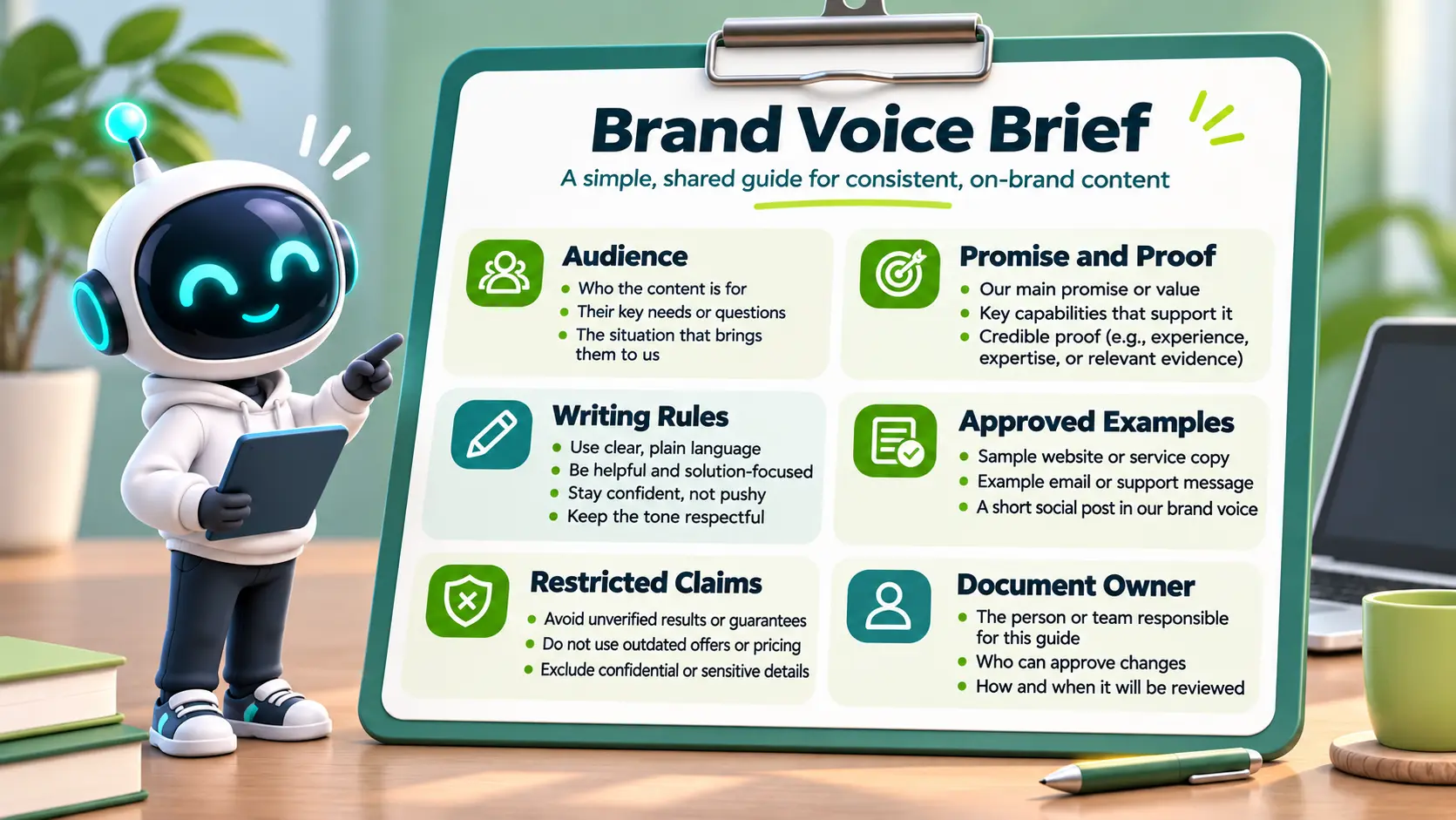
A useful brand voice guide does not need to be lengthy. It needs enough specificity for different writers and AI tools to make similar communication decisions. Start with an approved document that contains the following information.
1. Define Your Audience and Core Message
Identify the primary customer for the content, the situation that brings them to your business, and the question they need answered. Avoid relying only on broad demographic labels.
Then document your main brand promise, the real capabilities supporting it, and any important service limitations. AI should not be allowed to expand those claims simply to make the writing more persuasive.
2. Translate Voice Traits Into Writing Rules
Descriptions such as friendly, trustworthy, and professional leave too much room for interpretation. Explain what those traits mean in actual sentences.
- Clear: Explain unfamiliar terms instead of assuming the reader understands industry language.
- Confident: Describe verified capabilities directly without exaggerated superiority claims.
- Helpful: Give readers practical information before asking them to contact the business.
- Respectful: Avoid pressure, misleading urgency, or language that dismisses customer concerns.
These rules are illustrative. Your business should select behaviors that genuinely reflect its identity rather than adopting every positive-sounding trait.
3. Add Approved Examples and Restrictions
Collect writing samples that accurately represent how your business wants to communicate. These could include approved service descriptions, customer emails, or website paragraphs. Explain why each example works, rather than expecting AI to infer every rule from the sample.
Also document preferred terminology, expressions to avoid, product and service names, approved factual statements, and claims requiring additional review. Exclude outdated offers, unsupported results, confidential customer details, and examples you do not have permission to use.
Keep the guide in a shared, controlled location. Assign someone responsibility for approving changes so different teams do not gradually develop conflicting versions.
Set Up a Repeatable AI Writing Workflow
Once the voice guide is approved, use it as part of a consistent drafting process. The objective is not to find one perfect prompt. It is to make sure every writing assignment starts with the same reliable information.
- Check the tool and its permissions: Review the provider’s applicable data-use, privacy, retention, and sharing settings before entering internal material. Do not assume every AI tool handles business information the same way.
- Provide the current brand guide: Supply the approved voice rules and relevant examples through the tool’s supported instructions or reference-material workflow. Confirm that the tool has the information for the current task rather than assuming it remembers earlier work.
- Write a specific assignment brief: Identify the intended reader, content channel, purpose, approved facts, required next action, and any restrictions. A homepage introduction needs a different brief from a customer support response.
- Ask for a draft, not automatic publication: Instruct the tool not to invent results, testimonials, product details, policies, or guarantees. Require uncertain information to be flagged for verification.
- Review, approve, and record corrections: A responsible editor compares the draft with the guide and original evidence. Record repeated problems so the team can improve its instructions instead of correcting the same issue indefinitely.
The expected result is a draft that follows recognizable communication rules and contains fewer avoidable assumptions. It is not a guarantee that the content is accurate, distinctive, or ready to publish.
Keep One Brand Voice Across Different Marketing Channels
Consistency does not mean publishing nearly identical sentences everywhere. Your core message should remain recognizable while the wording reflects what people need from each channel.
Consider a fictional bicycle repair business whose actual operating approach is to explain repair options before customers approve work. It wants to sound practical, approachable, and clear.
Website Copy
Illustrative example: “We explain your bicycle repair options in plain language before you decide what work to approve.”
The website version communicates what the business does and explains a specific part of its process.
Social Media Copy
Illustrative example: “Hearing a new rattle on your ride? Ask what your repair options mean before choosing a fix.”
The social version starts with a familiar problem and uses a conversational tone while preserving the same underlying service message.
Customer Follow-Up Email
Illustrative example: “Thanks for checking in. We can explain the available repair options and answer your questions before you make a decision.”
The email version is more personal and reassuring without introducing a new promise.
These examples do not describe a real business, customer experience, or tested campaign. They are appropriate only for a business that genuinely follows the described process.
When reviewing multiple AI drafts, ask whether customers would recognize the same business behind each message. The words can change, but the business facts, underlying promise, and communication principles should remain consistent.
Check AI-Generated Content Before Publishing
A brand voice guide becomes more useful when the team can evaluate its results. Instead of approving a draft simply because it sounds polished, apply the same pass-or-revise checks to every important piece of content.
| Review Area | What a Passing Draft Must Show | Action if It Fails |
|---|---|---|
| Audience fit | The message addresses the intended customer’s actual question or situation. | Clarify the reader and rewrite the brief. |
| Brand voice | The draft follows approved language and communication behaviors without generic filler. | Compare it with approved examples and revise. |
| Positioning and claims | The message reflects the real offer, with important statements supported by appropriate evidence. | Verify, narrow, or remove unsupported claims. |
| Channel suitability | The tone, detail, and next action match the channel without changing the brand promise. | Adapt the presentation while preserving the factual message. |
| Approval and permissions | Required factual, privacy, rights, and editorial reviews are completed by an authorized person. | Hold publication until the issues are resolved. |
This is a practical editorial checklist, not a scientifically validated measurement scale. A passing review means the team has completed its defined checks, not that the content is guaranteed to improve brand perception or sales.
Keep a short record of recurring corrections. If several drafts introduce unsupported claims, adjust the factual boundaries. If the writing sounds different across channels, strengthen the voice examples and explain which changes in tone are acceptable.
Know Where AI Brand Consistency Can Go Wrong
AI can imitate a writing pattern while still making an incorrect or misleading statement. A consistent tone does not make inaccurate content trustworthy.
For US advertising, the Federal Trade Commission’s advertising guidance explains that advertisers need appropriate evidence to support objective claims before running an advertisement. AI-generated wording does not remove that responsibility.
Pay particular attention to product benefits, guarantees, customer testimonials, professional credentials, competitor comparisons, prices, and statements about measurable outcomes. Verify them against current approved records rather than asking AI to supply plausible details.
Privacy and intellectual property also matter. Review whether source materials contain confidential customer information, personal data, licensed content, or unpublished business plans before sharing them with an AI provider. Check the applicable tool terms, internal permissions, and relevant privacy requirements.
The NIST Generative AI Profile provides a voluntary risk-management reference for organizations using generative AI. It is not a certification that a particular marketing workflow is safe.
For website content, Google Search’s guidance on generative AI content emphasizes accuracy, quality, relevance, and manual fact-checking. Generating large amounts of content without adding reader value may violate its spam policies.
Human approval is especially important when a message involves a complaint, sensitive personal information, a policy change, a consequential financial or health claim, or a promise the business must fulfill. In those situations, accuracy and appropriate judgment take priority over matching a preferred tone.
Decide Whether Your Business is Ready to Scale AI Content
Start with a limited set of content tasks that your team can review carefully. A website paragraph, a social post, and a customer email provide useful opportunities to check whether the same voice rules work in different situations.
Compare the drafts with your approved guide. Record the kinds of corrections reviewers make, whether factual claims require additional verification, and whether the content answers the intended reader’s question. Do not treat faster drafting or fewer edits as automatic proof of better customer outcomes.
If your team repeatedly disagrees about the audience, central promise, or appropriate evidence, the issue is probably bigger than the AI tool. Revisit brand positioning and messaging decisions before expanding production.
Businesses that need help aligning their brand narrative with wider marketing execution can review ImiliCorp’s performance branding service. Its published scope connects brand storytelling and marketing measurement. Confirm whether the specific messaging and AI workflow support you require is available before discussing an engagement.
AI can help maintain a recognizable brand voice when it follows clear rules and receives careful review. The foundation is still human: a defined audience, a credible promise, approved language, reliable evidence, and someone accountable for the final message.