
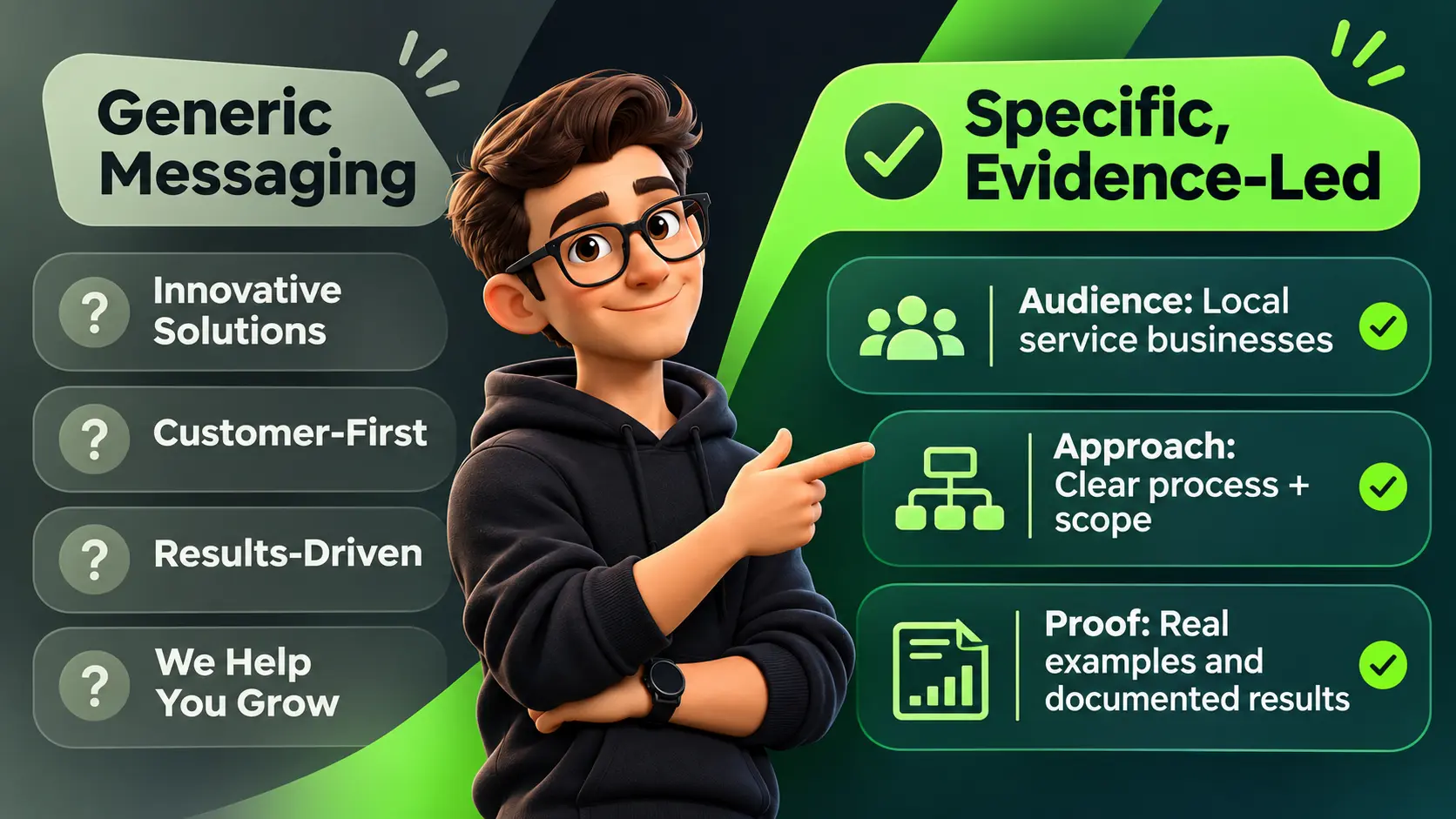
If your About Us page could appear on a competitor’s website with only the company name changed, the problem is probably not your writing style. It is a lack of meaningful specificity. To fix it, explain who your business serves, what problem you understand, how you approach that problem, and what evidence supports your claims.
You do not need a dramatic founding story or clever slogans. You need an accurate account of your business that helps a potential customer decide whether you are a good fit. Research by the Nielsen Norman Group on company information found that people value clear explanations, authenticity, transparency, and information they can use to evaluate an organization.
First, Run the Competitor Swap Test
Read the opening of your About Us page without looking at the company name or logo. Could another business in your category publish the same paragraph without changing anything important? If the answer is yes, your message is probably describing what your industry wants to sound like rather than what your company actually does.
Expressions such as “innovative solutions,” “passionate professionals,” “customer-first service,” and “unmatched quality” are not automatically wrong. The problem is that they ask readers to accept a conclusion without showing how you reached it.
Consider the statement, “We offer personalized solutions to help businesses grow.” A potential customer still cannot tell which businesses you help, what you deliver, how you make decisions, or what makes your approach suitable for their situation.
Apply three questions to every important claim:
- Could a competitor reasonably say this? If so, identify the decision, capability, or operating detail that makes your version more specific.
- Would a prospective customer learn anything useful? Explain something that helps them understand fit, scope, or expectations.
- Can we support the statement? Locate evidence or narrow the wording until it accurately describes the business.
This is an editorial diagnostic, not a scientifically validated score. Its value is that it makes vague language easier to identify before you rewrite it.
Collect the Evidence Before You Rewrite the Copy
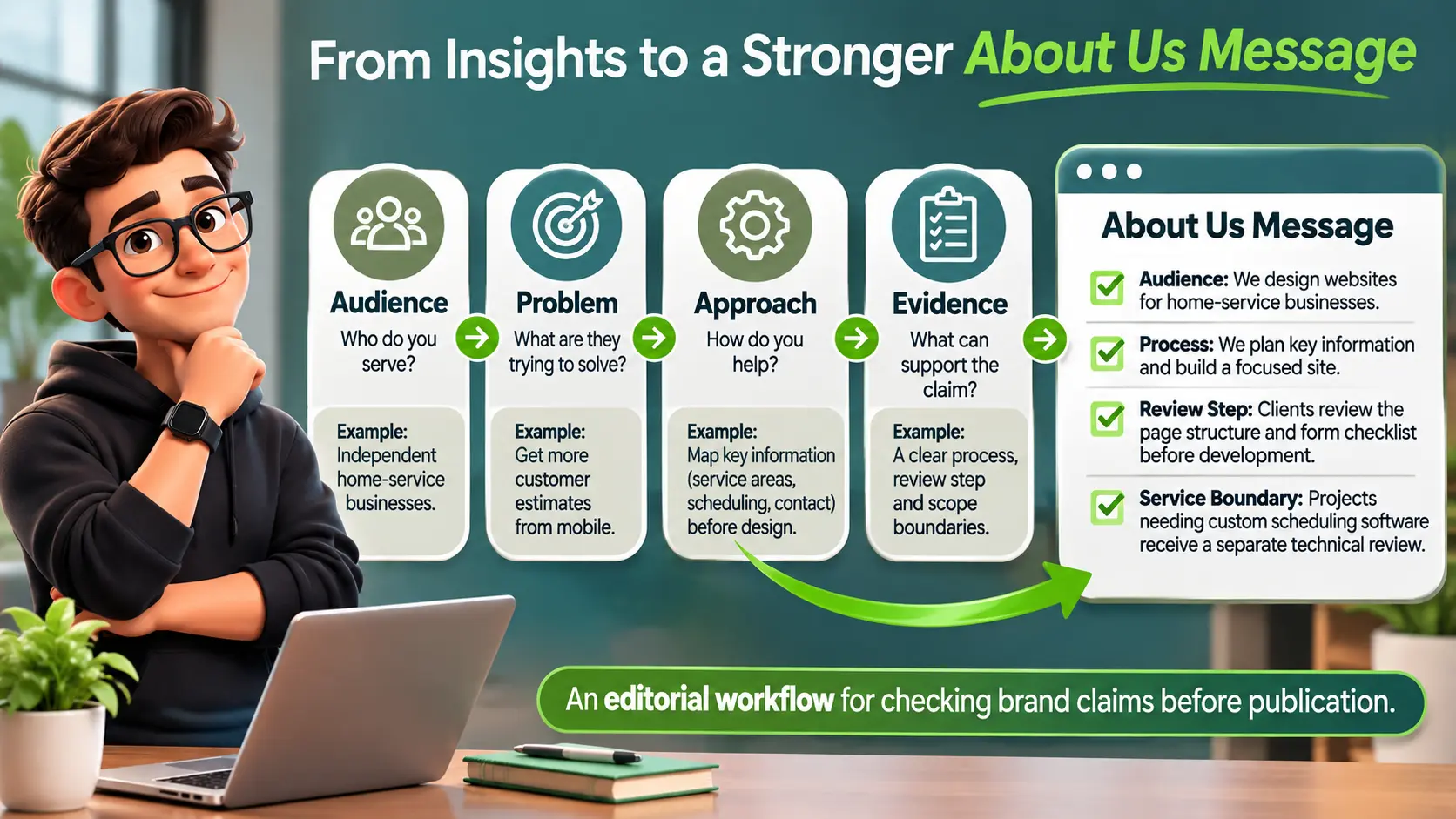
A stronger About Us page usually begins with better business information, not better adjectives. Gather answers from people who understand your customers, operations, and actual commitments.
Start with five areas:
- Audience: Which customers are the clearest fit for your products or services? Describe their situation, not just their industry or demographic profile.
- Problem: What are they trying to solve when they consider a company like yours? Use recurring questions from real inquiries, sales conversations, support requests, or customer research when available.
- Approach: What do you actually do to address that problem? Explain meaningful decisions, processes, or service boundaries instead of calling the approach unique.
- Proof: What can a reader inspect or verify? Examples may include relevant work, a documented process, authentic team information, published policies, or properly authorized customer feedback.
- Limits: When are you not the right choice? Honest limitations can help qualified customers understand whether your offering matches their needs.
Do not assume that every customer values the same differentiator. A founder may care about direct communication, while a marketing manager may care more about deliverables, approvals, and reporting. Select the audience that matters most to the page, then make sure your claims answer that audience’s questions.
If a claim cannot be supported, narrow the wording or remove it. Do not fill the gap with an invented statistic, fictional testimonial, or unsupported comparison.
Rewrite Your Opening With Four Useful Sentences
Instead of opening with several paragraphs about passion and excellence, build a short introduction that answers four practical questions.
- Who do you serve? Identify a meaningful customer group and the situation that brings them to your business.
- What do you help them accomplish? Describe a relevant problem or outcome without promising a result you cannot substantiate.
- How do you work? Explain one concrete aspect of your process, product, or operating philosophy.
- What should they understand before choosing you? Give an appropriate proof point, qualification, limitation, or next source of detail.
These sentences are a starting structure, not a formula that every company must follow. A specialist manufacturer may need to explain materials and production standards. A professional services firm may need to clarify engagement scope. A local business may need to establish its service area and availability.
An Illustrative Before-and-After Rewrite
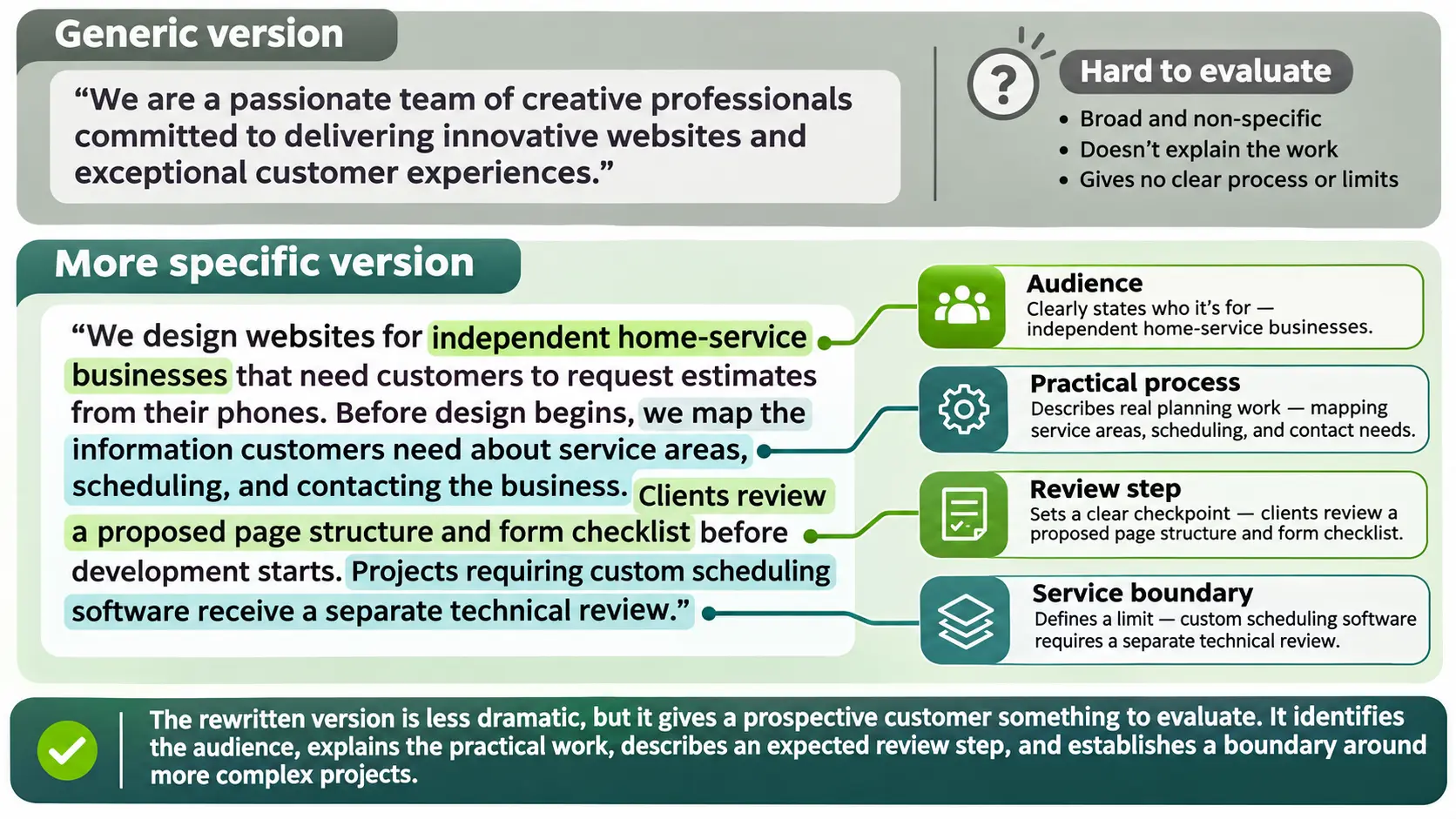
Generic version: “We are a passionate team of creative professionals committed to delivering innovative websites and exceptional customer experiences.”
That sentence communicates enthusiasm but provides almost no basis for evaluating the company.
More specific version: “We design websites for independent home-service businesses that need customers to request estimates from their phones. Before design begins, we map the information customers need about service areas, scheduling, and contacting the business. Clients review a proposed page structure and form checklist before development starts. Projects requiring custom scheduling software receive a separate technical review.”
This is a fictional example created to demonstrate a writing method. It does not describe a real company, verified client engagement, or tested business process.
The rewritten version is less dramatic, but it gives a prospective customer something to evaluate. It identifies the audience, explains the practical work, describes an expected review step, and establishes a boundary around more complex projects.
Use this approach only with facts your own business can substantiate. Specificity improves credibility when the details are true, not simply because the copy sounds more convincing.
Make the Proof Proportional to the Promise
Not every statement needs a case study. Saying that your business provides monthly reports may be supportable through a genuine description of your reporting process. Claiming that your reports consistently improve customer revenue is a substantially different statement and requires appropriate performance evidence.
Use the following questions to decide what belongs on the page.
| Generic Claim | What the Buyer Needs to Know | Useful Supporting Evidence |
|---|---|---|
| Personalized service | Which parts of the work are tailored, and how are those decisions made? | A genuine intake process, scope example, or explanation of client-specific decisions. |
| Experienced professionals | Who performs the work, and what relevant experience can be verified? | Accurate team roles, relevant credentials, or authorized examples of completed work. |
| Outstanding results | Which outcome improved, over what period, and according to which measurement? | A substantiated, appropriately qualified performance record, or narrower wording if one is unavailable. |
| Community-focused values | What does the business actually do that reflects those values? | A documented activity, policy, initiative, or other verifiable example. |
Proof should also be presented honestly. An authentic photograph of the people performing the work can help explain who is behind a business. A generic office photograph cannot establish that the pictured people work there. Likewise, an anonymous testimonial should not be presented as independently verified customer feedback.
For US businesses using reviews or endorsements, the Federal Trade Commission’s endorsement guidance reinforces the importance of truthful, nonmisleading claims and appropriate disclosures. Verify permissions, accuracy, and relevant requirements before publishing customer statements.
Arrange the Page Around the Buyer’s Questions
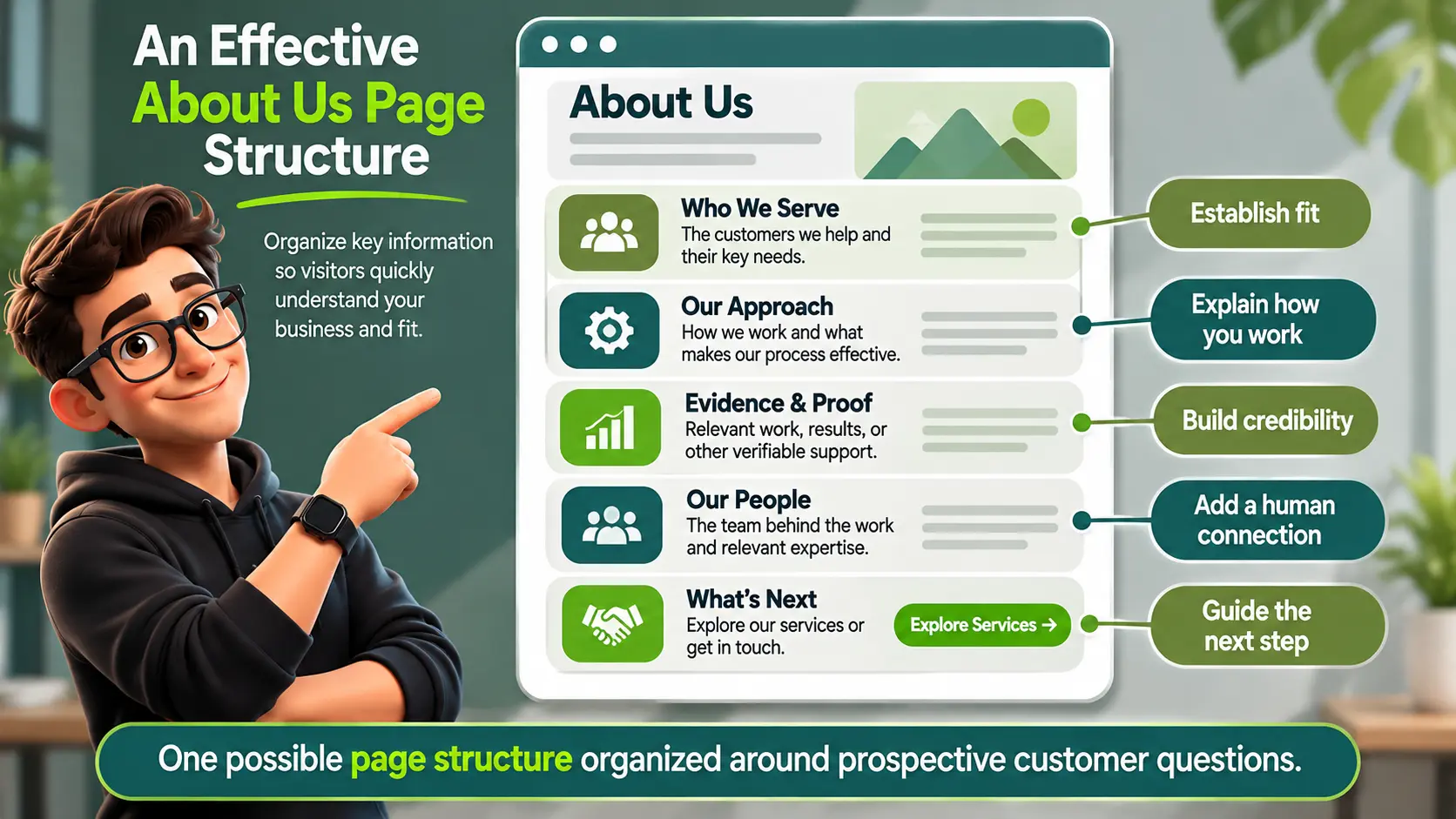
A clear About Us page does not have to follow a dramatic story arc. It should make important information easy to find in the order that helps your intended audience make sense of the business.
Start with a short explanation of who you serve and what you do. Then explain why your company approaches the work in a particular way. Follow with relevant people, history, process details, and evidence. Give visitors a logical route to examine your services or contact the business if they want to continue.
Your founding story belongs on the page when it explains an important decision, customer problem, or principle that still shapes the business. If the history is interesting but unrelated to what a customer needs to know, keep it brief or place the additional detail on a separate page.
Use recognizable section headings, readable paragraphs, accessible links, and genuine images where they help visitors understand the company. Do not bury basic facts beneath decorative slogans, large animations, or repeated calls to action.
The About Us page and your service pages also have different jobs. The About page explains the company and establishes context. Service pages can go deeper into deliverables, prerequisites, pricing where appropriate, and the engagement process. Link between them when a reader needs that additional detail.
Check Whether the Rewrite Actually Helps People
Before publishing, show the revised page to people who did not help write it. Give them a realistic task rather than asking whether they like the design.
Ask them to answer:
- What does this company do, and who is it primarily for?
- What specific information helps you decide whether the company is relevant to your needs?
- What would you want to verify or do next before contacting or buying from the company?
Observe where readers hesitate, misunderstand a phrase, or look for information that is missing. Revise those areas first. Feedback from a few readers is useful for discovering problems, but it is not a representative survey or proof of a conversion improvement.
If your website already has reliable analytics, you can also monitor relevant About-page visits, navigation to service pages, and contact actions. Define those events clearly and examine the audience and time period before comparing results. A change in page traffic or clicks does not, by itself, demonstrate that the rewrite caused more qualified inquiries.
Know When the Problem Is Bigger Than Copy
Sometimes a business sounds like every competitor because its positioning has not been defined clearly. If your team cannot agree on the priority audience, meaningful alternatives, differentiated approach, or evidence behind your promise, polishing a few sentences will not resolve the underlying problem.
That calls for a broader positioning discussion before the About page is finalized. Decide which customers you are best equipped to serve, what makes your approach relevant to them, which claims you can defend, and how the same message should appear across your website and sales conversations.
For businesses considering outside support, ImiliCorp describes a connection between brand positioning, creative storytelling, and measurement in its performance branding service. Review the stated scope and confirm whether it fits the specific messaging work you need before considering an engagement.
Conclusion: Give People a Reason to Recognize Your Business
A memorable About Us page does not need bigger claims. It needs clearer choices, useful details, and evidence that belongs to your business rather than your industry as a whole.
Start by removing interchangeable language. Gather real information about your customers and how you work. Rewrite the opening so a reader understands your fit, then support the most important claims with proof you can verify.
The goal is not to sound different at any cost. It is to make your business easier to understand and evaluate for the people you actually want to serve.