

If your brand is trying to speak to everyone, start by identifying the customers with a specific problem your business can solve, a clear reason to consider your offer, and a realistic way to reach them. Your real audience is not simply everyone who could buy from you. It is the group you have good reasons to prioritize in your marketing.
That does not mean turning away every other customer. It means choosing whose needs should guide your main message, website, content, and campaigns. The right choice comes from customer evidence, business capabilities, and buying situations, not a fictional persona or a broad demographic label.
Your Real Audience is the Group You Can Help and Reach
A target market describes the broader set of potential customers for a product or service. An audience segment is a smaller group with meaningful similarities, such as a shared problem, buying situation, or desired outcome. Your primary audience is the segment you choose to prioritize when making marketing decisions.
This distinction follows the established approach of segmentation, targeting, and positioning, explained in the educational guide Target Market and Audiences. First understand the different groups, then decide which to prioritize, and finally explain why your offer is relevant to them.
For a business selling to other businesses, the person experiencing the problem may not be the person approving the purchase. A marketing manager might use a service, while a founder or finance leader approves the budget. Your audience definition should identify both roles when they influence the decision.
Rather than beginning with a description such as “small business owners aged 25 to 55,” begin with a buying situation: “Owners of growing service businesses who need reliable marketing reporting before increasing advertising spend.” The second description gives you a problem to investigate, not just a group to advertise to.
Collect Evidence Before You Create a Persona
Your existing customers and inquiries can provide a starting point for audience research, but they are not a complete picture of the market. Look for evidence from several sources before deciding which group deserves the most attention.
- Review completed sales and customer records: Identify which customers purchased, what they needed, how they found you, and whether your business could deliver the promised work. Compare similar time periods and avoid assuming that your largest customer is automatically your best future audience.
- Study inquiries that did not become customers: Review sales notes and lost opportunities where records are available. Separate budget concerns, timing, unsuitable requirements, unclear messaging, and other reasons. Do not treat an unknown reason as confirmed evidence.
- Ask customer-facing employees what they hear: Sales, support, and delivery teams may recognize recurring questions or constraints. Record these as working observations until customer evidence supports them.
- Speak directly with potential buyers: Include people who purchased, people who chose another option, and relevant prospects who have never worked with your business. Ask what caused them to search, what alternatives they considered, and what influenced their decision.
The U.S. Small Business Administration’s market research guidance recommends combining existing market information with direct customer research. Public data can help describe a market, while interviews and surveys can explore needs specific to your offer.
Ask About Real Decisions, Not Imagined Preferences
Useful research questions ask people to describe what happened, rather than encouraging them to agree with your marketing ideas. For example, ask what problem first made them look for a solution, how they handled it previously, which alternatives they considered, and what information they needed before deciding.
Avoid leading questions such as “Would our premium service save you time?” Instead, ask “What takes the most time when dealing with this problem?” The Pew Research Center’s guidance on survey questions explains how wording, question order, and response choices can influence answers.
A few interviews may reveal useful patterns, but they cannot establish how common those patterns are across the entire market. Also consider whose voices are missing. Research involving only loyal customers may overlook the needs of people who rejected your offer or never considered it.
Turn Individual Customers Into Useful Segments
Once you have collected evidence, look for groups of buyers who share a meaningful purchasing situation. Grouping people only by age, job title, or industry may hide the reasons they need your product or service.
Use these questions to describe each potential segment:
- Problem: What recurring challenge brings these buyers into the market?
- Trigger: What event or change makes the problem important enough to address?
- Desired outcome: What would a useful solution help them accomplish?
- Alternative: What are they doing now, and which other options might they consider?
- Buying constraints: What limits their budget, authority, timing, location, or implementation choices?
- Service fit: Can your business credibly meet their needs with its current offer and capabilities?
For example, two companies in the same industry may be different audience segments if one needs an urgent replacement provider and the other is planning a long-term operational change. Their questions, purchase timelines, and reasons for choosing a supplier may differ.
The Nielsen Norman Group’s research discussion of qualitative and statistical personas emphasizes understanding user motivations and behavior rather than building personas from assumptions or demographic data alone.
Use an Audience Decision Card to Set Priorities
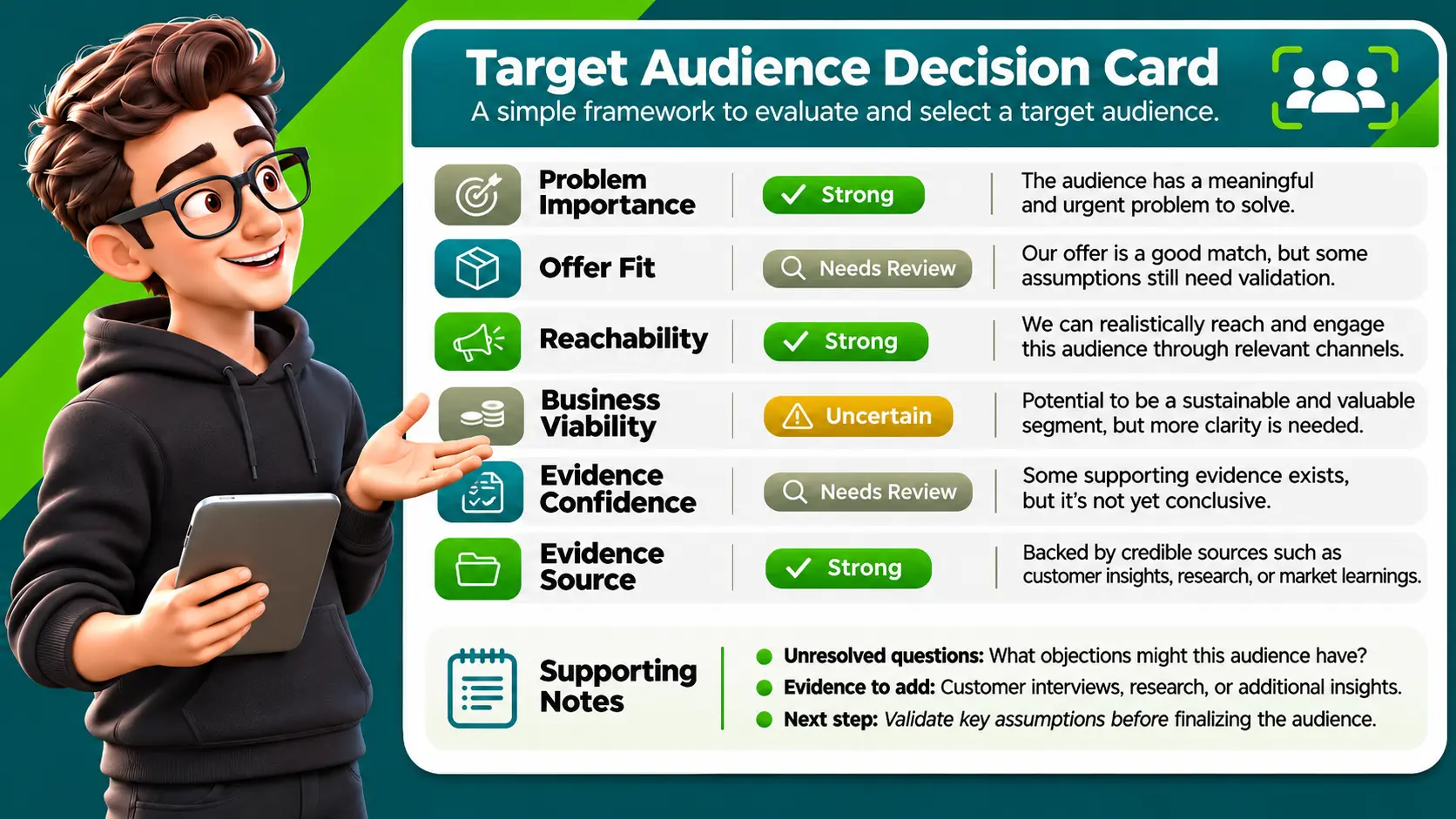
Not every identifiable segment deserves equal marketing attention. A useful next step is to create an audience decision card for each realistic candidate and evaluate them against the same business questions.
Consider five criteria:
- Problem importance: Is there credible evidence that this group experiences a problem worth solving?
- Offer fit: Can your business deliver the required service or product without making unsupported promises?
- Reachability: Can you identify relevant places, channels, communities, or buying situations where this group can realistically be reached?
- Business viability: Can the work fit your available capacity, delivery costs, and commercial model? Check real costs and sales records where available.
- Evidence confidence: Are your conclusions supported by customer behavior, independent market information, or direct research, rather than internal guesses?
Mark each criterion as Strong, Uncertain, or Weak and record the evidence behind the judgment. These are working labels for business discussion, not a validated statistical scoring system.
A segment with a clear need but no realistic service fit should not become your primary audience simply because its market appears large. A segment with strong service fit but little evidence of demand may deserve more research before receiving a substantial campaign budget.
Choose a primary audience when the evidence supports a practical decision. Keep secondary segments under review, and document why other groups are not currently priorities. If every candidate remains uncertain, the next action is research rather than a new slogan or advertising campaign.
Worked Example: A Bookkeeping Firm With Three Possible Audiences
Imagine a fictional U.S. bookkeeping firm considering three customer groups. Its current offer includes monthly bookkeeping, but its team is still assessing which additional reporting needs it can reliably serve. The following comparison is illustrative, not an actual customer study, campaign result, or ImiliCorp client example.
| Potential Audience | Need to Investigate | Important Fit Check | Working Decision |
|---|---|---|---|
| Residential contractors | Whether they need clearer records of expenses and margins by project. | Can the firm accurately provide job-cost reporting with its existing systems and expertise? | Possible primary audience if buyer research and delivery capability support it. |
| Early-stage software companies | Whether their immediate need is basic bookkeeping or more specialized investor reporting. | Does the firm have the required reporting knowledge and capacity? | Do not prioritize specialized work until capability and demand are verified. |
| Single-location retail businesses | Whether reconciliation and recurring bookkeeping difficulties are important buying triggers. | Can the firm meet their needs with a commercially practical service? | Potential secondary audience pending customer and competitor research. |
This exercise does not establish that contractors are the best audience. It shows how an audience decision becomes more useful when the team records what it needs to verify.
If contractor interviews reveal a recurring need, the firm can deliver the required reports, and the commercial terms are workable, contractors may become a sensible priority. If those conditions fail, the team should reconsider rather than forcing the message to fit its preferred audience.
Write a Message for the Buying Moment
Once you choose an audience, your message should make the intended buyer, problem, offer, and relevant reason to consider your business understandable. Brand positioning is not just choosing a visual identity or a friendlier writing style. It is deciding how your offer should be understood relative to realistic alternatives.
A broad message for the fictional bookkeeping firm might be: “We provide accounting solutions for businesses of every size.”
A more focused version could be: “Monthly bookkeeping and job-cost reports for residential contractors who need clearer information about project expenses.”
The second version describes an audience, a need, and a service. It should only be used if the fictional firm genuinely provides those reports and the intended buyers value them. A specific statement is not automatically a true or effective one.
For a deeper review of competitive claims and supporting evidence, see ImiliCorp’s guide on how to stand out when competitors sound the same.
Validate the Audience Before You Change Every Channel
Your initial audience choice is a working hypothesis. Before rewriting every page or increasing campaign investment, check whether real potential buyers recognize the problem and see your offer as relevant.
- Review the audience description with customer-facing staff: Ask for examples that support or contradict it. Look for concerns the initial research missed.
- Show the proposed message to relevant prospective buyers: Without explaining it first, ask who they think the service is for, what it provides, and what questions remain unanswered.
- Compare the message with actual service requirements: Confirm that the claims, qualifications, and limitations match what the business can deliver.
- Test through an appropriate limited channel or page: Where measurement and traffic permit, compare message comprehension, qualified inquiries, and other relevant outcomes while documenting what changed.
- Record what would change your decision: Reconsider the audience if buyers consistently misunderstand the offer, demand evidence remains weak, acquisition is commercially impractical, or delivery requirements exceed your capabilities.
Define a qualified inquiry before evaluating results. For a service business, that might mean an inquiry matching agreed service requirements, geography, decision authority, and purchasing conditions. Use criteria relevant to the actual business, not a universal lead-quality formula.
Website visits and ad clicks indicate activity, not necessarily buyer fit. Qualified inquiries are more meaningful when their definitions and data collection are consistent. Small informal message reviews can reveal confusion, but they do not prove a change will increase sales. Even a rise in inquiries does not establish that the message caused incremental revenue.
If you are adapting organic search pages for different buying stages, ImiliCorp’s guide to organic SEO for lead generation explains how page intent and qualification can work together.
Keep a One-Page Audience Brief
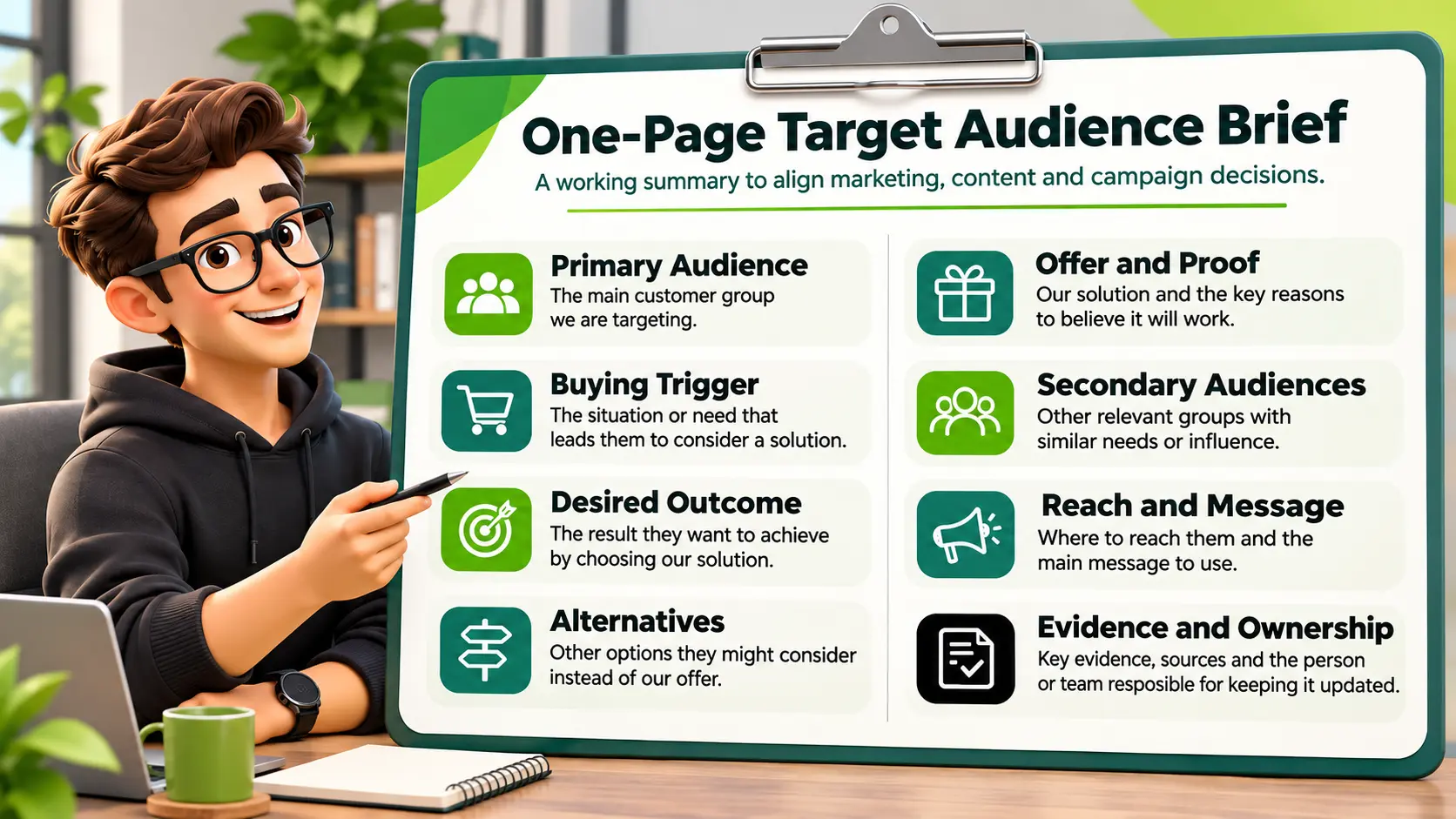
An audience definition becomes useful when different teams can apply it to decisions. Keep a short working document that records what you know, what remains uncertain, and who is responsible for reviewing the choice.
- Primary audience: The customer group and buying situation selected for priority.
- Buying trigger: The problem or event that creates a reason to act.
- Desired outcome: What the customer needs to achieve.
- Current alternatives: Other providers, internal solutions, or the choice to do nothing.
- Offer and proof: The actual service, its limitations, and evidence supporting important claims.
- Secondary audiences: Other suitable groups that are not the current marketing priority.
- Reach and message: Relevant channels, content needs, and the message being evaluated.
- Evidence and ownership: Source notes, research limitations, review date, and the person accountable for updates.
Share the brief with the people responsible for website content, sales, advertising, and customer experience. The goal is not identical wording everywhere. It is a consistent understanding of whose needs the business is prioritizing and what it can truthfully promise.
When Should You Expand or Reconsider Your Audience?
Audience focus should change when the evidence changes. You might expand into a secondary segment after confirming its needs, delivery fit, and commercial viability. You might narrow your focus if a broad offer creates conflicting expectations or requires capabilities your business does not have.
Revisit the decision when your services change, customer needs shift, sales feedback contradicts the original research, or reliable measurement reveals a different pattern of qualified demand. Do not interpret one unusually strong or weak campaign as proof that an entire market is attractive or unsuitable.
If your business needs help connecting a documented audience choice with messaging and campaign execution, review ImiliCorp’s performance branding service and confirm whether the proposed scope includes the specific research and implementation work you need.
Finding your real audience is not about making your brand smaller. It is about making your next marketing decision more specific and defensible. Start with customer evidence, choose a group your business can genuinely help, test whether buyers recognize the value, and revise the decision as you learn.