

Refreshing a high-potential post can be faster, cheaper, and more reliable than starting from a blank page. The key is knowing when an old URL still has search equity and when it is holding you back. This guide breaks down the signals, the decision criteria, and the safest way to update without losing traction.
Why Updating Often Beats Starting Over?
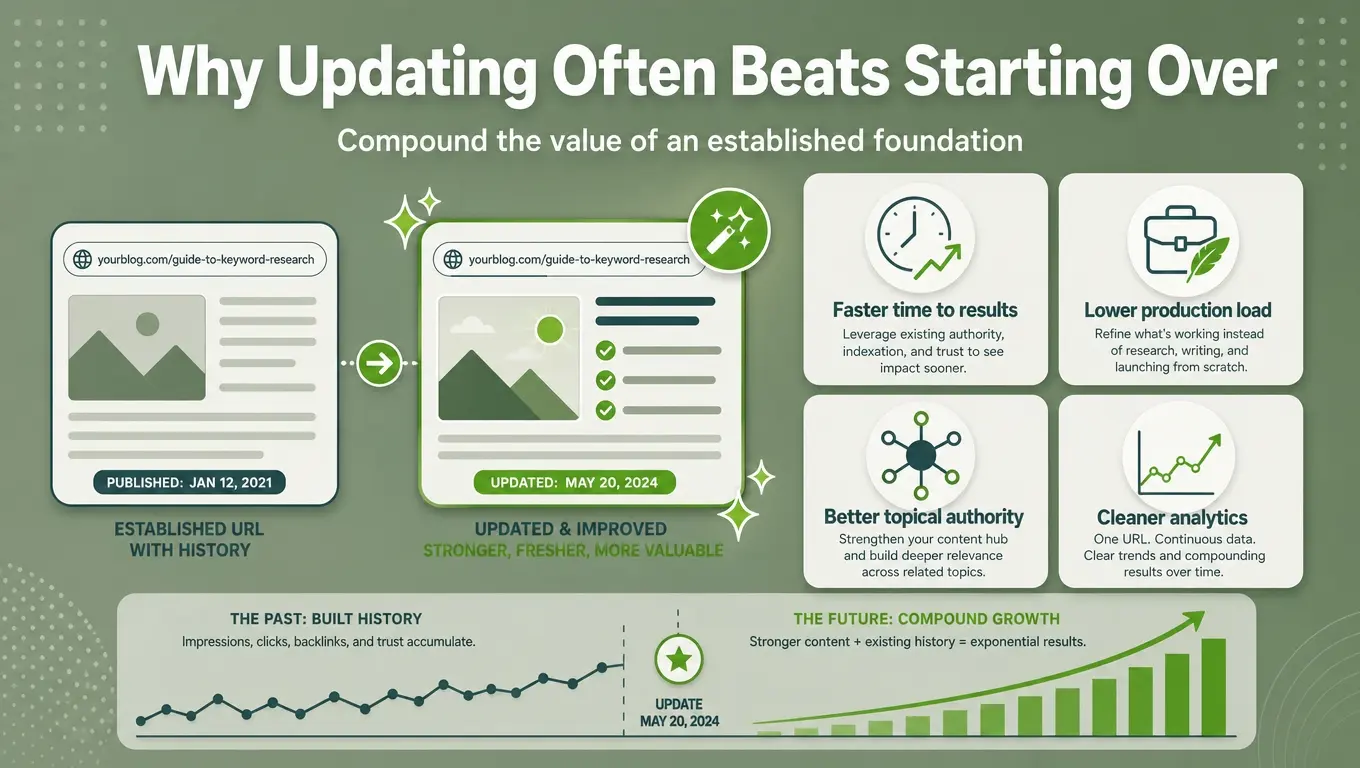 Search engines evaluate more than words on a page. They also read history, internal links, engagement patterns, and how consistently a URL satisfies intent. When an older post already has visibility, improving it can compound the value of that foundation.
Updating also supports users who already found the page through bookmarks, newsletters, or internal navigation. A stronger version of the same URL preserves continuity and reduces the risk of fragmenting authority across multiple pages.
- Faster time to results: A page with existing impressions can rebound quickly once content gaps and technical issues are fixed.
- Lower production load: Research and structure already exist, so the effort shifts to accuracy, depth, and clarity.
- Better topical authority: Strengthening a core URL helps your entire cluster by passing stronger internal link value.
- Cleaner analytics: A single URL keeps performance history intact, which makes improvement easier to measure.
These benefits only apply when the original post is still a good fit for the topic and intent. The next sections show how to evaluate that fit.
Performance Signals That Point To An Update
If a post is already getting search impressions, it is already in the conversation. That makes it a strong candidate for an update, especially when rankings have slipped or plateaued. Look for signs that the page is close to winning but not fully satisfying search intent.
Start with your search performance data and on-page engagement. A decline is not always a reason to abandon a URL, it often means the page is outdated or has been outpaced by better structured competitors.
- Consistent impressions but weak clicks: The snippet may not match intent, or the title and description may be misaligned with what searchers want.
- Ranking positions near page one: Moving from positions 8 to 3 is often easier than launching a new URL from zero.
- Traffic decline after an update elsewhere: Competitors may have refreshed their pages or expanded coverage, creating a content depth gap.
- High bounce or short dwell time: The intro, structure, or content promise may not match what the query expects.
- Strong backlinks and mentions: External signals are difficult to recreate, so improving the same URL protects that asset.
When these patterns show up, an update is usually the highest ROI move. The decision becomes clearer when you compare update versus new content side by side.
Update Or New Post Decision Table
Use the table below as a quick decision filter. It combines intent fit, existing equity, and practical constraints so you can choose the safest route.
| Signal | Update The Old Post | Write A New Post |
|---|---|---|
| Search intent | The intent is the same and only details have changed | The intent has shifted or needs a different angle and structure |
| Backlinks and authority | The URL has quality links, shares, or references worth preserving | The old URL has no meaningful equity or is off-topic |
| Keyword coverage | The post can be expanded to cover missing subtopics cleanly | The post would become bloated or unfocused after expansion |
| Content freshness | Facts, screenshots, pricing, or steps are outdated but fixable | The whole framework is obsolete and requires a new approach |
This framework prevents two common mistakes. One is rewriting everything when a targeted refresh would do. The other is publishing near-duplicate pages that cannibalize each other.
When An Old Post Is Worth Saving?
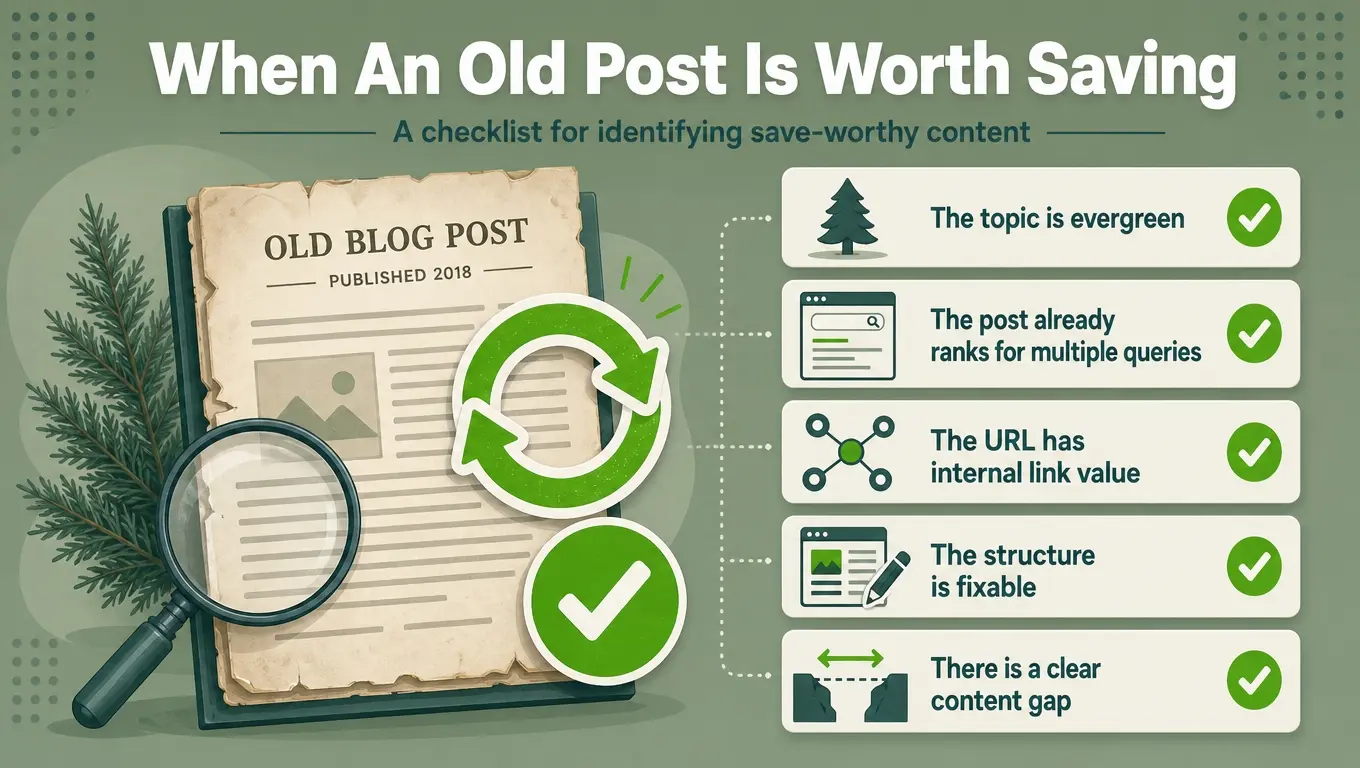 A post is worth updating when its core promise still matches what readers search for. The best candidates have a stable topic, an established URL, and room for improvement without changing the page identity. In practice, that means the page can be modernized while staying true to its original intent.
Prioritize updates when you can clearly improve usefulness. Small edits are rarely enough, the goal is a meaningful upgrade in completeness, clarity, and trust signals.
- The topic is evergreen: The fundamentals are still valid, even if tools, standards, or best practices have evolved.
- The post already ranks for multiple queries: A refresh can improve relevance across a wider set of related searches.
- The URL has internal link value: Other pages rely on it as a hub, resource, or reference point.
- The structure is fixable: You can improve headings, navigation, and scannability without changing the topic.
- There is a clear content gap: Competitors answer questions your post skips, and you can address them thoroughly.
Once you identify a save-worthy post, the next step is deciding whether an update is safe or whether a new page would serve users better.
When You Should Write A New Post Instead?
Sometimes an old URL has too much baggage. If the post targets the wrong intent, combining everything into one refreshed page can create a confusing, unfocused result. In those cases, a new URL lets you build a cleaner information architecture.
Creating a new post also makes sense when the old one is tied to a very specific context that no longer applies. Forcing a refresh can dilute topical relevance and reduce rankings for the remaining audience segment.
- The search intent is different: The query now expects a guide, comparison, or template and the old post cannot pivot without becoming misleading.
- The post targets multiple unrelated keywords: The page is already a catch-all and needs separation into distinct pages.
- The content has brand or product mismatch: The old angle no longer represents your services, positioning, or audience needs.
- You need a different funnel stage: The old post is informational, but you now need a page designed for evaluation or purchase readiness.
If you go the new-post route, plan a clean redirect strategy and internal linking so you do not leave users stranded. If you update, follow a disciplined process to reduce risk.
How To Update Without Losing Rankings?
A successful refresh is not a quick rewrite. It is a controlled improvement that protects what already works while closing gaps that limit performance. The most reliable approach starts with diagnosis and ends with validation.
- Confirm the primary intent: Re-check what the query expects and ensure the page still matches that intent from the first screen onward.
- Audit what already drives traffic: Identify the queries, sections, and internal links that currently bring users, then keep those strengths intact.
- Fix accuracy and freshness issues: Update facts, processes, and references that are outdated, and remove claims you can no longer support.
- Expand with purpose: Add missing subtopics, definitions, and decision help that make the post more complete without turning it into a different page.
- Improve on-page SEO elements: Refine headings, add descriptive anchor links where helpful, and tighten the title and meta description for clarity.
- Strengthen trust signals: Add author accountability, cite internal policies or methodology where appropriate, and ensure the page reflects real expertise.
- Review internal linking: Point related articles to the refreshed URL and ensure the updated post links back to relevant supporting pages.
- Measure after publishing: Track impressions, clicks, and ranking movements for several weeks and adjust sections that underperform.
That process keeps updates intentional and measurable. It also reduces the chance of accidental topical drift.
Content Quality Checks That Matter Most
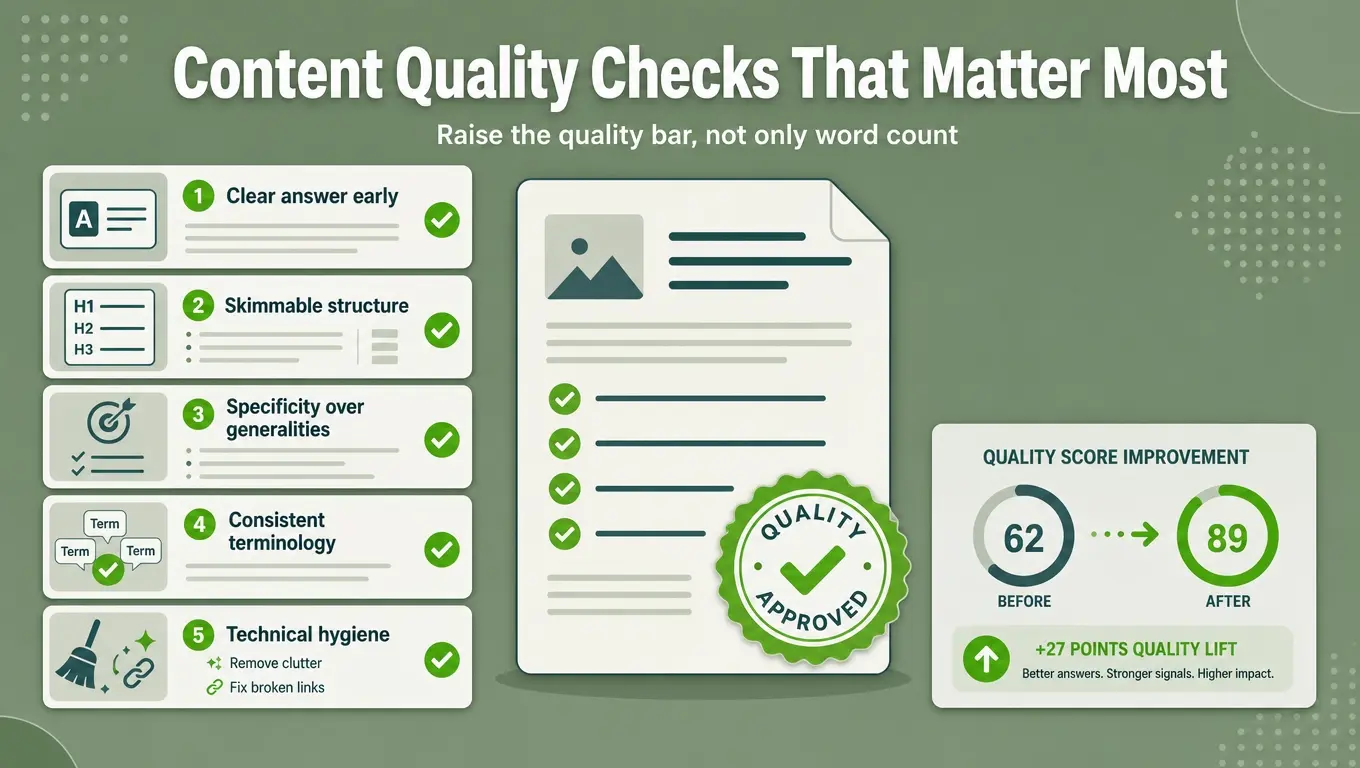 Search performance improves when the page becomes easier to trust and easier to use. A refresh should raise the overall quality bar, not only add words. Focus on clarity, completeness, and the signals that show you understand the topic deeply.
Work through quality checks that align with helpful content and user satisfaction. These checks also support stronger conversion rates when the post is part of your lead flow.
- Clear answer early: State what the page will help the reader do, then deliver that value without long preamble.
- Skimmable structure: Use short paragraphs, descriptive headings, and concise bullet lists where they reduce reading friction.
- Specificity over generalities: Replace vague advice with concrete criteria, definitions, and decision rules.
- Consistent terminology: Use the same phrases for the same concepts to avoid confusion and reduce misinterpretation.
- Technical hygiene: Check broken internal links, outdated screenshots, formatting glitches, and duplicated sections.
Once quality is handled, align the refresh with your broader content system so the updated post strengthens your site, not only itself.
How Updates Fit Into A Content Strategy?
Updating older posts is most effective when it is planned, not reactive. A refresh program keeps your best URLs current and prevents content decay across your knowledge base. It also helps you concentrate authority into fewer, stronger pages.
For teams managing many pages, a quarterly review cycle works well. Prioritize pages that sit on the edge of higher rankings, pages that support key services, and pages tied to high-intent internal paths.
- Build topic clusters: Refresh the main hub page first, then update supporting articles to reinforce the same theme.
- Prevent keyword cannibalization: Consolidate overlapping posts into one best page when the intent is identical.
- Coordinate with sales and support: Update posts that repeatedly trigger questions, objections, or confusion.
If your organization needs repeatable systems for content audits, on-page SEO, and technical cleanup, Imili Corp supports content optimization projects that turn aging blogs into dependable traffic assets. That kind of structured support is especially useful when multiple stakeholders touch the same pages.
Conclusion
Update an old blog when the topic and intent still match, the URL has earned visibility, and improvements can make the page more useful and trustworthy. Write a new post when the intent has shifted, the old page is unfocused, or a refresh would create a different promise than the URL originally made.
Use performance signals, content fit, and the decision table to choose confidently. Then apply a controlled update process that protects existing equity while delivering a clearer, more complete experience.
Frequently Asked Questions
How much should I change when updating an old blog post?
Change what is necessary to meet intent better than competing pages while keeping the core topic consistent. Focus on accuracy, missing subtopics, structure, and internal links. Avoid rewriting sections that already rank well unless they are unclear or outdated.
Will updating an old post reset its rankings?
A refresh can cause short-term movement, but strong updates typically stabilize once search engines reprocess the page. The biggest risk comes from changing the intent, removing valuable sections, or breaking internal links. A measured update with clear improvements is usually safer than a full pivot.
Should I change the URL when I update a post?
Keep the URL when the topic remains the same and the page has any search history, links, or shares. Change it only when the URL is misleading or when the new content targets a genuinely different intent. If a change is required, plan redirects and update internal links to preserve equity.