

As companies expand into new products, services, markets, or acquisitions, a single brand identity can become harder to manage. Customers may struggle to understand how different offerings connect, while marketing teams face inconsistent naming, overlapping messages, and fragmented campaigns. Brand architecture provides a structured way to organize parent brands, sub-brands, product lines, and independent brands. However, growth does not automatically mean a company needs more brands. The goal is to create the simplest structure that helps customers understand each offering, preserves brand equity, and supports future expansion.
What Brand Architecture Means in Practice

Brand architecture is the strategic framework that defines how a company’s corporate brand, business units, sub-brands, product lines, and individual offerings relate to one another. It establishes which names lead, how brand identities are connected, and where shared reputation or independent positioning matters most. A well-designed architecture helps customers navigate the portfolio while giving internal teams clear rules for naming, messaging, visual identity, and future expansion.
For growing companies, brand architecture is both a customer experience tool and an operating model. It aligns sales decks, websites, proposals, packaging, and partner messaging. It reduces the hidden cost of constant reinvention and makes future launches faster.
For a broader explanation of portfolio structure, NielsenIQ’s brand architecture guide describes how companies organize parent brands, sub-brands, and independent brands. It also explains common architecture models and how different structures support long-term portfolio management.
Signs One Brand is No Longer Enough
A single brand can stretch far, but it starts to break when the portfolio becomes complex. The most common symptom is confusion, not competition. If people ask what you do after reading your homepage, the structure is missing.
- Offer Sprawl: Services and products multiply, but naming and positioning do not keep up.
- Audience Divergence: One brand voice tries to speak to very different buyers with different needs.
- Sales Friction: Reps spend time explaining relationships between offers instead of value.
- Mergers And Acquisitions: New entities join, but customers cannot tell what changed.
- Channel Conflict: Partners, resellers, or internal teams compete for the same terms and identity.
These signals point to the same root issue – a lack of clear hierarchy and roles for each brand element.
How to Confirm Whether Brand Architecture Needs to Change
Before creating a new sub-brand or reorganizing your portfolio, examine whether the current structure is causing measurable problems.
Look for these signals:
- Customer Confusion: Prospects regularly misunderstand which products or services belong together.
- Audience Overlap: Multiple offerings target similar customers without clearly differentiated benefits.
- Sales Delays: Sales teams repeatedly explain the relationship between brands before discussing customer needs.
- Search Competition: Different product or service pages compete for the same search intent without a clear hierarchy.
- Operational Duplication: Teams maintain separate messaging, websites, or design systems without a justified business reason.
- Expansion Challenges: Acquisitions or new product launches require repeated exceptions to existing naming rules.
Review customer interviews, sales feedback, website navigation data, search performance, and internal workflows before deciding whether a new architecture is necessary.
If the problem is unclear messaging rather than genuinely different audiences or offers, improving positioning within the existing brand may be more effective than launching another identity.
Core Brand Architecture Models
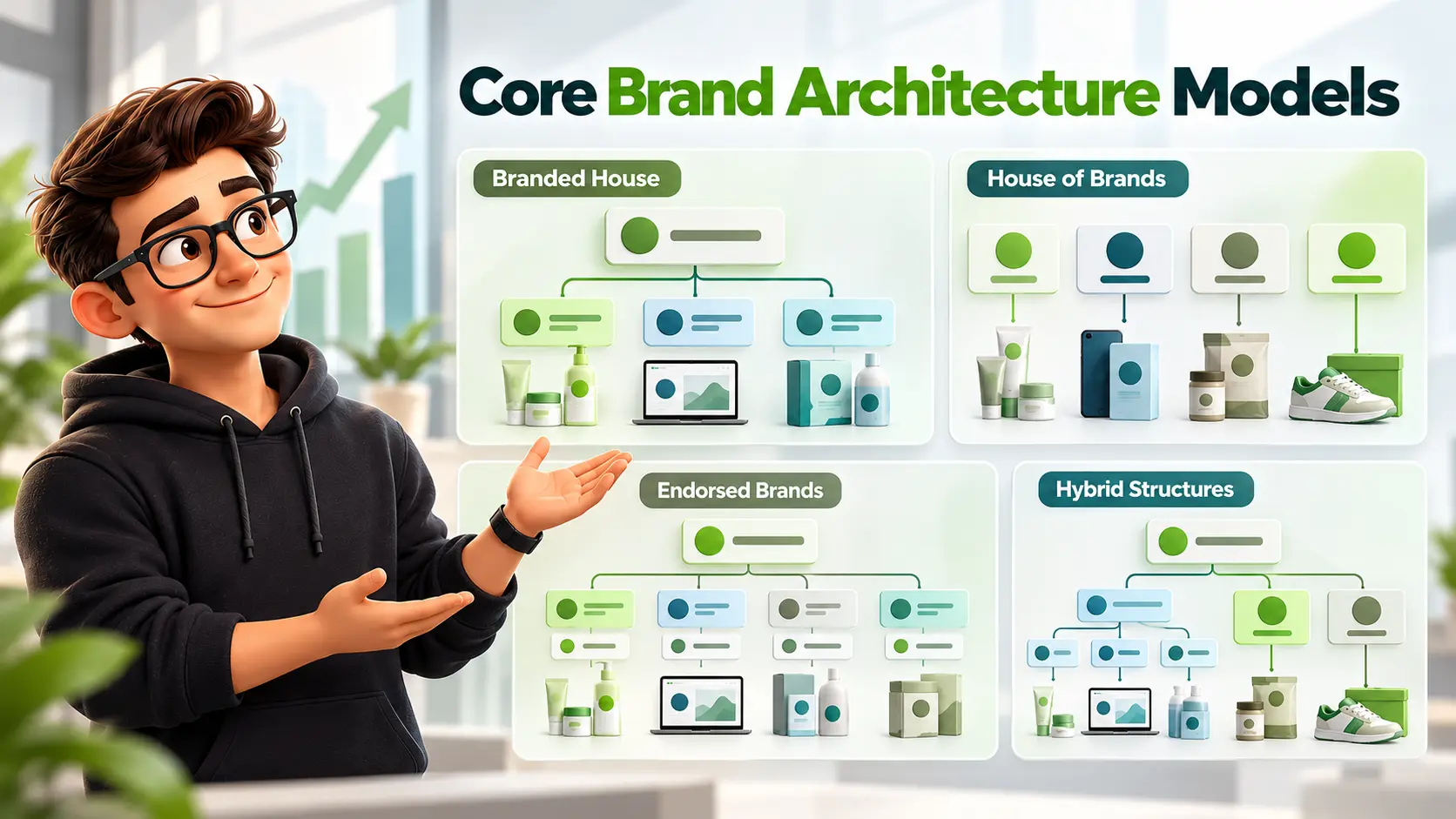
Most portfolios fit into a small set of proven models. The right choice depends on how much equity sits in the parent brand, how different the offers are, and how much risk you can tolerate when launching new lines. The models also affect your website structure, SEO footprint, and sales enablement.
Branded House
One master brand powers everything, and sub-offers use descriptive names. This works well when credibility, trust, and consistency drive conversion. It can also reduce marketing cost because every launch strengthens the same brand.
House of Brands
Independent brands sit under one corporate owner, often with minimal public connection. This approach fits when audiences and value propositions differ sharply, or when a parent brand should not constrain positioning. It can be powerful, but it demands more investment and tighter governance.
Endorsed Brands
Sub-brands lead with their own identities while borrowing trust from an endorser brand. It is useful for new categories, acquisitions, or distinct business units that still benefit from shared credibility. Endorsement levels can be strong or subtle depending on strategy.
Hybrid Structures
Many growing companies blend models. A core platform may use a branded house approach, while an acquired niche solution remains endorsed. Hybrids require clear rules, otherwise they drift into a confusing mix of naming styles and inconsistent messaging.
Real-World Examples of Brand Architecture Models
Understanding how established companies organize their portfolios makes the four models easier to compare.
Branded House FedEx
FedEx uses its master brand across multiple services, including FedEx Express and FedEx Ground. This approach reinforces recognition while using descriptive service names to distinguish offerings. It demonstrates how a strong parent brand can connect several related operations.
Endorsed Brands Marriott
Marriott’s portfolio includes brands that maintain their own positioning while benefiting from a visible connection to Marriott, such as Courtyard by Marriott. This structure combines differentiated hospitality experiences with parent-brand recognition.
Hybrid Architecture Alphabet and Google
Alphabet owns businesses operating with different public identities. Within its ecosystem, Google products share a highly recognizable master brand, while YouTube maintains a distinct brand identity. This demonstrates how different brand relationships can coexist within a larger corporate portfolio.
These examples are illustrative rather than permanent classifications. Large organizations may change naming, ownership arrangements, and endorsement practices over time.
Naming and Hierarchy That People Understand
Names are not cosmetic. They teach customers how to navigate your portfolio and how to remember you. A scalable naming system also saves internal time and prevents politics from driving identity decisions.
- Start With Roles: Define what the corporate brand, sub-brands, and products are responsible for in the buyer journey.
- Use A Consistent Grammar: Decide whether names are descriptive, evocative, or a mix, then apply the rule across the portfolio.
- Limit Levels: Too many tiers make it hard to recall and hard to maintain on web navigation and sales materials.
- Design For Search Behavior: Choose names and descriptors that align with category language and intent, not internal jargon.
Once hierarchy is clear, you can translate it into site structure, product pages, service pages, and conversion paths.
How Brand Architecture Supports Marketing and SEO
Brand architecture influences how companies organize websites, landing pages, product categories, and marketing campaigns. A clear portfolio structure can help customers understand which offerings belong together and make navigation easier. From an SEO perspective, logical website hierarchies, descriptive page titles, internal links, and distinct search intent for important pages can improve content organization and discoverability.
However, creating separate brands or domains does not automatically improve search rankings. Multiple websites may require independent content development, technical maintenance, and marketing resources. When restructuring an existing portfolio, businesses should evaluate whether a single domain, subdirectories, or separate websites best serve their audiences. If existing URLs change, plan redirects, update internal links, review canonical tags, and monitor indexing through Google Search Console. Brand architecture should support customer understanding first, with SEO implementation following the chosen business structure.
If restructuring brands involves changing website domains or URLs, follow Google’s official site migration guidance. It explains how to map old and new URLs, implement redirects, update internal links, and monitor indexing while minimizing disruption to search performance.
Brand architecture decisions also influence technical SEO and content organization. ImiliCorp’s search engine optimization services cover keyword research, content mapping, internal linking structures, and technical website improvements that can support a more organized digital presence.
Governance That Keeps the System Clean
Architecture fails when it is treated as a one-time branding exercise. Governance is the ongoing set of decisions, templates, and approvals that keep the structure intact as new offers launch. It prevents one-off naming and design decisions from slowly undoing the logic.
- Decision Rights: Assign who can approve names, positioning, and visual identity at each level.
- Brand Standards: Document how logos, typography, color, and voice scale across parent and sub-brands.
- Launch Checklist: Require every new offer to map to the hierarchy, audience, and value proposition rules.
- Portfolio Reviews: Reassess relevance and overlap on a regular cadence to prevent duplication.
Governance turns brand architecture into a durable operating system. It also reduces rework across design, content, and product marketing.
What to Include in a Brand Architecture Governance Framework
A governance framework should explain how brands are created, managed, reviewed, and retired as the company grows.
Document the following responsibilities:
- Brand Ownership: Identify the team or executive responsible for each brand and product family.
- Naming Approval: Establish who can approve new brand names, product names, and extensions.
- Positioning Rules: Define the intended audience, value proposition, and market role of every major brand.
- Visual Identity Standards: Document how typography, colors, logos, and design systems should be applied.
- Website and SEO Standards: Set rules for domains, page hierarchy, internal linking, redirects, and naming consistency.
- New Launch Requirements: Require teams to explain why a new offering needs an independent brand, sub-brand, or existing product-line name.
- Performance Reviews: Assess customer understanding, brand overlap, operating costs, and business performance at agreed intervals.
- Brand Retirement Process: Establish how discontinued or consolidated brands will be communicated, redirected, and removed from active materials.
Review the governance framework whenever major acquisitions, new market entries, or portfolio changes occur.
Brand Architecture Decisions to Make Early
Clarity comes from making a few hard decisions before design work begins. Teams often jump into logo changes and web layouts while the underlying structure is still debated. That sequence leads to waste and inconsistent outcomes.
- Define The Primary Buyer Groups: Align the portfolio to how customers choose, not how internal teams are organized.
- Choose The Master Brand Role: Decide whether the parent brand is the main promise or a silent holding brand.
- Set Criteria For Sub-Brands: Establish what qualifies as a sub-brand versus a product line or feature set.
- Determine Endorsement Rules: Specify how and where the parent brand appears across touchpoints.
- Plan Migration Paths: Map how existing names and URLs transition to avoid confusion and loss of equity.
With these decisions in place, creative execution becomes faster and the final system is easier to maintain.
Brand Architecture Selection Checklist
Before choosing a branded house, house of brands, endorsed brand, or hybrid model, answer the following questions:
- Audience Similarity: Do the products or services serve the same customer groups?
- Value Proposition: Can the offerings share one clear brand promise without confusing customers?
- Existing Brand Equity: Does the parent brand have sufficient recognition and credibility to support additional offerings?
- Positioning Differences: Do new products require distinct pricing, messaging, or market identities?
- Reputation Risk: Would a problem affecting one offering significantly damage the others?
- Marketing Resources: Can the company support separate websites, campaigns, identities, and content programs?
- Acquisition Strategy: Will acquired brands retain independent market recognition?
- Long-Term Growth: Can the structure accommodate future products and business units without creating unnecessary complexity?
Use the answers to assess the degree of independence each offering needs.
A branded house may suit closely related products with shared audiences. A house of brands may work when audiences and positioning differ substantially. Endorsed or hybrid structures may be useful when a company needs both differentiation and parent-brand recognition.
For another perspective on model selection, Saint Associates’ brand architecture models guide examines branded house, house of brands, and endorsed structures, with practical considerations for selecting a model based on business requirements rather than design preferences alone.
Common Pitfalls That Create Confusion
Most portfolio problems are self-inflicted. They happen when companies chase novelty, reward internal politics, or overreact to competitive moves. Avoiding a few predictable errors can protect years of brand equity.
- Too Many Sub-Brands: Every new name adds marketing load and fragments trust.
- Inconsistent Descriptors: Switching between category terms makes it harder to understand what each offer does.
- Visual Mismatch: Unrelated design systems suggest unrelated companies, even when the back end is shared.
- Weak Differentiation: Multiple offerings appear interchangeable because positioning is not distinct.
- No Retirement Plan: Legacy names stay alive in decks and pages long after they should be sunset.
Fixing these issues usually requires both strategic alignment and detailed execution across digital and sales channels.
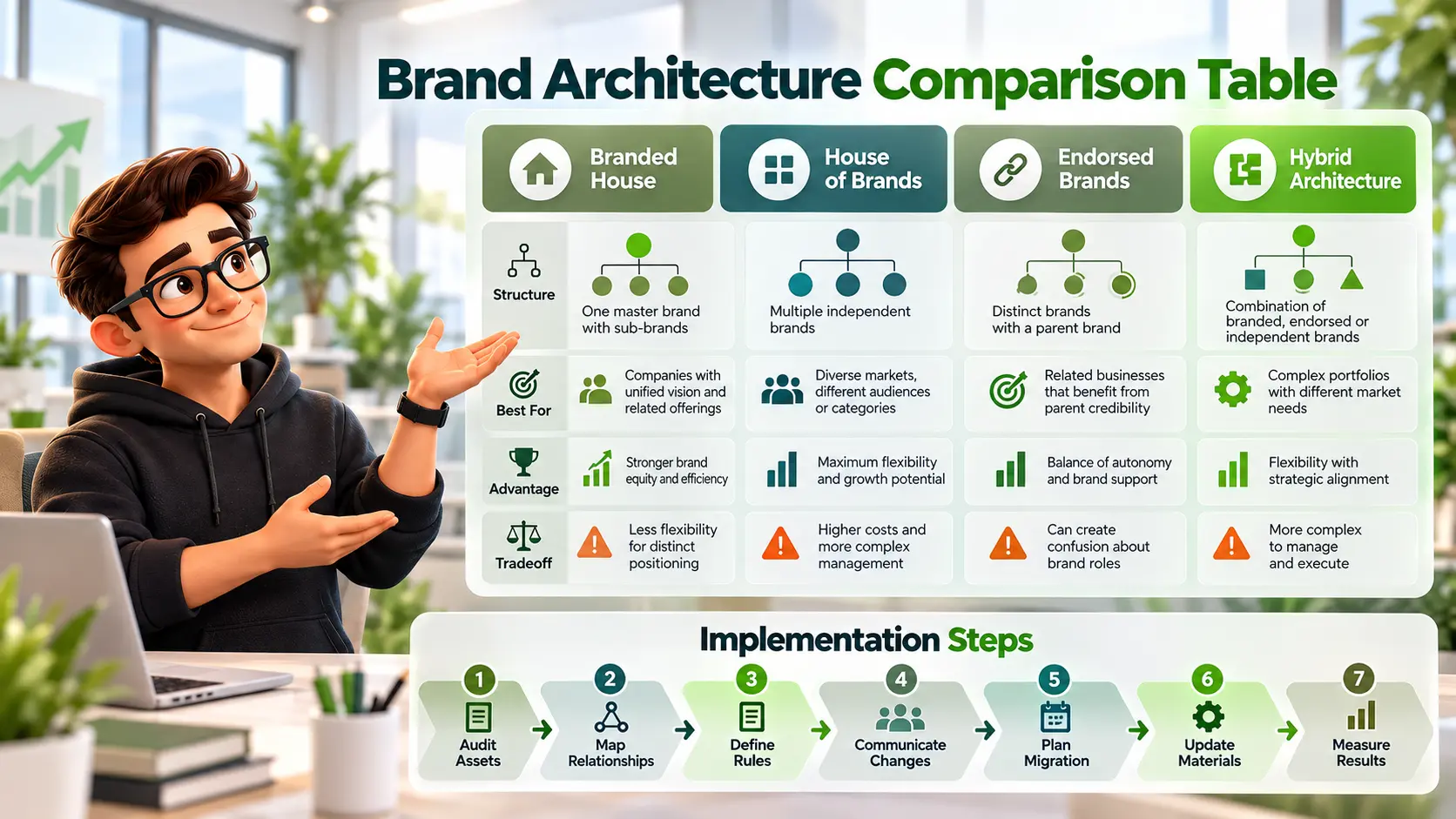
Brand Architecture Comparison Table
This table summarizes how the main models tend to perform across common growth needs. Use it to pressure-test what you can realistically support with your current resources and future roadmap.
| Brand Architecture Model | Structure | Best For | Main Advantage | Main Tradeoff |
|---|---|---|---|---|
| Branded House | One master brand connects related products and services | Companies with shared audiences and a consistent brand promise | Builds recognition through one primary identity | Reputation issues or confusing positioning may affect multiple offerings |
| House of Brands | Independent brands operate under a corporate owner | Companies serving distinct markets, audiences, or price segments | Allows separate positioning and brand identities | Requires greater marketing investment and operational coordination |
| Endorsed Brands | Distinct brands receive visible support from a parent brand | Businesses that need differentiation alongside parent credibility | Combines independent positioning with shared reputation | Requires consistent endorsement and identity rules |
| Hybrid Architecture | Multiple brand relationships coexist within one portfolio | Companies managing acquisitions, legacy brands, and diverse product lines | Offers flexibility across different market needs | Can become difficult to manage without clear governance |
After selecting a model, the next priority is mapping it into customer-facing experiences such as navigation, page templates, and messaging frameworks.
How to Implement a New Brand Architecture Without Confusing Customers
Choosing a model is only the beginning. Companies also need a transition plan that protects customer recognition and maintains consistency across marketing channels.
Follow these steps:
- Audit Existing Brand Assets: Inventory current names, websites, domains, product pages, marketing materials, and customer touchpoints.
- Create a Brand Relationship Map: Document the parent brand, sub-brands, product lines, and independent brands.
- Define Naming and Identity Rules: Specify which names and visual elements will change and which should remain consistent.
- Prepare Customer Communication: Explain relevant changes to customers, employees, distributors, and partners.
- Plan Website Migration: Map old URLs to appropriate destinations, configure redirects, and update internal links where necessary.
- Update Marketing Materials: Align advertisements, landing pages, social profiles, sales presentations, and email templates.
- Measure the Transition: Monitor customer questions, branded search demand, website performance, lead quality, and conversion trends.
Avoid changing every customer-facing element simultaneously unless the transition requires it. A carefully planned rollout makes it easier to identify problems and preserve valuable existing brand recognition.
How ImiliCorp Helps Growing Companies Organize Their Brands
Brand architecture decisions connect closely with positioning, creative strategy, website structure, and performance marketing. ImiliCorp’s approach to performance branding combines brand storytelling with data-driven marketing, helping businesses align their messaging with measurable growth objectives. For companies evaluating a more complex brand portfolio, this alignment can be useful when reviewing audience differences, positioning consistency, and customer-facing communication.
Learn more about ImiliCorp’s approach to performance branding and data-driven storytelling, which connects brand positioning, creative messaging, and performance analytics to help businesses maintain a consistent market presence while pursuing measurable growth.
A practical brand architecture project should begin with an assessment of the current portfolio, followed by clear recommendations for naming, messaging, digital structure, and governance. Businesses considering external support can discuss their objectives, existing brand challenges, and proposed rollout requirements before defining the scope of any engagement.
If your company is struggling with overlapping offerings, unclear positioning, or inconsistent marketing communication, you can contact ImiliCorp for a strategy discussion to outline your business challenges and discuss the type of strategic or marketing support you may need.
Conclusion
Brand architecture helps growing companies organize products, services, and business units without creating unnecessary customer confusion. The right structure may involve strengthening an existing master brand, introducing distinct sub-brands, maintaining independent brands, or combining several approaches within a governed portfolio.
Before selecting a model, businesses should evaluate audience overlap, brand equity, market positioning, operating resources, and long-term expansion plans. A successful architecture should be easy for customers to understand and practical for teams to maintain. With clear naming rules, consistent messaging, and a thoughtful implementation strategy, companies can support growth while protecting the recognition and trust they have already built.
Frequently Asked Questions
How Do I Know Whether to Create a Sub-Brand or a Product Line?
A sub-brand is justified when the offer needs a distinct positioning, audience, or buying journey that cannot live comfortably under the existing name. Product lines work best when the master brand promise still fits and you mainly need clearer organization. If the difference is mostly features, pricing tiers, or packaging, a product line is usually enough.
Will Changing Brand Architecture Hurt Existing Brand Equity?
It can if changes are rushed or inconsistent across channels. A careful migration plan, consistent naming rules, and clear communication protect recognition and trust. The goal is to preserve what customers already know while making the expanded portfolio easier to understand.
What Should Be Documented in Brand Architecture Governance?
Governance should include naming rules, hierarchy definitions, endorsement rules, and basic visual identity standards. It should also clarify who approves changes and what criteria new offerings must meet. Strong governance keeps your structure stable as teams and products evolve.