

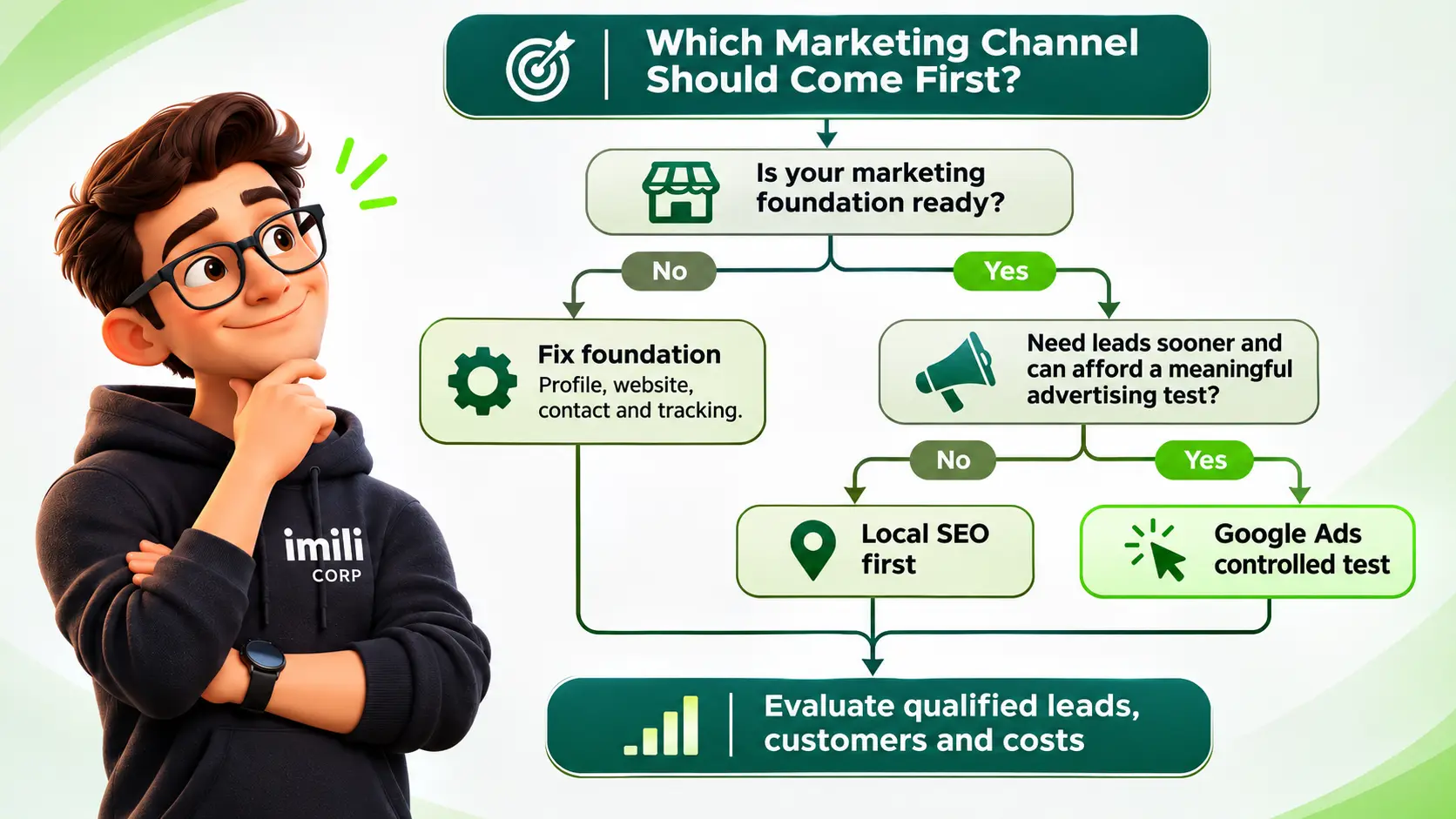
A service business should invest in local SEO first when it needs to establish a credible local presence, improve its visibility in Google Maps and build a sustainable source of customer inquiries. Google Ads may deserve the first substantial marketing investment when the business needs leads sooner, already has a reliable website and can afford to test paid customer acquisition.
However, neither channel is a good first investment if customers cannot easily contact the business, service areas are unclear or inquiries regularly go unanswered. Fixing these foundational problems should come before increasing marketing spending.
The right decision depends on how quickly you need customers, how much you earn from each completed job, how competitive your local market is and whether your business is ready to convert inquiries into paying customers.
How Local SEO and Google Ads Work for Service Businesses?
Local SEO helps a business become more discoverable in unpaid local search results. It involves maintaining an accurate Google Business Profile, developing useful service pages, managing business information, earning genuine customer reviews and improving the relevance of your website to local searches.
According to Google’s local ranking documentation, local search visibility depends primarily on relevance, distance and prominence. Businesses cannot pay Google to improve their unpaid local rankings.
Google Ads works differently. With a Google Search campaign, businesses can compete for advertising placements when potential customers search for relevant products or services. Advertisers can configure keywords, geographic targeting, budgets and campaign goals.
For example, a plumbing company could improve its organic visibility for local water heater repair searches through local SEO while also running paid search advertisements for that service. Both approaches address existing customer demand, but they involve different costs, controls and time horizons.
For this comparison, Google Ads refers primarily to standard paid Search campaigns. Other advertising formats, including Local Services Ads where available, require separate consideration of eligibility, campaign structure and billing.
Local SEO vs. Google Ads: Key Differences
| Decision Factor | Local SEO | Google Ads Search Campaigns |
|---|---|---|
| Speed of visibility | Usually develops gradually and varies by market | Can begin after campaign approval and activation |
| Primary costs | Website improvements, profile management, content and ongoing maintenance | Advertising spend, campaign management and landing page improvements |
| Geographic reach | Influenced by location, relevance and prominence | Configurable geographic targeting, subject to platform limitations |
| Visibility after spending stops | Existing visibility may continue but can change over time | New paid exposure generally stops when campaigns stop serving |
| Budget control | Control over implementation spending, not ranking outcomes | Configurable campaign budgets, with auction-dependent costs |
| Best initial use | Building a credible local presence and long-term discoverability | Testing demand and reaching potential customers sooner |
| Main risk | Investing time and resources without achieving sufficient visibility | Paying for traffic that does not become profitable customers |
Local SEO is not free simply because businesses do not pay Google for organic clicks. Website development, content improvements and ongoing maintenance require time or money. Similarly, Google Ads does not guarantee leads simply because a campaign has an active budget.
What to Fix Before Spending on Either Channel?
Before choosing between local SEO and Google Ads, establish a minimum marketing foundation. This does not require an expensive website or a complete digital marketing strategy, but it does require a reliable way for customers to understand your services and contact your business.
- Google Business Profile: Create or claim an eligible profile, complete verification and maintain accurate business information.
- Service pages: Clearly explain what you offer, where you operate and how customers can request service.
- Contact experience: Make phone numbers, inquiry forms and booking options easy to find and use on mobile devices.
- Customer trust: Display genuine reviews and accurate business information, along with relevant qualifications or credentials where applicable.
- Lead handling: Assign responsibility for answering calls, responding to inquiries and following up on quotes.
- Measurement: Establish a way to distinguish genuine inquiries from irrelevant contacts and track which inquiries become customers.
Businesses that travel to customers should also follow Google’s service-area business guidelines. If customers are not served at your business address, Google instructs you to remove that address from your Business Profile.
Adding cities to a Business Profile does not guarantee visibility throughout those cities. Avoid creating misleading business locations or promising service coverage that your team cannot deliver.
When Local SEO Should Get Your First Marketing Budget
Local SEO is generally the stronger starting point when your business has an incomplete local presence but can afford to build visibility gradually.
Your Business Profile and Website Are Underdeveloped
If your profile contains outdated information, your website does not explain your main services or potential customers cannot find reliable contact details, these weaknesses should receive attention before substantial advertising spending.
Improving them can support both unpaid discovery and the experience of customers who arrive through paid advertising.
You Serve a Stable Local Market
Businesses such as residential cleaning companies, landscapers and appliance repair providers often depend on customers within a defined service area. Developing useful service information and maintaining an accurate local presence can support customers who are researching providers in that area.
Prioritize your most important services and actual coverage areas rather than publishing large numbers of nearly identical city pages.
Your Advertising Budget Cannot Support a Meaningful Test
If your available marketing budget would purchase very few relevant advertising clicks in your market, a paid campaign may provide too little information to evaluate its viability.
In that situation, prioritize affordable foundational improvements while researching the likely costs of a future paid search test. Do not assume that every small budget is unsuitable for advertising. The decision depends on local demand, click costs and the economics of your services.
When Google Ads Should Get Your First Marketing Budget
Google Ads can be the better first substantial investment when your business has the operational and financial readiness to acquire customers through paid search.
You Need Customer Inquiries Sooner
A new HVAC company with available technicians, an established repair service entering another city or a seasonal landscaping business may need to reach potential customers before organic visibility develops.
Search advertising can provide an earlier opportunity to reach people looking for those services, provided the campaign is approved, eligible to serve and competitive in the advertising auction.
You Have a Service With Healthy Job-Level Economics
Paid advertising is easier to evaluate when you understand how much a completed job contributes to your business after direct delivery costs.
A higher-priced service is not automatically a better advertising opportunity. Its labor requirements, materials, travel costs, cancellation rate and likelihood of converting an inquiry into a completed job also matter.
Your Business Can Track and Handle New Inquiries
Before launching a campaign, confirm that phone calls and forms work correctly, your team can respond to new inquiries and you have a process for recording lead quality.
Use geographic targeting that reflects your actual service area. Review search terms and lead locations to identify irrelevant traffic instead of assuming every advertising click comes from an appropriate potential customer.
Set up meaningful Google Ads conversion measurement where appropriate, but remember that a recorded call or form submission is not necessarily a qualified lead or completed sale.
How to Decide Where Your First Marketing Dollar Goes?
Instead of dividing your budget equally between local SEO and advertising, use the following decision matrix to identify the business constraint that needs attention first.
| Business Situation | First Investment | Reason |
|---|---|---|
| Incomplete Business Profile and unclear service pages | Local marketing foundation | Improves discoverability and customer confidence |
| Reliable website, urgent demand for jobs and sufficient test budget | Google Ads | Provides an earlier opportunity to test paid demand |
| Limited budget relative to expected advertising costs | Foundational local SEO | Avoids an advertising test that may be too small to evaluate |
| Established local presence with inconsistent inquiries | Controlled Google Ads test | Tests an additional customer acquisition channel |
| Many inquiries but few completed jobs | Conversion and lead-handling improvements | More traffic may amplify existing business problems |
| Healthy margins, reliable tracking and sufficient resources | Coordinated SEO and Google Ads | Supports immediate testing and longer-term visibility |
When several situations apply, address customer contact, measurement and operational problems first. Then choose the channel that best matches your financial capacity and customer acquisition needs.
Calculate What You Can Afford to Pay for a Lead?
Before deciding how much to spend on Google Ads or local SEO, estimate the maximum acquisition cost your business can reasonably support.
Start with the contribution from an average completed job after direct costs, then decide how much of that contribution can be allocated to acquiring a customer while leaving enough to cover overhead and profit.
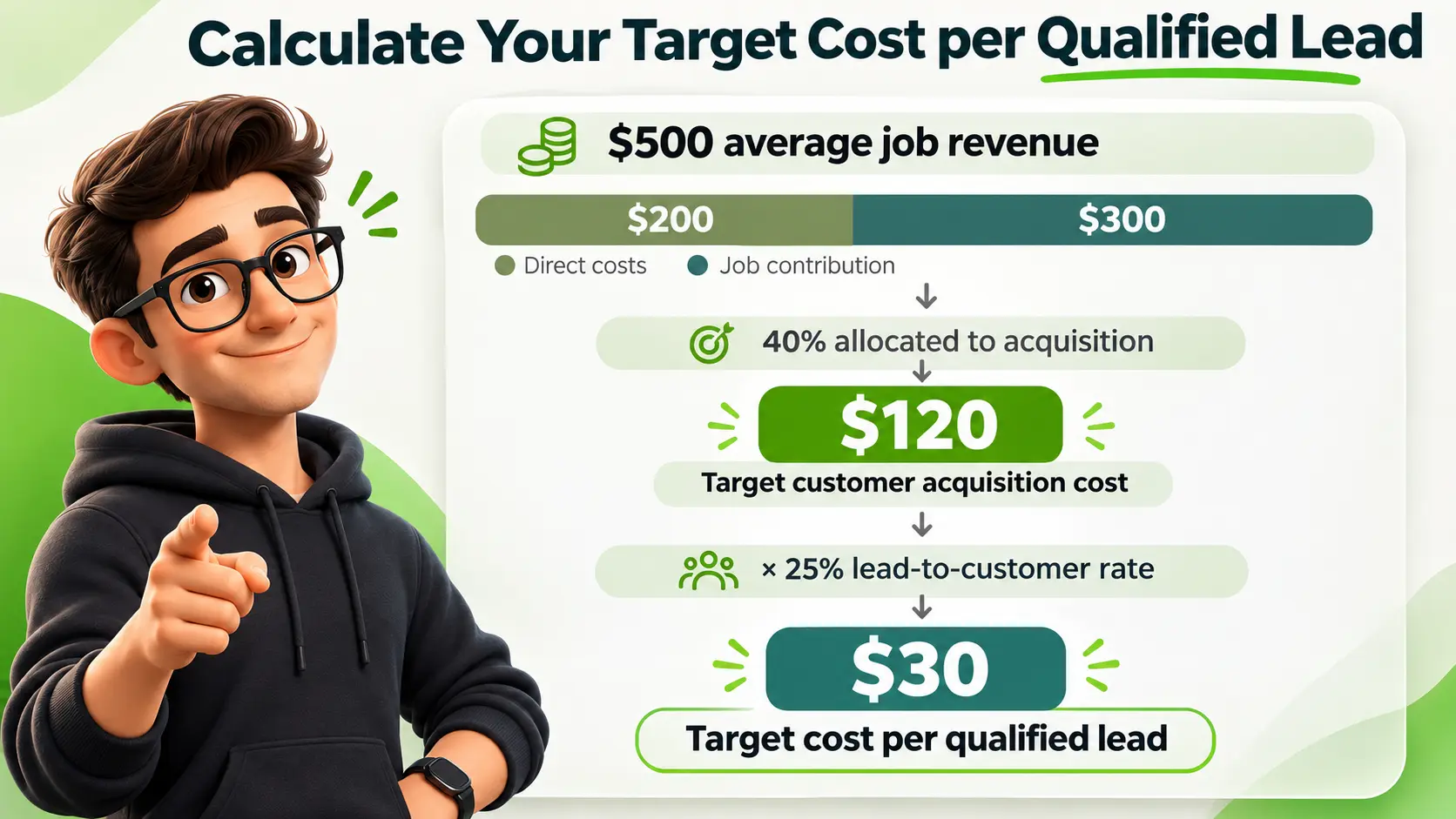
Target customer acquisition cost = Contribution per completed job × Chosen acquisition budget percentage
Target cost per qualified lead = Target customer acquisition cost × Qualified lead-to-customer conversion rate
Illustrative Example: A Local Repair Business
Suppose a repair business has the following hypothetical figures. These are example calculations, not industry benchmarks or predicted campaign results.
| Business Metric | Illustrative Value |
|---|---|
| Average revenue per completed job | $500 |
| Direct cost per completed job | $200 |
| Contribution before marketing and fixed overhead | $300 |
| Chosen acquisition budget percentage | 40% |
| Target customer acquisition cost | $120 |
| Qualified lead-to-customer conversion rate | 25% |
| Target cost per qualified lead | $30 |
Under these assumptions, the business can aim for a customer acquisition cost of $120 and a qualified lead cost of $30. These targets must account for relevant marketing expenses, not just the amount paid to an advertising platform.
If the business discovers that acquiring customers costs substantially more than its target, it should investigate lead quality, pricing, conversion rates and campaign efficiency before increasing spending.
A business with no historical lead-to-customer conversion data should treat its initial estimate as a planning assumption and replace it with observed results when sufficient data becomes available.
How to Allocate Your Initial Marketing Budget?
There is no universally appropriate percentage split between local SEO and Google Ads. A useful starting budget separates foundational work, customer acquisition testing and ongoing marketing improvements.
Foundation-First Approach
Allocate the initial budget to Business Profile improvements, important service pages, reliable contact methods and lead measurement. This approach suits businesses that are not yet ready to turn paid traffic into customers.
Advertising-First Approach
Once the foundation is ready, concentrate the advertising test on a clearly defined service and realistic geographic area. Keep enough budget for campaign management, landing page improvements and measurement rather than allocating everything to advertising clicks.
Google allows advertisers to configure campaign budgets, but spending on individual days can differ from the average daily budget. Review Google’s advertising spending guidance before setting your financial limits.
Combined Approach
If your resources allow both channels to receive meaningful investment, maintain your local search presence while using Google Ads to test demand for selected services. Advertising search-term and lead-quality data can help identify questions and services that deserve better website coverage.
However, paying for advertisements does not directly improve unpaid local rankings. The advantage of combining the channels comes from better information, coordinated customer acquisition and improvements to shared website assets.
Measure Customers, Not Just Clicks or Rankings
A business cannot make a reliable budget decision by comparing Google Ads clicks with organic search impressions. Both channels should ultimately be evaluated using consistent business outcomes.
Track the following measurements over comparable periods:
- Qualified leads: Inquiries from potential customers who need a service you provide and meet your relevant service-area and eligibility requirements.
- Cost per qualified lead: Allocated channel costs divided by qualified leads attributed to that channel.
- Lead-to-customer conversion rate: New paying customers divided by qualified leads from the corresponding lead cohort.
- Customer acquisition cost: Allocated acquisition costs divided by new paying customers.
- Contribution after acquisition costs: Revenue from acquired customers minus direct delivery costs and allocated acquisition expenses.
Use a consistent method for allocating shared expenses such as website development and tracking. Local SEO can involve upfront work that continues supporting discovery in later periods, so comparing only the first month’s spending may produce a misleading result.
Keep records of lead dates, sources, qualification outcomes and completed jobs. Where a customer interacts with both organic and paid search, avoid counting the same customer twice. Attribution helps explain recorded customer journeys, but it does not establish how many customers would have been lost without a particular marketing channel.
Review tracking accuracy and lead quality regularly. Make larger budget changes only when the available data, normal sales cycle and business capacity support the decision.
When Should You Invest in Both Local SEO and Google Ads?
Invest in both channels when your business has enough resources to maintain its organic presence and conduct a meaningful advertising test without compromising service delivery or financial stability.
For example, an established electrician could maintain local service pages and its Business Profile while using paid search to test demand for electrical panel upgrades. If the campaign generates relevant inquiries, the business can investigate whether that service also deserves more detailed organic content.
Do not automatically expand the advertising budget after an increase in calls. Review completed jobs, customer acquisition costs and profitability first. Likewise, do not discontinue useful local SEO work simply because paid advertising starts generating inquiries.
If you need professional help evaluating these trade-offs, prepare your service areas, monthly marketing budget, job-level economics and recent lead records before discussing digital marketing services. These details can help establish whether the priority should be local visibility, paid acquisition or improvements to your existing customer journey.
Final Recommendation
For a service business with an underdeveloped online presence, local SEO fundamentals and a reliable customer contact experience should usually come first. For a business with an established foundation, sufficient margins and an immediate need for customers, a controlled Google Ads campaign may be the better initial investment.
The most important decision is not which channel is universally better. It is which investment addresses your current business constraint without exposing the company to unnecessary financial risk. Establish the foundation, define affordable acquisition costs, measure qualified leads and completed jobs, and allocate additional spending according to the results.