
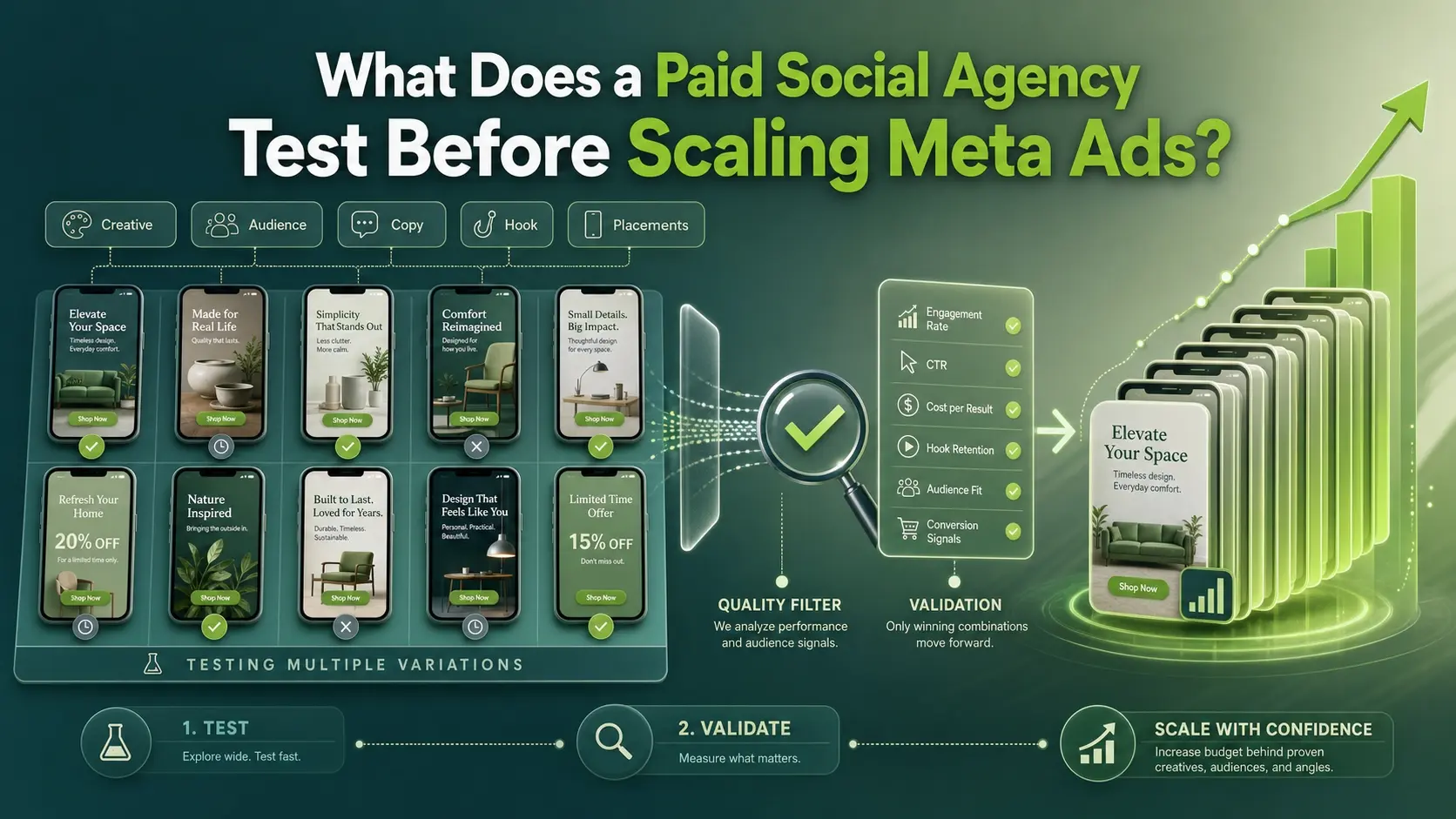
Scaling Meta Ads works best when growth is the result of proof, not pressure. A paid social agency tests the full system behind performance so increases in spend do not break efficiency, reporting, or customer experience. The goal is stable delivery, predictable results, and clean decision-making when budgets rise.
What Scaling Means In Meta Ads?
Scaling means increasing volume while protecting the outcome that matters, such as revenue, qualified leads, or booked appointments. It also means keeping performance stable as delivery expands into new pockets of an audience and the algorithm learns at higher spend levels.
A competent agency defines scaling targets in advance so the account does not drift into vanity metrics. The team aligns on the primary conversion event, the acceptable cost range, and the time window used to judge changes.
Measurement And Tracking Readiness
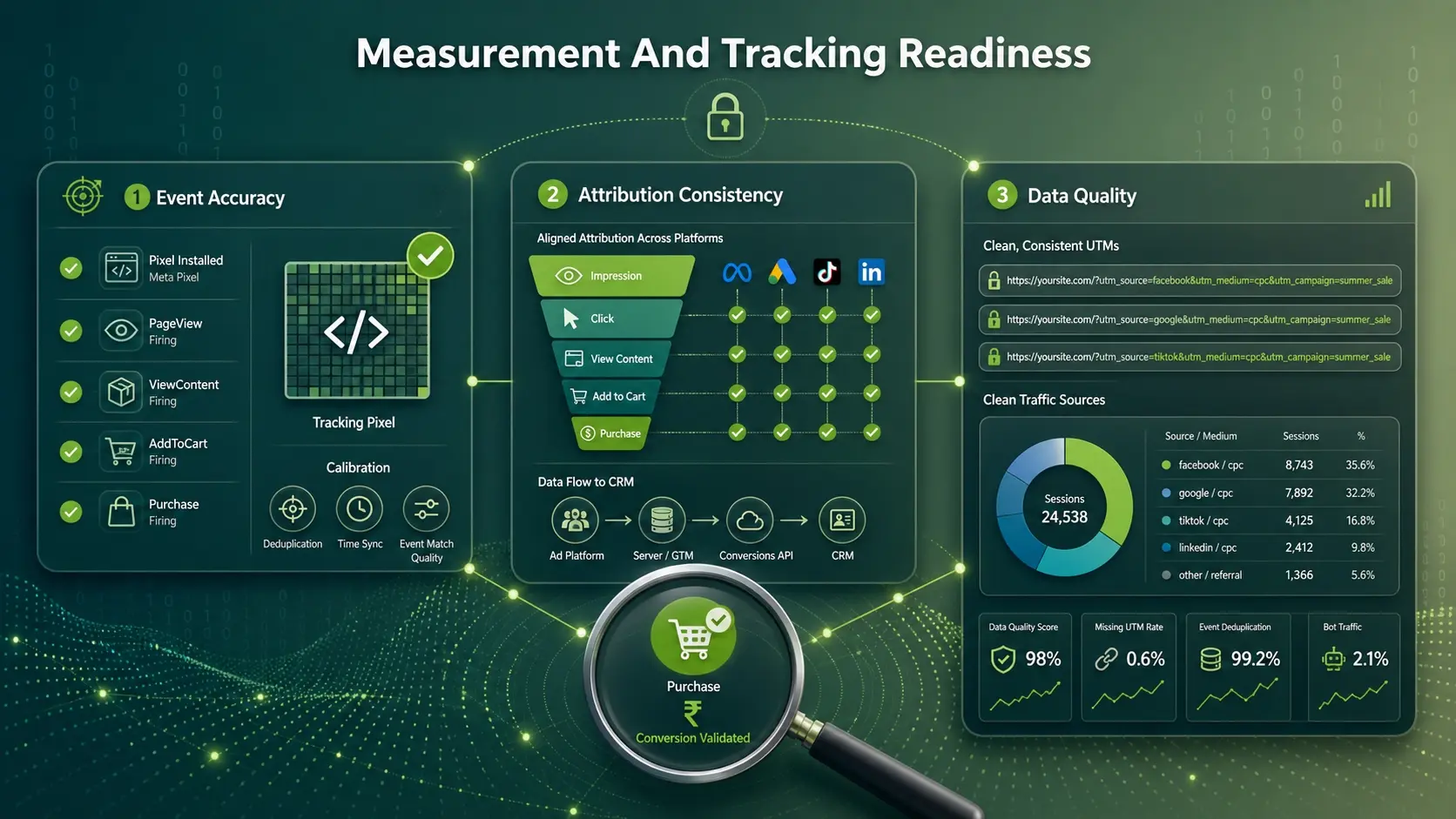 Before adding spend, agencies validate that reporting reflects reality. If tracking is incomplete, scaling can hide waste because the account appears to perform better or worse than it truly does.
This stage typically includes Pixel and Conversions API alignment, domain verification, aggregated event measurement setup, and consistent naming conventions. It also includes checks for duplicated events, missing parameters, and misattribution caused by redirects or payment processors.
- Event accuracy: Confirm that key events fire once, at the right time, with correct values and currency.
- Attribution consistency: Align platform attribution settings with the buying cycle and internal reporting needs.
- Data quality: Validate UTM hygiene and ensure analytics and CRM fields map cleanly to paid traffic.
- Conversion prioritization: Make sure the optimized event reflects business value, not just volume.
Once measurement is trustworthy, scaling decisions become less emotional and more repeatable.
Offer And Funnel Stability
Meta Ads cannot scale an offer that does not convert. Agencies test the offer structure, the landing page, and the on-site flow to confirm that increased traffic will not collapse conversion rate.
This includes checking page speed, mobile usability, form friction, inventory or appointment availability, and post-click tracking. It also includes reviewing how the offer is presented so the message in the ad matches the message on the page.
- Message match: Keep the promise in the ad consistent with the headline, visuals, and call to action on the landing page.
- Conversion friction: Reduce unnecessary fields, unclear pricing, and distracting navigation.
- Capacity checks: Ensure sales teams, clinics, or customer support can handle higher lead volume without response delays.
With funnel stability confirmed, scaling becomes an operational decision, not just a media decision.
Creative Testing That Predicts Scale
Creative is the primary lever in Meta Ads. A paid social agency tests creative angles and formats to find patterns that remain strong when frequency rises and audiences expand.
Testing covers concept, hook, visual style, copy length, and call to action, while keeping the learning environment clean. Agencies also review whether the creative can be produced consistently so the account does not run out of fresh assets during growth.
- Concept themes: Identify the top few messaging angles that earn efficient conversions across placements.
- Format coverage: Test short video, static, carousel, and native placement variations for feed and Reels.
- Iteration velocity: Confirm the team can ship new variants weekly without quality dropping.
- Fatigue thresholds: Monitor frequency and declining click and conversion rates to time refreshes.
Strong creative testing produces scalable winners and a clear pipeline of next iterations.
Audience And Targeting Validation
Scaling requires enough addressable demand. Agencies test whether results come from a narrow pocket of users or from a broader audience that can support higher budgets.
This usually includes comparing broad targeting, interest clusters, lookalike models, and retargeting pools. Agencies also test exclusions to prevent overlap and reduce self-competition across ad sets.
- Broad stability: Validate whether broad or Advantage targeting can hold efficiency as spend increases.
- Lookalike quality: Check whether seed events are high-intent and large enough to produce reliable models.
- Retargeting health: Ensure retargeting size is sufficient and not starved by tight windows.
- Overlap control: Reduce audience collisions that inflate costs and complicate learning.
When audiences are validated, budget increases are less likely to force the account into inefficient inventory.
Bidding And Budget Strategy
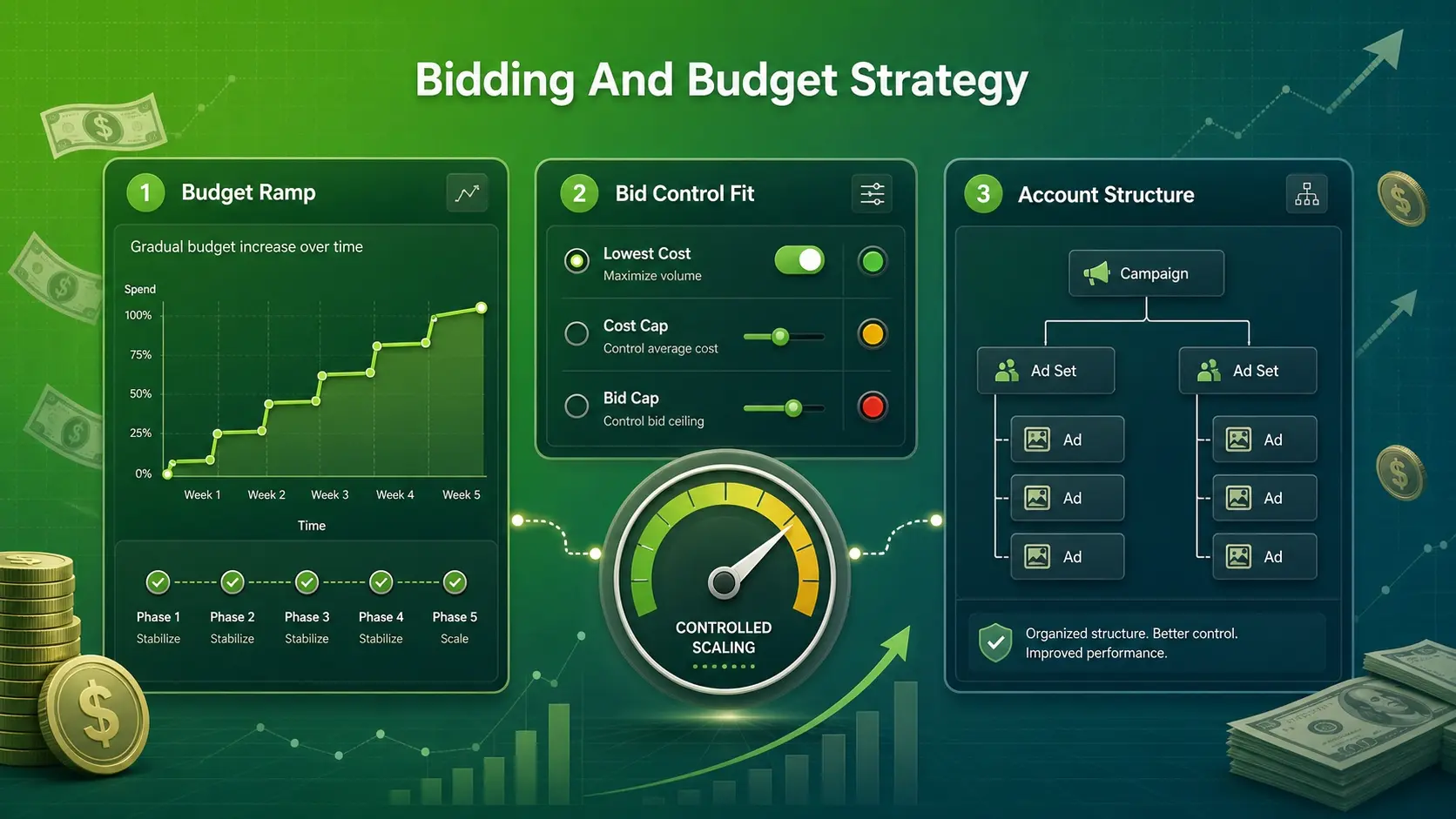 An agency tests how the account behaves under different controls. Some accounts scale best with lowest cost and stable structure, while others need cost caps or bid caps to protect margins.
Budget strategy is also about pacing. Agencies test daily budgets, campaign budget optimization, and spending limits to avoid sharp shocks that reset learning or spike costs.
- Budget ramp rate: Increase spend gradually enough to keep delivery stable and avoid sudden efficiency loss.
- Bid control fit: Validate whether cost cap protects results or restricts volume too aggressively.
- Account structure: Keep campaigns organized so each objective has enough data without fragmentation.
With a clear budget and bidding plan, scaling becomes controlled and measurable.
Placement And Device Performance
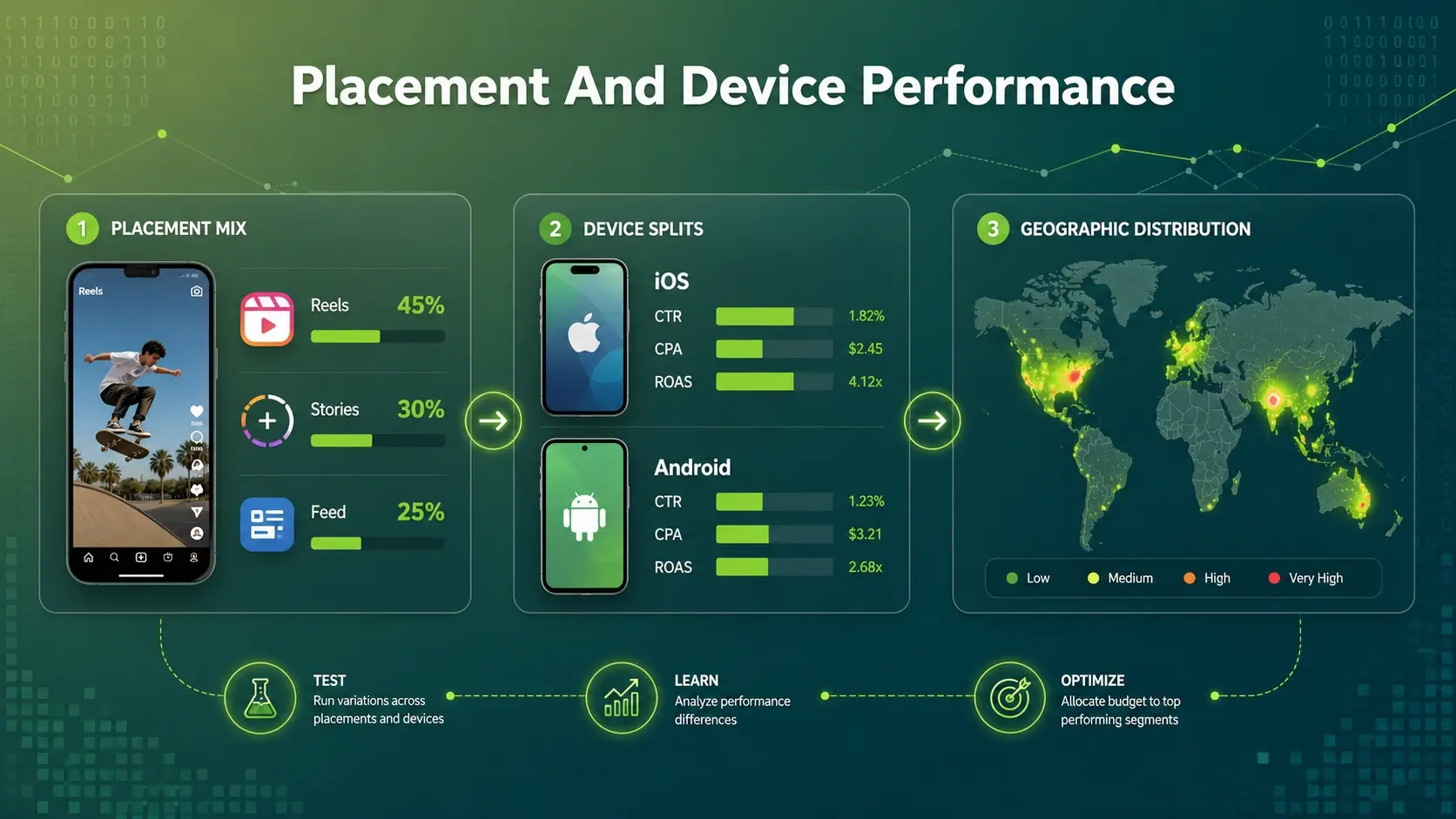 Meta delivery changes as spend rises. A paid social agency tests placements and devices to prevent scale from pushing spend into weak inventory.
This includes evaluating Advantage placements versus selective placements, plus performance by device, region, and age bands where relevant. The purpose is to find where conversion efficiency holds and where it drops.
- Placement mix: Confirm whether Reels, Stories, and feed can all contribute efficiently at higher spend.
- Device splits: Identify any gaps between iOS and Android performance that affect reporting and costs.
- Geographic distribution: Ensure expansion does not dilute quality if the business serves specific areas.
These checks reduce surprises when budgets force delivery into new segments.
Key Tests And What They Protect
A good testing plan connects each test to the risk it prevents. That keeps the account from chasing superficial lifts that disappear at scale.
| Test Area | What Gets Verified | What It Protects During Scale |
|---|---|---|
| Tracking And Attribution | Pixel and Conversions API match, clean event values, consistent UTMs | Reliable reporting and correct optimization signals |
| Creative Performance | Winning concepts across formats, fatigue limits, refresh cadence | Stable CPA and reduced efficiency drop as frequency rises |
| Audience Depth | Broad and lookalike viability, retargeting pool health, overlap control | Enough demand to absorb higher spend without cost spikes |
| Budget And Bidding | Ramp rate, CBO behavior, cost cap constraints, pacing stability | Predictable spend and fewer learning disruptions |
This framework helps stakeholders understand why testing is not delay, it is insurance.
Quality Control And Account Governance
Scaling often increases complexity. Agencies test governance so the account stays clean when more campaigns, creatives, and audiences are introduced.
This includes naming standards, change logs, clear roles, and rules for when to pause, duplicate, or consolidate. It also includes review routines for comments, brand safety, and ad approvals to avoid interruptions.
- Change management: Keep a documented record of edits so performance swings can be traced to specific actions.
- Creative QA: Check rendering across placements and ensure the call to action remains clear on mobile.
- Policy resilience: Reduce disapprovals by validating claims, formatting, and landing page consistency.
Governance reduces chaos and keeps learning signals intact as activity increases.
How A Paid Social Agency Uses Results To Decide Scaling?
Testing is only useful when it leads to a repeatable decision. Agencies set pass fail criteria that tie to business outcomes, not isolated ad metrics.
Common criteria include stable conversion rate on the landing page, acceptable cost per acquisition, and healthy incrementality signals from blended results. Agencies also check whether sales quality holds when volume increases.
- Confirm signal integrity: Verify conversion events, value tracking, and attribution settings are stable across recent changes.
- Pick a scalable winner: Select the creative and audience combination that performs best with enough delivery volume.
- Set guardrails: Define the maximum acceptable cost and the minimum volume that justifies continued spend.
- Increase budget gradually: Ramp spend in controlled increments while monitoring volatility and frequency.
- Refresh and expand: Introduce new creative variants and audience layers to maintain efficiency at higher spend.
This approach prevents scaling from becoming a gamble based on a short-lived spike.
Working With A Partner For Meta Ads Growth
Businesses often reach a point where internal teams can launch campaigns but struggle to build a durable testing engine. That is where a paid social agency adds leverage through structured experimentation, creative direction, and measurement discipline.
Imili Corp supports Meta Ads growth by aligning tracking, creative strategy, and performance management around business goals. This kind of support is most useful when the priority is scaling with clarity rather than chasing short-term volume.
Conclusion
A paid social agency tests tracking, funnel readiness, creative durability, audience depth, and budget controls before scaling Meta Ads. These checks protect efficiency and keep reporting trustworthy when spend increases.
When the system is proven end to end, scaling becomes a controlled process with clear guardrails. That is how growth stays profitable and predictable rather than volatile.
Frequently Asked Questions
How Long Should Testing Run Before Scaling Meta Ads?
Testing should run long enough to capture consistent conversion data and reduce day-to-day volatility. Many teams use at least one full learning cycle per key change and evaluate performance across multiple days, not single-day spikes.
What Metrics Matter Most When Deciding To Scale?
Cost per acquisition and conversion rate are primary, but they must be paired with lead or customer quality. Agencies also monitor frequency, CPM, and the stability of tracked conversion values to avoid scaling into hidden inefficiency.
Can You Scale Meta Ads Without Creating New Creatives?
Limited scaling is possible, but performance often decays as frequency rises and audiences saturate. A reliable creative pipeline makes scaling more sustainable because it reduces fatigue and keeps the algorithm learning from fresh inputs.