
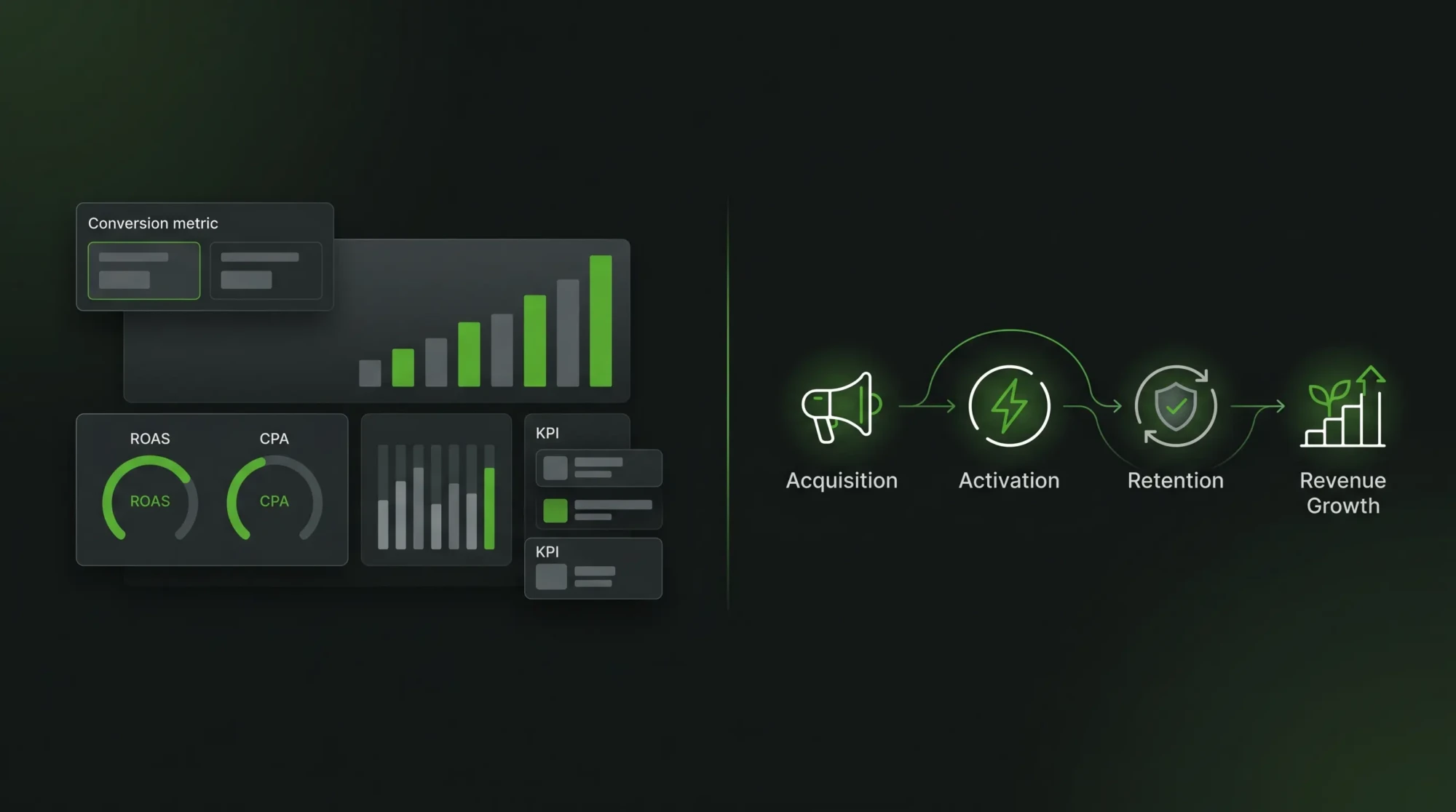
Choosing between a performance marketing agency and a growth marketing agency affects what gets measured, what gets prioritized, and how fast results compound. Both can drive customer acquisition, but they do it through different operating models and success definitions.
This guide breaks down performance marketing vs growth marketing so you can match the right partner to your goals, budget, and internal capabilities. You will also learn what to ask before signing a contract so marketing ROI stays clear and defendable.
Performance Marketing Agency vs Growth Marketing Agency: Which Should You Choose? performance marketing agency
Performance Marketing Agency Fundamentals

A performance marketing agency is built around measurable actions tied to spend. The agency typically optimizes channels where attribution is clearer, reporting is frequent, and ROI-focused marketing decisions can be made quickly.
Most performance teams live close to platform data and conversion events. They improve outcomes by tightening targeting, refining creative, and adjusting bids, budgets, and landing pages to increase return.
What Performance Teams Optimize Daily
Performance marketing is often easiest to spot in the rhythm of work. The focus is on short feedback loops and continuous testing tied to a defined conversion.
- Media efficiency: Spend shifts toward the best performing audiences and placements to protect marketing ROI.
- Conversion rate: Landing page and checkout improvements increase the percentage of visitors who complete the target action.
- Creative performance: New angles, formats, and offers are tested to reduce fatigue and improve response.
- Attribution and tracking: Pixels, events, and server-side signals are maintained to keep reporting reliable.
When the conversion is clear and the data is clean, this model can scale efficiently.
Growth Marketing Agency Fundamentals
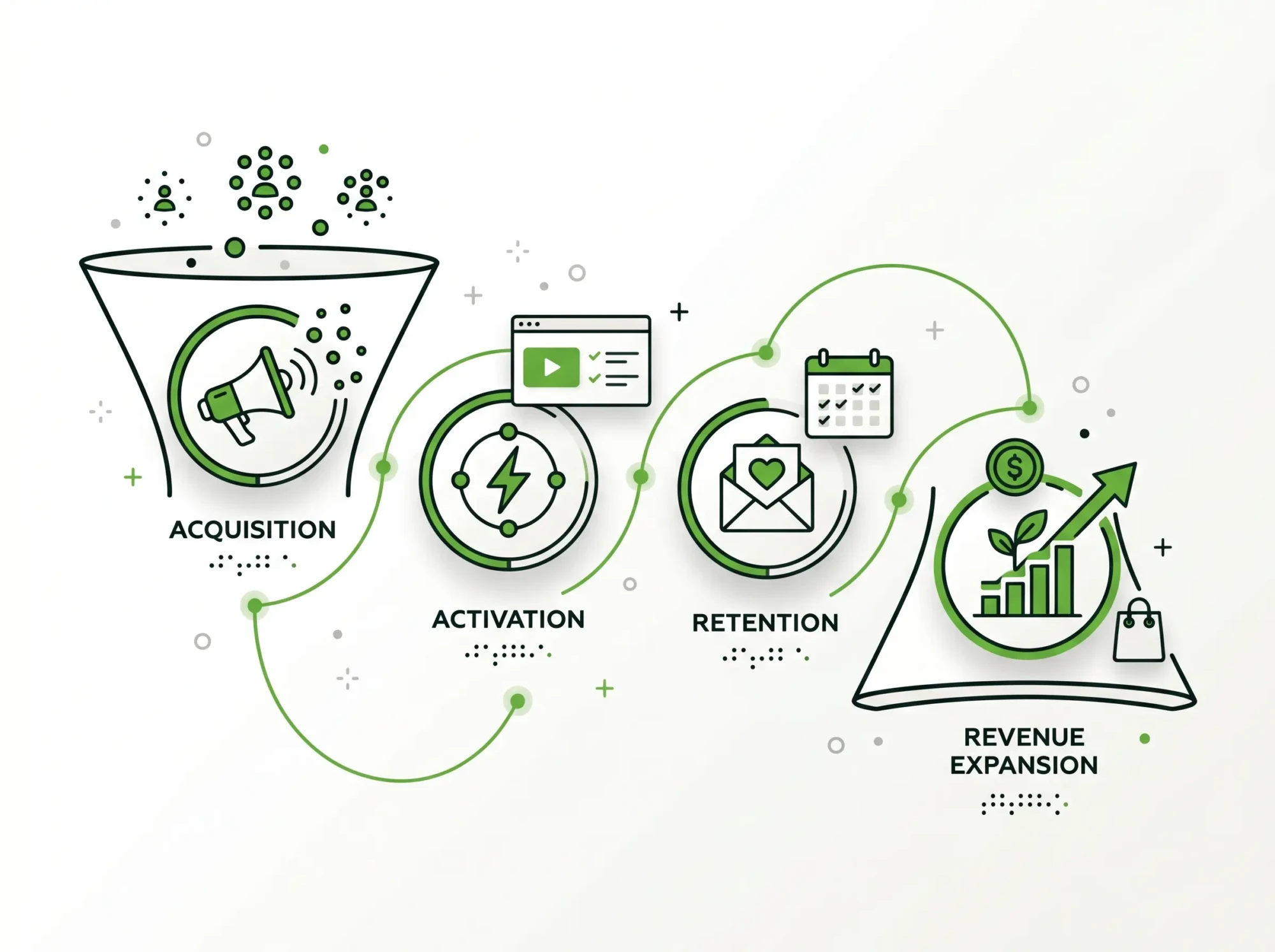
A growth marketing agency is designed to improve the entire customer journey, not just the point of conversion. It connects acquisition with activation, retention, and monetization through a full-funnel growth strategy.
Growth teams usually combine channel execution with product-aware experimentation. They work across lifecycle messaging, onboarding, pricing, referral loops, and analytics so improvements stack over time.
What Growth Teams Work On Across The Funnel
Growth marketing extends beyond paid media efficiency into how customers experience the brand after the click. It often involves deeper coordination with product, sales, and customer success.
- Acquisition: Channel mix, positioning, and demand creation that feeds sustainable customer acquisition.
- Activation: Onboarding flows and first value moments that reduce drop-off.
- Retention: Lifecycle messaging, customer education, and habit loops that lower churn.
- Revenue expansion: Packaging, upsell paths, and win-back programs that lift lifetime value.
This approach shines when the biggest constraints are after the first conversion, not before it.
Performance Marketing Vs Growth Marketing In Plain Terms
The simplest distinction is scope. A performance marketing agency is narrower and deeper in paid acquisition and conversion, while a growth marketing agency is broader and deeper across the funnel.
Neither approach is automatically better. The right choice depends on what is currently limiting marketing ROI and how quickly you need to prove impact.
| Decision Factor | Performance Marketing Agency | Growth Marketing Agency |
|---|---|---|
| Primary Goal | Efficient conversions and ROI-focused marketing | Full-funnel growth strategy and compounding gains |
| Typical Metrics | CPA, ROAS, conversion rate, lead quality signals | Activation rate, retention, LTV, funnel velocity, CAC payback |
| Best Fit | Clear offer, trackable events, stable demand | Multiple funnel drop-offs, retention issues, pricing or onboarding friction |
| Core Capabilities | Paid media operations, creative testing, landing page optimization | Experiment design, lifecycle programs, analytics instrumentation |
ROI Focused Marketing And How Each Agency Proves Value
ROI-focused marketing is not only about reporting a number. It is about proving that the number is trustworthy and tied to business outcomes you can defend in leadership reviews.
A performance marketing agency often proves value faster because the measurement window is shorter. A growth marketing agency may take longer to show full impact, but it can deliver larger lifts by improving conversion, retention, and revenue per customer together.
Attribution Expectations And Reporting Cadence
Performance marketing relies heavily on platform signals and conversion tracking. Growth marketing relies more on shared analytics, cohort views, and multi-touch thinking, even when last-click data looks strong.
Both models can fail if tracking is weak or goals are vague. Clarify definitions for conversion, qualified leads, and revenue attribution before work begins.
Customer Acquisition Differences That Matter
Customer acquisition is the headline promise for many teams, but acquisition quality often decides whether ROI holds. A performance marketing agency tends to optimize for lower acquisition costs, while a growth marketing agency tends to optimize for customers who stay and expand.
If your pipeline looks good but customers churn quickly, cheaper acquisition does not solve the core problem. In that case, full-funnel growth strategy work can improve downstream value and make acquisition scalable.
Where Acquisition Breaks First
Most acquisition problems come from a small set of root causes. Knowing where the break is helps you choose the right agency style.
- Message to market mismatch: Ads reach people, but the promise does not match their urgency or expectations.
- Offer friction: Pricing, packaging, or required commitments block conversion even with strong traffic.
- Low intent traffic: Volume rises but lead quality drops, hurting sales efficiency and true marketing ROI.
- Weak post-click experience: Pages load slowly, forms are long, or trust signals are missing.
When the issue is mostly top-of-funnel mechanics, performance marketing usually wins. When the issue sits across the funnel, growth marketing is often the better lever.
Full Funnel Growth Strategy And The Operating Model
A full-funnel growth strategy requires more than channel skill. It needs a cadence for hypothesis creation, prioritization, testing, and learning that is shared with your internal team.
This is where many partnerships succeed or fail. Growth marketing needs access to data, product inputs, and the ability to deploy changes across web, email, in-app, or sales workflows.
What To Expect In A Growth Experiment Program
Healthy growth programs keep the process simple and consistent. They prioritize learning velocity and statistical discipline without getting lost in dashboards.
- Define the north star. Choose one primary outcome metric and a short list of supporting metrics to prevent conflicting optimizations.
- Instrument tracking. Ensure events, UTMs, CRM stages, and revenue mapping align so insights are actionable.
- Prioritize tests. Rank ideas by expected impact, confidence, and effort to keep the roadmap focused.
- Run and review. Launch controlled experiments, document results, and convert winners into standard operating practice.
This operating model can coexist with performance media buying, but it requires cross-functional access and speed.
How To Choose The Right Agency For Your Current Stage
Your stage is less about company size and more about constraints. If you can already convert traffic efficiently, the next gains may come from improving retention, monetization, and funnel handoffs.
If you have product-market fit and a clear offer but need consistent lead flow now, a performance marketing agency can be the most direct path to scale.
Signals A Performance Marketing Agency Is The Better Fit

These signs usually point to a need for stronger paid acquisition execution and conversion optimization. They also suggest attribution can be made reasonably clean.
- Clear conversion event: Purchases, booked calls, or qualified lead submissions are well defined.
- Stable unit economics: Margins and close rates are predictable enough to set a target CPA or ROAS.
- Fast feedback cycles: You can see performance changes within days or a couple of weeks.
- Creative and landing pages available: You can produce and iterate quickly to avoid ad fatigue.
In this scenario, performance marketing vs growth marketing is mainly a question of urgency and scope.
Signals A Growth Marketing Agency Is The Better Fit
These signs point to a multi-variable funnel where fixing acquisition alone will not unlock durable marketing ROI. Growth teams can isolate bottlenecks and build compounding improvements.
- Retention limits growth: Churn, repeat purchase rate, or renewals are the biggest constraints.
- Activation is weak: New users sign up but do not reach the first value moment consistently.
- Sales handoff is messy: Lead quality disputes and slow follow-up reduce conversion downstream.
- LTV is underdeveloped: Monetization paths, packaging, or lifecycle programs are not optimized.
When these are true, a full-funnel growth strategy tends to outperform pure acquisition optimization.
Questions To Ask Before You Sign
Agency labels can be misleading, so focus on specifics. The goal is to confirm that the partner can run the work and measure it in a way that protects trust.
Ask questions that reveal process maturity, data discipline, and how decisions get made under uncertainty.
- What is your primary success metric definition? Ensure both sides agree on what counts as a win and what gets ignored.
- How do you handle tracking and attribution? Look for comfort with first-party data, CRM reconciliation, and clear reporting logic.
- What levers will you own? Clarify ownership across ads, creative, landing pages, email, analytics, and CRO.
- How do you prevent conflicting optimizations? The answer should connect channel metrics to business outcomes like revenue and payback.
- What does your testing cadence look like? You want a repeatable loop of planning, execution, and documented learning.
These questions help you choose a performance marketing agency or growth marketing agency based on behavior, not branding.
Conclusion
A performance marketing agency is the right choice when you need efficient acquisition with clear tracking, tight optimization, and quick proof of marketing ROI. A growth marketing agency is the right choice when the biggest gains come from improving the full customer journey through a full-funnel growth strategy.
Choose the model that matches your bottleneck, your data readiness, and your ability to implement changes. When those align, performance marketing vs growth marketing becomes less of a debate and more of a strategic fit.