

Scaling a paid campaign too early can turn a profitable account into a volatile one. Scaling too late can leave growth on the table while competitors buy the same attention more aggressively. The safest path is to raise budgets only when performance is stable, tracking is trustworthy, and your funnel can absorb more volume without breaking.
What Scaling Really Means in Paid Media

Scaling is not only increasing daily spend. It is increasing spend while protecting efficiency metrics such as cost per acquisition, return on ad spend, and lead quality. The goal is predictable growth, not a temporary spike followed by fatigue and wasted spend.
Scaling can change where and how a campaign delivers. A larger budget may allow the platform to capture more eligible demand, reach additional audience segments, or distribute spend differently across auctions and placements. As spend rises, monitor whether the additional volume continues to meet your efficiency and customer-quality targets.
Sign One Tracking and Attribution are Reliable
If tracking is inconsistent, scaling multiplies bad decisions. You need confidence that conversions, revenue, and key events are being captured accurately across devices and browsers. Offline conversion imports and CRM matching should also be tested if sales happen outside the platform.
Look for consistent event definitions, reliable tag firing, and explainable differences between ad-platform, analytics, CRM, and backend reporting. The goal is not necessarily identical counts across every system; it is a measurement setup where material discrepancies can be reconciled and understood before additional budget is committed.
Before scaling, a marketing attribution audit can help verify conversion definitions, deduplication, attribution windows, CRM integration, and backend reconciliation so budget decisions are based on dependable data.
Sign Two You Have A Clear Primary KPI and A Backup KPI
A campaign is ready to scale when success is defined in one measurable outcome. That primary KPI should align with business value, not vanity engagement. A backup KPI helps you diagnose issues quickly when performance changes after a budget increase.
Primary KPIs should represent meaningful business outcomes such as qualified leads, purchases, booked appointments, contribution-generating revenue, or acquired customers. Supporting metrics such as click-through rate, cost per click, landing-page conversion rate, and lead-to-customer rate are useful for diagnosis, but they should not replace the business outcome used to judge whether additional spend is actually working.
Sign Three Results are Stable Over A Meaningful Time Window
Scaling on a single good day is a common mistake. You want consistency across enough time to smooth out weekday patterns, audience cycles, and platform learning. Stability matters more than a single peak.
Use a review window long enough to capture normal demand patterns and the typical conversion delay for your business. A fast ecommerce account may produce useful evidence quickly, while a B2B campaign with a long sales cycle may require a longer cohort or CRM-based view. The important point is that performance remains within acceptable ranges without constant emergency intervention.
Also distinguish average performance from marginal performance. A campaign can show an attractive historical CPA or ROAS while the next layer of spend produces more expensive or lower-quality conversions, so scaling decisions should focus on what additional budget is likely to return.
Sign Four Your Bidding Strategy Has Reliable Conversion Signals
Automated bidding works best when the conversion signals it receives are accurate, relevant, and timely, but there is no single conversion-volume threshold that applies to every platform, campaign type, or bidding strategy. Evaluate whether the system is receiving enough recent, high-quality information to optimize toward the outcome you actually value.
For example, Google states that Target CPA bidding can be used without prior conversion history, which is why a universal minimum-conversion rule should not be applied across every campaign.
If signal quality is weak, first check for fragmented campaign structure, duplicate or low-value conversion actions, long conversion delays, and inconsistent tracking. Consolidating unnecessary fragmentation can help, but do not automatically switch optimization to a higher-funnel event unless that event has been validated as a useful predictor of the business outcome you ultimately want.
Sign Five Your Funnel Can Handle Higher Demand
More clicks and leads only create value if the business can handle the additional demand. Limited sales capacity, slow follow-up, inventory shortages, booking constraints, or onboarding delays can reduce close rates or customer experience even when front-end advertising metrics remain strong.
Check response times, follow up sequences, and availability. Ensure landing pages load fast under higher traffic and that forms, chat, and checkout flows do not break at higher volume. Operations readiness is a scaling requirement.
Sign Six You Have Creative and Offer Depth
Higher spend can increase frequency, expand delivery, or expose your creative to a broader mix of users depending on the platform and campaign setup. That can make creative performance less predictable over time. A campaign is better prepared for scale when it has additional tested concepts, formats, or variations available instead of relying entirely on one asset.
Creative depth also includes offer clarity. Your value proposition, pricing structure, and incentives should be easy to understand and strong enough to compete as auction costs rise. If the offer is weak, bigger budgets only amplify inefficiency.
- More Than One Viable Creative Route: Performance is not dependent on a single ad, message, or format, and additional tested variations are available when delivery shifts.
- Fresh Assets Ready: New variations are queued so you can rotate before fatigue damages efficiency.
- Consistent Messaging: Ads, landing pages, and follow up content use the same promise and language.
Once creative depth is in place, budget increases become less risky because performance is not tied to one fragile variable.
Sign Seven the Campaign is Not Limited By Avoidable Friction

Before scaling, remove issues that inflate costs and restrict delivery. These include slow pages, unclear forms, poor mobile experience, overly narrow targeting, and disapproved assets. Fixing friction often unlocks more volume at the same efficiency.
In paid search, review the search terms report before scaling as well. Additional budget can magnify irrelevant query spend if weak search intent has not been identified and controlled first.
If broad-match traffic is contributing to that problem, our guide to broad match vs phrase match for lead generation explains how match type, bidding, search-term quality, and lead outcomes should be evaluated together.
Also verify whether delivery is being constrained by budget, bid targets, search demand, targeting, policy issues, or account structure. These constraints require different fixes. Increasing budget will not solve a campaign that is primarily limited by weak query quality, restrictive bid targets, poor landing-page relevance, or insufficient eligible demand.
For Google Search campaigns, Search Impression Share can help separate budget-driven lost visibility from rank-driven losses before you decide that more spend is the correct solution.
Sign Eight You Have A Controlled Budget Increase Plan
Scaling should be planned and measured. Budget changes can alter delivery patterns, auction participation, and the mix of users reached, while the exact effect on automated bidding depends on the platform and strategy. Make major changes in a way that lets you identify whether the budget increase itself changed performance.
Google Ads also changed the behavior of budget-constrained target-based strategies in August 2026. For eligible Target CPA and Target ROAS campaigns that are limited by budget, Google now aims to deliver more consistently toward the stated target as budgets change. Google recommends evaluating performance for about one to two conversion cycles after a budget increase rather than judging the change immediately.
A strong plan includes a schedule, thresholds, and clear actions if metrics drift. It also defines when to pause increases, when to hold steady, and when to roll back.
- Set Guardrails: Define acceptable ranges for CPA, ROAS, lead quality, and conversion rate before increasing budgets.
- Change Budget Deliberately: Size the increase according to the platform, bidding strategy, available demand, and your economics. Avoid stacking several major campaign changes together, and allow enough time for conversion lag and bidding response before judging the result.
- Monitor Platform and Business Outcomes: Track platform CPA or ROAS alongside qualified-lead rate, close rate, acquired-customer cost, revenue quality, contribution margin, or other downstream metrics relevant to the business.
- Document Changes: Record budget shifts, creative swaps, and landing page updates so performance shifts are traceable.
- Know Your Rollback Point: Decide in advance what triggers a pause or reduction to protect profitability.
This process keeps scale predictable and reduces wasted spend during volatility.
Quick Scale Readiness Scorecard
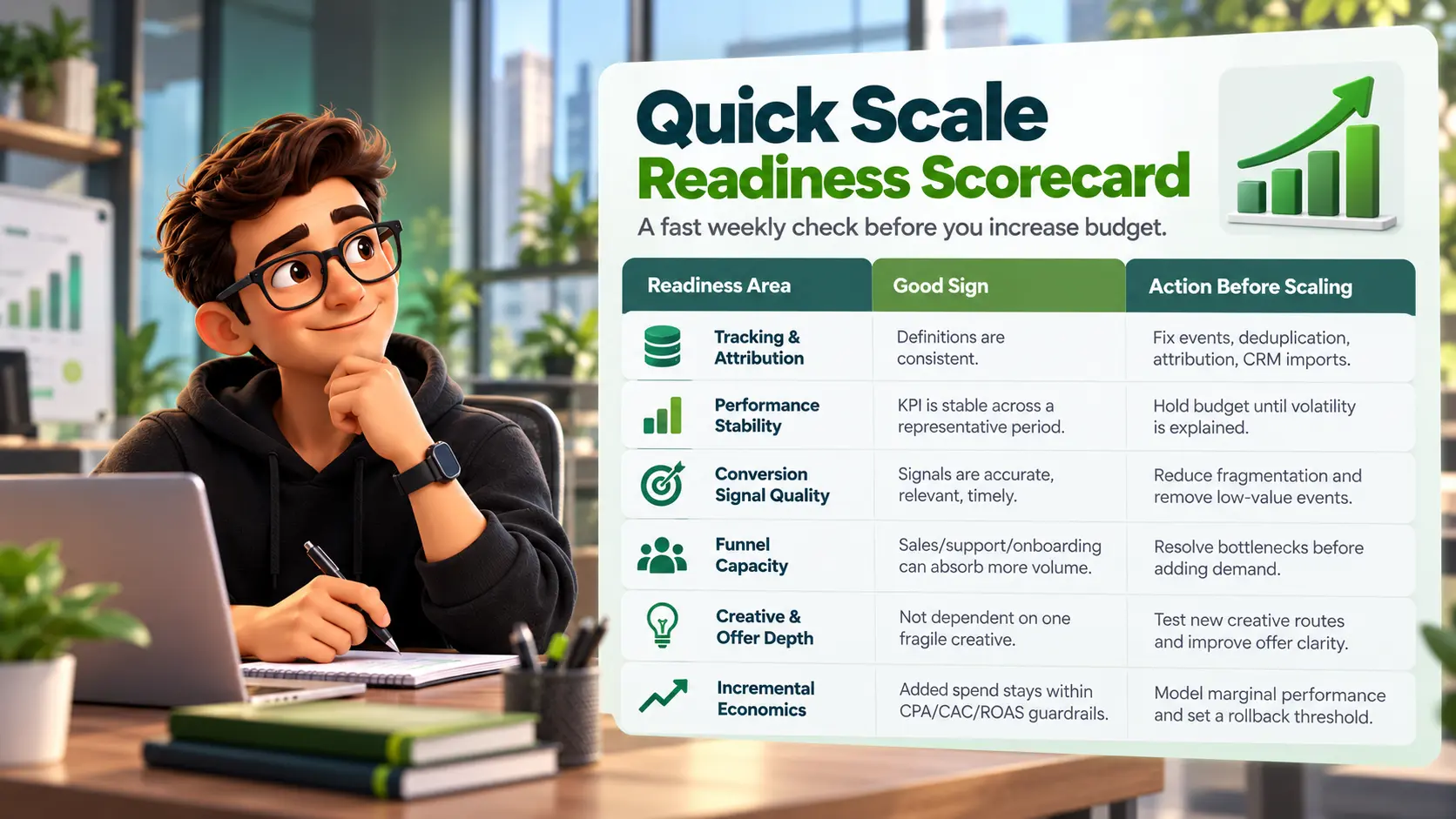
If you want a fast check before increasing budget, use the table below. It helps you separate readiness signals from warning signs and choose a safe action. Use it as a weekly review tool when you are preparing for growth.
| Readiness Area | Good Sign | Action Before Scaling |
|---|---|---|
| Tracking and Attribution | Conversion definitions are consistent and reporting differences can be explained | Fix broken events, deduplication, attribution settings, or CRM imports before increasing spend |
| Performance Stability | Primary business KPI stays within an acceptable range across a representative period and conversion lag | Hold budget steady until volatility has a clear explanation |
| Conversion Signal Quality | The bidding strategy receives accurate, relevant, and timely primary conversion signals | Reduce fragmentation and remove misleading or low-value optimization events |
| Funnel Capacity | Sales, inventory, booking, support, and onboarding can absorb additional volume | Resolve operational bottlenecks before generating substantially more demand |
| Creative and Offer Depth | Performance is not dependent on one fragile creative or unclear offer | Prepare and test additional creative routes and improve offer clarity |
| Incremental Economics | Additional spend is expected to remain within acceptable CPA, CAC, ROAS, or margin guardrails | Model marginal performance and define a rollback threshold before increasing budget |
How Imili Corp Supports Safe Scaling?
Scaling requires more than raising a number inside an ad platform. Measurement, bidding structure, creative testing, landing-page performance, and downstream lead or revenue quality all affect whether additional spend remains efficient.
Imili Corp provides paid search, paid social, performance-marketing, and analytics services that can support this process. For teams preparing to scale, the useful work is identifying measurement gaps, account constraints, creative dependencies, and funnel bottlenecks before those weaknesses are amplified by a larger budget.
Conclusion
A paid campaign is ready to scale when measurement is dependable, the business outcome is clearly defined, performance has been stable across a representative period, and the bidding strategy is receiving reliable conversion signals. The funnel also needs enough operational capacity, creative coverage, and economic headroom to absorb incremental demand.
Use the eight signs as a pre-scaling checklist, but treat the budget increase as a controlled business decision rather than a platform-only optimization. Define your guardrails and rollback point in advance, then evaluate the additional spend against both platform performance and downstream customer outcomes.
Frequently Asked Questions
How Fast should I Increase Budgets When Scaling Paid Ads?
There is no universal percentage or number of days that fits every campaign. Size the increase according to the platform, bidding strategy, available demand, conversion delay, and acceptable economics. Avoid combining a large budget change with several other major edits. For Google Ads target-based strategies, Google currently recommends evaluating performance for roughly one to two conversion cycles after a budget increase.
What Metrics Matter Most When Deciding to Scale a Paid Campaign?
Start with a business outcome metric such as CPA, ROAS, or qualified lead volume. Then monitor supporting metrics like conversion rate, cost per click, and lead quality signals. Downstream metrics like close rate and revenue per lead help confirm that growth is profitable.
Why Does Performance Sometimes Drop Right After Increasing the Budget?
Higher budgets can expose a campaign to additional eligible demand and change the mix of auctions, audiences, queries, or placements receiving spend. The effect depends on the campaign type and bidding strategy, so a short-term change should not automatically be interpreted as failure. Compare performance after allowing for conversion lag, then check whether incremental traffic is less qualified, auction costs changed, or another campaign setting changed at the same time.