
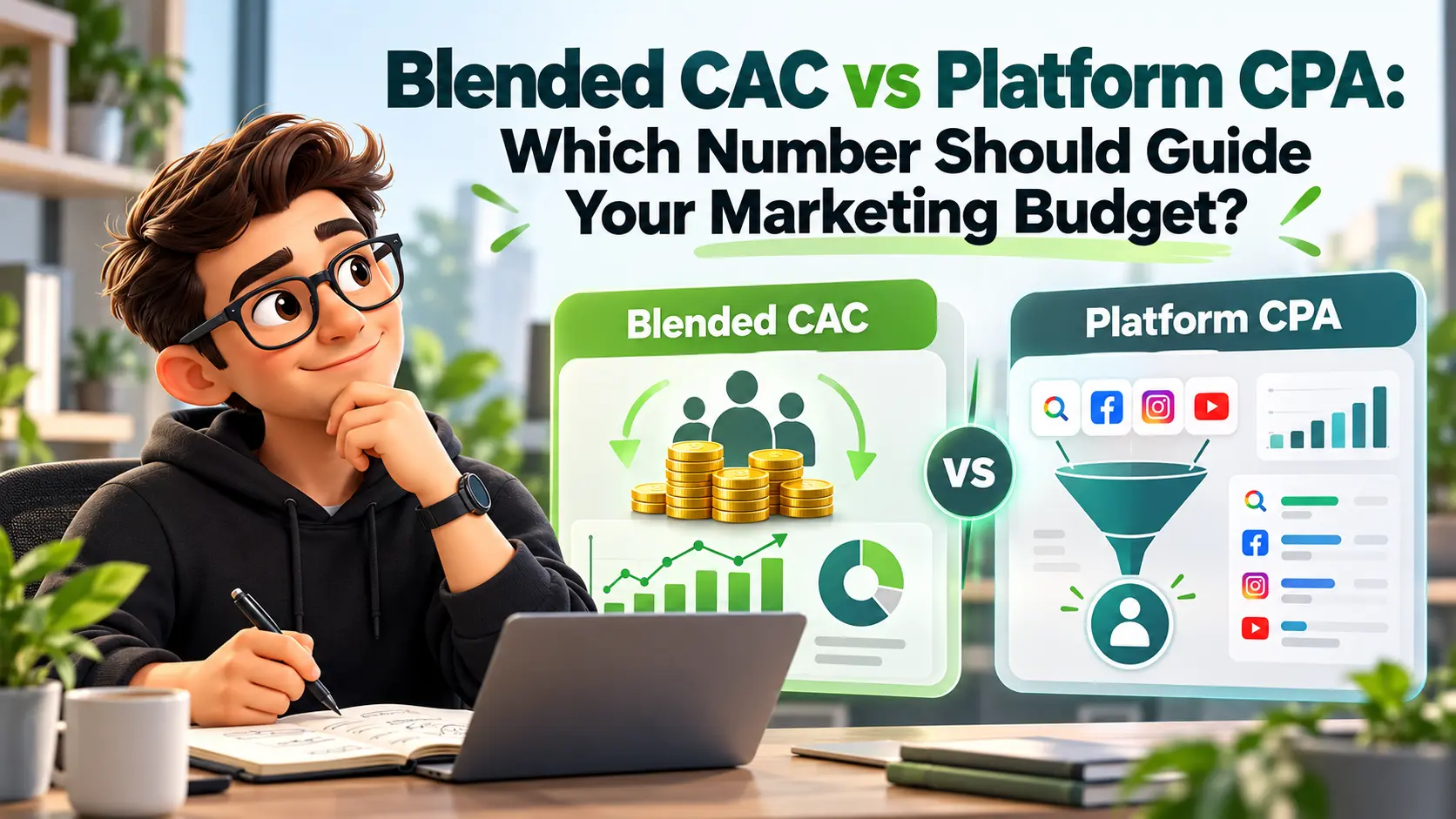
Blended CAC and platform CPA both influence how money moves across your marketing plan, but they answer different questions. Confusing them leads to overfunding channels that look efficient on paper while underinvesting in the work that actually drives new customers.
Blended CAC Meaning and What it Includes?
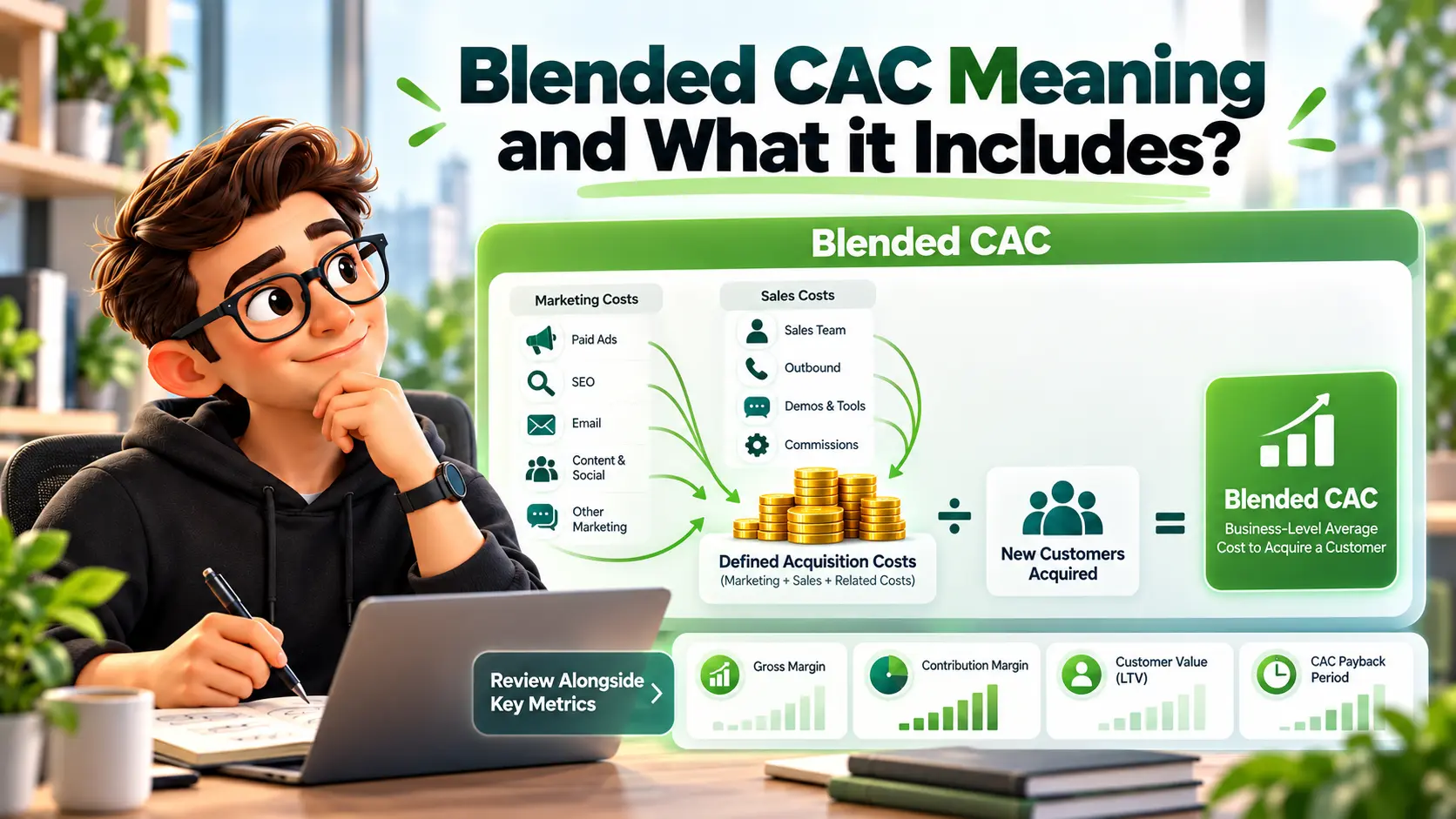
Blended CAC measures the average acquisition cost across the business rather than attributing each customer to one channel. For this article, blended CAC means the defined sales and marketing costs tied to acquiring new customers divided by the number of new customers acquired during the same measurement period.
Your CAC definition may include paid media, agency and creative costs, acquisition-focused software, and the salaries or commissions of sales and marketing teams involved in winning new customers. Shared costs should be allocated consistently, and post-acquisition support or servicing costs should not automatically be included unless your accounting definition specifically treats them as acquisition costs.
A practical formula is: Blended CAC = Defined Acquisition Costs ÷ New Customers Acquired. Use the same cost categories and time period each time you compare performance. This customer acquisition cost formula should use the same cost categories and measurement period each time you compare performance.
Because blended CAC aggregates acquisition costs across the defined scope, it provides a useful business-level view of how much the company is spending to acquire new customers. It becomes much more meaningful when reviewed alongside gross margin, contribution margin, customer value, and CAC payback.
Platform CPA Meaning and What it Measures
Platform CPA is the average cost of the conversion actions reported by a specific advertising platform. Depending on the account setup, that conversion might represent a purchase, lead, registration, signup, or another configured action, so platform CPA should not automatically be interpreted as the cost of acquiring a new customer.
At its simplest, Platform CPA = Platform Ad Cost ÷ Platform-Reported Conversions. The usefulness of that number depends heavily on what the account defines as a conversion.
Platform CPA is still useful because it is fast and directional. It tells you which ad sets, audiences, creatives, and bidding strategies are producing the lowest reported acquisition cost inside that platform.
The challenge is that platform CPA can drift away from business reality when conversions are not aligned to true customers, when attribution overcounts, or when downstream conversion rates change. That is why it should not be the sole budget compass.
Why These Metrics Often Disagree?
Disagreement is normal because the metrics sit at different layers of the funnel and use different accounting rules. One is a business metric, the other is a platform optimization metric.
- Attribution and Conversion Windows: Platform-reported conversions depend on the attribution model and the time window during which an ad interaction remains eligible for conversion credit. The applicable interaction types and windows vary by campaign and conversion setup.
- Conversion Definitions: A platform may optimize around leads, signups, trials, purchases, or other configured actions, while blended CAC should use a clearly defined new-customer count that is consistent with the business’s reporting rules.
- Cross channel effects: Brand, email, partnerships, and sales outreach can lift conversion rates, lowering blended CAC without changing platform CPA much.
- Hidden costs: Creative production, agency fees, and sales time rarely appear in platform CPA but can be material in blended CAC.
- Delay between touch and revenue: Longer sales cycles create timing gaps, especially for B2B or high consideration offers.
Once you expect divergence, you can use both numbers without forcing them to match.
For example, suppose a company records $80,000 of defined acquisition costs and 160 new customers during a quarter. Its blended CAC is $500. During that same period, one ad platform might spend $24,000 and report 200 configured conversions, producing a $120 platform CPA. The two figures are not contradictory if those platform conversions are leads or attributed actions rather than the same new-customer count used in blended CAC.
When Blended CAC Should Guide Budget
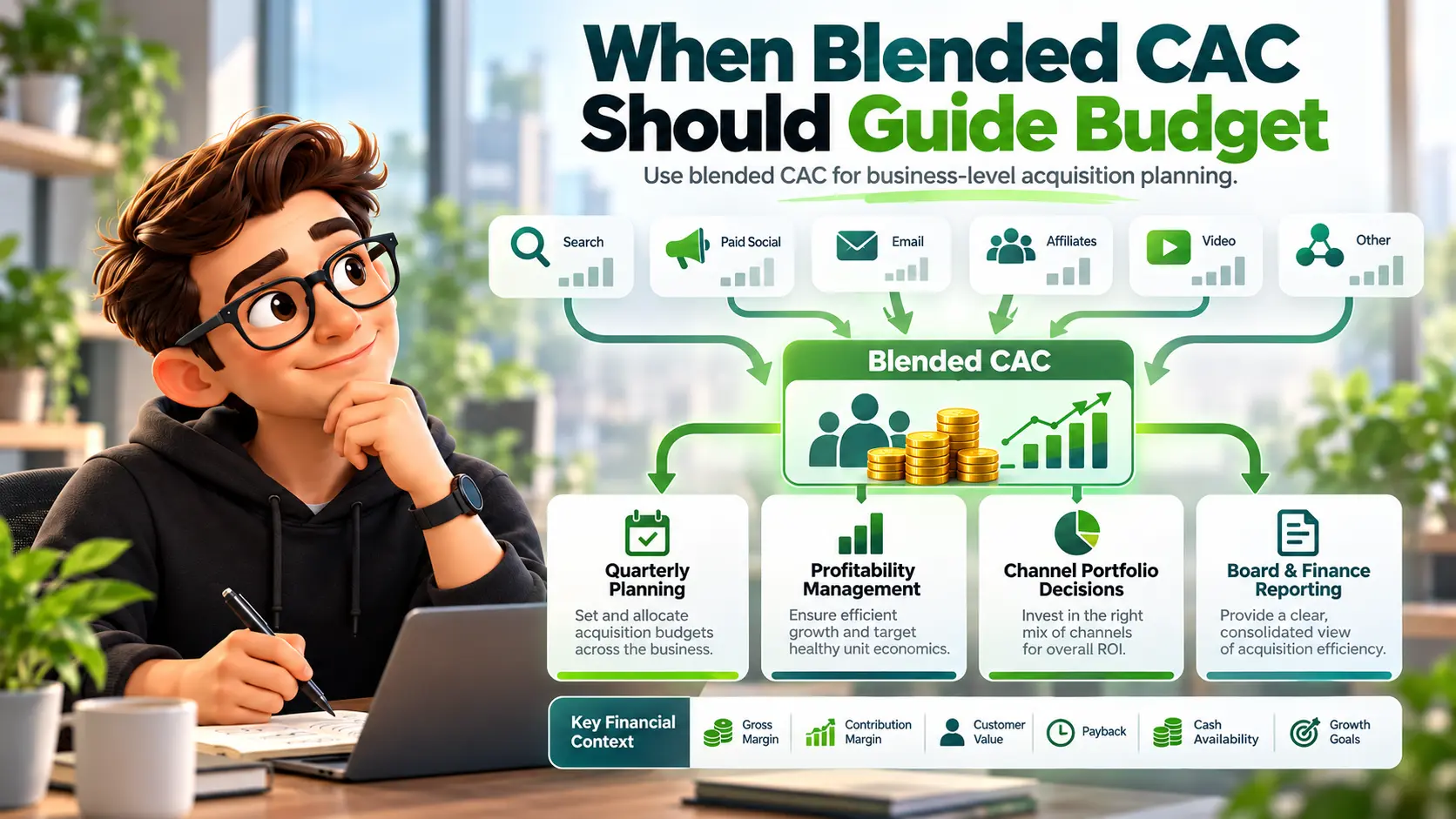
Use blended CAC as a business-level acquisition guardrail when evaluating how overall customer acquisition spending is changing. Budget capacity should still be considered alongside gross margin, contribution margin, customer value, payback period, cash availability, and growth goals rather than being determined by CAC alone.
Blended CAC is especially important when your mix includes multiple channels that interact, when sales is involved, or when you are optimizing for profitability and payback. It also becomes critical when cash constraints tighten and you need a disciplined view of acquisition efficiency.
- Quarterly planning: Set overall acquisition targets and spend ceilings based on payback and margin.
- Profitability management: Track whether total customer acquisition costs fit within your gross margin and operating model.
- Channel portfolio decisions: Decide how much to allocate to brand and demand creation that may not show up cleanly in platform reporting.
- Board and Finance Reporting: Communicate acquisition efficiency using definitions that reconcile with the company’s P&L and financial reporting.
This is where a company wide measurement approach matters, including clean conversion definitions and consistent cost capture.
When Platform CPA Is Useful for In-Platform Decisions
Platform CPA is most useful as an operational signal inside an advertising platform. It can help identify changes in reported conversion efficiency across campaigns, targeting, creative, and bidding, but it should be reconciled with lead quality, customer outcomes, and business-level acquisition economics before major budget changes.
It should guide decisions like creative iteration, audience refinement, landing page testing, and bid strategy changes. It can also be used to maintain guardrails on spend when performance deteriorates inside the platform.
- Creative testing: Compare concepts and formats to reduce acquisition costs at the ad set level.
- Audience and targeting: Shift budget toward segments that convert at lower reported costs.
For Google Search campaigns, also evaluate whether keyword coverage is changing lead quality; our guide to broad match vs phrase match explains how match type, Smart Bidding, search-term quality, and downstream lead outcomes interact. - Campaign Structure: Use a structure that makes conversion goals, budgets, targeting, and performance differences easy to diagnose without unnecessary fragmentation.
- Short term pacing: Monitor whether current efficiency supports daily and weekly spend levels.
Platform CPA provides faster tactical feedback, while blended CAC provides a broader view of acquisition economics. Neither metric should be interpreted without the conversion definitions and business context behind it.
A Practical Framework to Use Both Numbers Together
A clean budget decision uses blended CAC to set the limits and platform CPA to drive improvement within those limits. The bridge between them is a measurement layer that connects platform signals to business outcomes.
- Standardize the customer definition: Align what counts as an acquired customer across marketing, sales, and finance.
- Build a complete cost ledger: Capture media, tools, people costs tied to acquisition, and variable onboarding costs where appropriate.
- Set a blended CAC guardrail: Define an acceptable range based on gross margin and expected payback period.
- Translate Platform CPA Into Expected Customer Cost: If the platform conversion is a lead rather than a customer, combine CPA with the validated lead-to-customer rate. For example, a $100 platform CPA with a 20% lead-to-customer rate implies roughly $500 of media spend per acquired customer before adding other acquisition costs.
- Evaluate Marginal Performance: Increase spend where additional investment continues to produce acceptable customer economics, and watch whether incremental CPA, customer quality, and blended CAC deteriorate as budgets rise.
This approach prevents overreacting to platform noise while still rewarding channel level improvements.
How to Read the Metrics With Attribution Limits in Mind
Attribution is a measurement model rather than a complete record of causality. Different models, conversion windows, observable signals, and privacy constraints can change how credit is assigned across campaigns.
Common failure modes include overcrediting retargeting, undercounting offline sales activity, and missing cross device journeys. Browser restrictions, consent requirements, and gaps in observable conversion data can affect platform measurement. Platforms may also use conversion modeling in supported situations where some conversions cannot be directly observed.
To stay grounded, review metrics in layers. Check platform CPA for operational issues, then confirm direction with CRM and revenue data, and finally validate budget decisions with blended CAC and payback.
Before relying on those platform numbers for a major budget change, run a marketing attribution audit to verify conversion definitions, deduplication, attribution windows, UTMs, CRM integration, and backend revenue reconciliation.
Key Inputs That Make Blended CAC Actionable
Blended CAC becomes more useful when paired with downstream value metrics. Without value, a low CAC can still be bad if customers churn fast or require heavy support.
The core companions are customer lifetime value, gross margin, and time to payback. Together they provide much more context about whether customer acquisition economics are sustainable, rather than simply showing the average cost to acquire a customer.
- Payback period: How long it takes for gross profit to cover acquisition costs.
- Contribution margin: Whether acquired customers generate profit after variable costs.
- Retention and churn: Whether customers stick long enough for acquisition to make sense.
- Sales cycle length: How quickly marketing investment turns into booked revenue.
If these inputs are noisy, your blended CAC interpretation will be noisy too.
Blended CAC Vs Platform CPA Comparison Table
| Decision Area | Blended CAC | Platform CPA |
|---|---|---|
| Definition Basis | Defined acquisition costs divided by new customers | Platform ad cost divided by platform-reported conversions |
| Scope | Business-level acquisition view | Specific advertising platform |
| Feedback Speed | Usually slower because customer and finance data may lag | Usually faster once platform conversions are reported |
| Best Use | Acquisition planning, payback analysis, and business-level guardrails | Campaign, bidding, creative, and targeting diagnostics |
| Main Limitation | Depends on complete cost capture and can hide individual channel contribution | Depends on conversion definitions, attribution rules, and platform observability |
| Budget Role | Helps assess overall acquisition economics | Helps improve execution within the platform |
Use the table as a routing rule. If the decision changes company level spend, default to blended CAC, then use platform CPA to execute better.
Common Budgeting Mistakes to Avoid

Most budgeting errors come from treating one metric as the only truth. That creates blind spots that compound over time.
- Chasing the lowest platform CPA: Low CPA conversions can be low quality, creating higher blended CAC once refunds, churn, or sales time is included.
In paid search, reviewing the search terms report can also reveal whether a low platform CPA is being supported by genuinely relevant queries or by traffic that does not match the business’s customer intent. - Ignoring Acquisition-Related People and Shared Costs: Excluding sales and marketing salaries, agency fees, acquisition tools, or other costs included in your documented CAC definition can understate customer acquisition cost.
- Changing definitions midstream: Switching conversion events or customer counting rules breaks trend lines and invites bad decisions.
- Overreacting to weekly variance: Short windows produce noise, especially with longer sales cycles and delayed conversions.
A disciplined measurement cadence reduces these errors and makes budget shifts more confident.
How Imili Corp Helps Teams Align Marketing Metrics With Budget Decisions
Reliable budget decisions require consistent definitions across advertising platforms, analytics, CRM records, and financial reporting. The objective is to connect platform conversion signals with verified leads, customers, revenue, and acquisition costs so discrepancies can be investigated rather than ignored.
Imili Corp supports measurement and performance-marketing workflows that connect campaign execution with downstream business outcomes, helping teams build reporting frameworks that are usable by both marketing and finance.
Conclusion
Blended CAC and platform CPA operate at different levels. Blended CAC can help set business-level acquisition guardrails because it connects defined acquisition spending with new customers, while platform CPA provides faster feedback about reported conversion efficiency inside individual advertising platforms.
Major budget decisions should consider both alongside customer quality, contribution margin, payback period, cash constraints, and expected incremental returns. Keeping conversion definitions and cost categories consistent makes the relationship between the two metrics far more useful.
Frequently Asked Questions
Is Blended CAC The Same As Cost Per Purchase?
No. Cost per purchase often reflects a platform reported conversion, while blended CAC includes all acquisition related costs across channels and teams divided by new customers. Blended CAC is closer to the financial reality of growth.
Can Platform CPA Be Trusted for Scaling Decisions?
Platform CPA can support scaling decisions, but first confirm that the reported conversion maps to a meaningful business outcome. If the conversion is a lead, monitor qualified-lead rate and customer conversion rate; if it is a purchase, reconcile reported sales with backend orders, refunds, and new-customer data. Then evaluate whether additional spend remains acceptable within your broader acquisition and payback targets.
How Often Should Blended CAC Be Reviewed?
Review cadence should match customer volume and the length of the sales cycle. Businesses with fast purchase cycles and high volume may use weekly or monthly operating views, while B2B companies with long sales cycles may need longer reporting windows or cohort analysis. Whatever cadence you choose, keep the cost scope and new-customer definition consistent.