
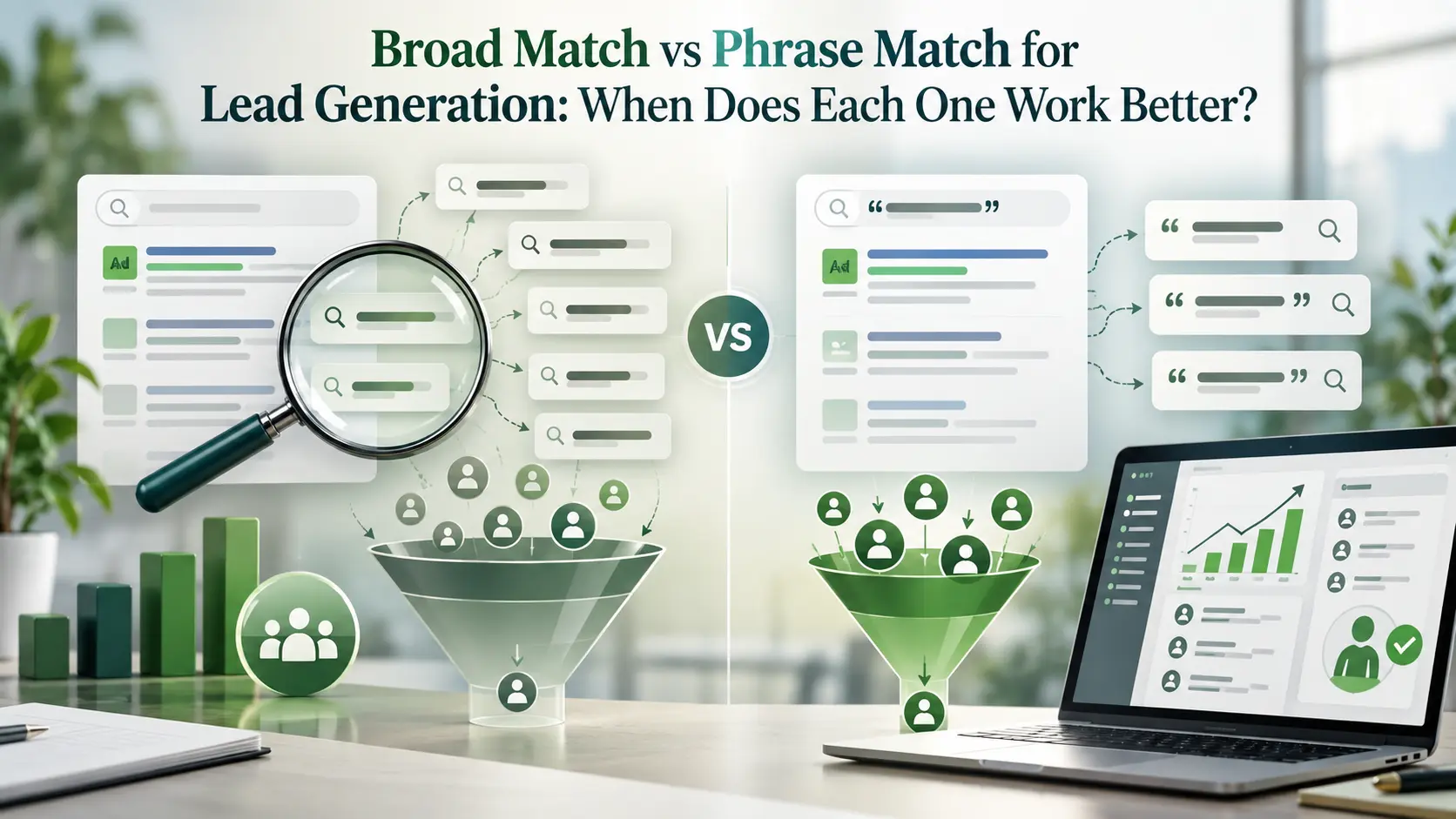
A plumbing company spending $60 a day on Google Ads cannot afford to attract people searching for DIY repair instructions. A business spending $300 a day has more room to test new keywords, but wasted clicks can still become expensive. This is where broad match and phrase match make a difference.
Both match types can bring customers to your website. The problem is that they don’t always attract the same searches. Broad match reaches further, while phrase match gives you a narrower range of search intent to work with. Neither automatically guarantees qualified leads.
So, which should you use? That depends on your budget, the searches your customers make and what happens after someone submits a form or calls your business.
What Broad Match Really Does?
Broad match allows Google Ads to show your advertisement for searches related to your keyword, even when people use different words.
For example, imagine you’re advertising an emergency plumbing service. You add emergency plumber as a broad match keyword. Google may also consider searches involving urgent pipe repairs, broken plumbing or nearby emergency repair services. The exact queries will depend on how Google interprets the keyword and other available signals.
That extra reach can help you find customers you might have missed. But a related search isn’t necessarily a valuable one.
Someone searching for plumbing repair training may have a completely different intention from someone who needs a plumber at home. That is why negative keywords, accurate conversion tracking and regular performance reviews matter. Before increasing broad match spending, check whether the inquiries are becoming booked jobs.
Google also recommends pairing broad match with Smart Bidding so bids can account for signals available during each auction.
What Phrase Match Really Does?
Phrase match gives you a more focused way to reach people searching for a particular service. It does not require someone to type your keyword word for word. Google can still match searches that carry the same meaning.
Let’s say a local plumbing company adds “emergency plumber” as a phrase match keyword. Searches such as “emergency plumber near me” or “24 hour emergency plumbing service” may be eligible because they express a similar need.
However, phrase match is not the same as exact match. Google interprets meaning rather than simply checking whether the words appear in the same order.
For businesses with a small advertising budget, that narrower reach can make early testing easier to manage. But it does not eliminate irrelevant traffic. You still need to check search terms, add appropriate exclusions and monitor whether the people contacting you are genuine potential customers.
Lead Quality Differences That Matter
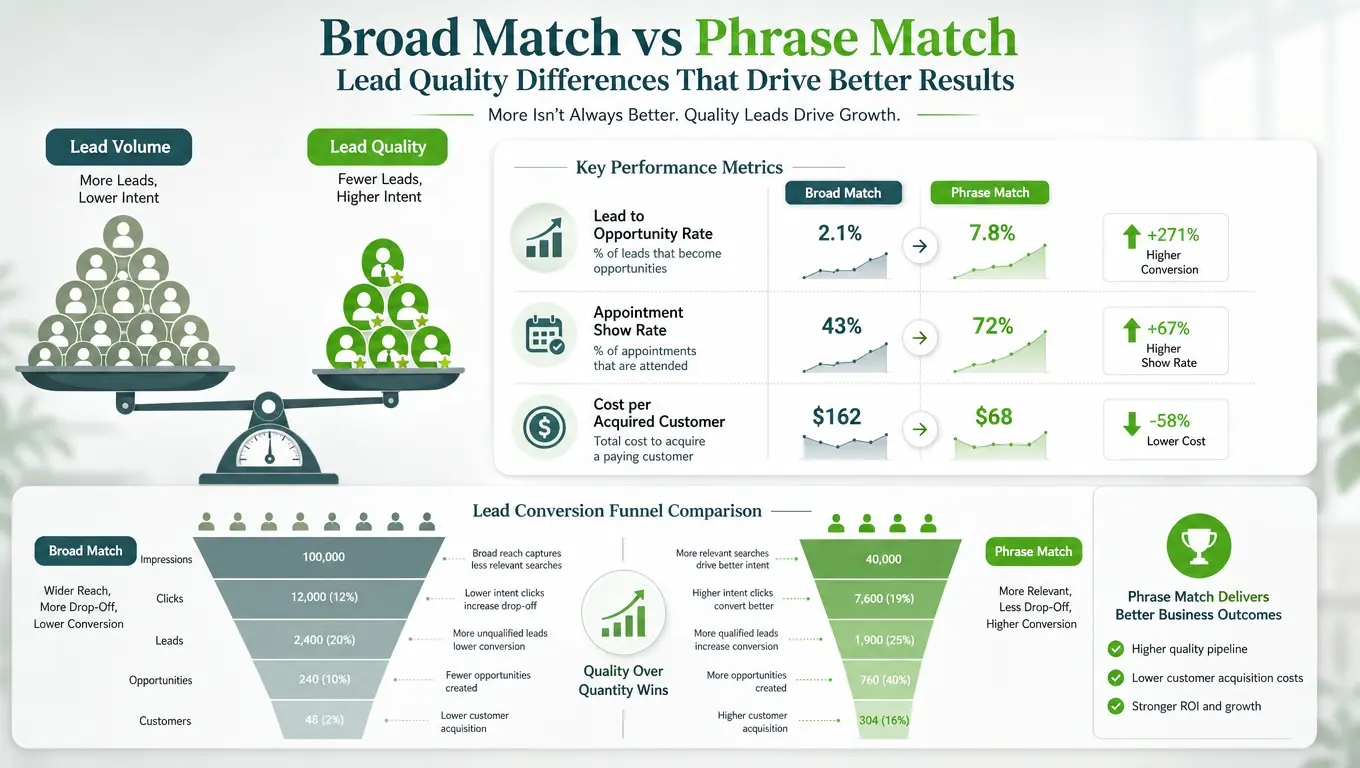
Imagine two Google Ads campaigns, each spending $2,000 during the same testing period.
Campaign A generates 40 inquiries, but only eight meet the business’s requirements. Campaign B generates just 20 inquiries, yet 12 are qualified. The first campaign looks more successful if you only check the number of form submissions. Once you consider lead quality, the picture changes.
Campaign A costs $250 per qualified lead. Campaign B costs approximately $167 per qualified lead.
These numbers are hypothetical, but they show why cost per lead can be misleading.
For a service business, a useful performance review should include qualified inquiries, booked appointments, actual customers and revenue where available. A cheap form submission means little if the person lives outside your service area or cannot afford your service.
Look at these outcomes before deciding which keyword match type deserves more budget.
When Broad Match Works Better for Lead Generation?
Broad match becomes more useful when a business already understands which inquiries turn into paying customers.
Consider a roofing contractor who has been advertising for several months. The company knows which services bring profitable jobs and which locations produce serious inquiries. Its Google Ads account also receives reliable conversion information.
At this stage, broad match could help identify searches that the original keyword list missed. A customer might describe a roof leak, storm damage or an urgent repair without using the exact service name advertised by the company.
There’s another important part of the setup: Smart Bidding.
Google’s Maximize Conversions and Target CPA strategies can use conversion information and auction-time signals to adjust bids. But if every contact form is treated as equally valuable, the system may optimize toward submissions that the sales team later rejects.
Before relying more heavily on broad match, make sure the tracking reflects meaningful actions. A verified service inquiry is more useful than an unchecked form submission. A booked appointment or completed sale can provide an even stronger business outcome to measure.
Broad match opens the door to additional searches. Your measurement setup helps determine whether that extra reach is worth paying for.
When Phrase Match Works Better for Lead Generation?
A new Google Ads account often has a simple problem: there is very little information about which searches will produce paying customers.
Imagine a small air conditioning repair company with a daily advertising budget of $50. The owner wants service calls, not traffic from people looking for repair courses, spare parts or free troubleshooting advice.
Starting with phrase match keywords such as “AC repair near me” and “emergency air conditioner repair” could make sense. These keywords describe services the company wants to sell.
The team can then check which searches generate inquiries, which locations those customers come from and whether calls turn into bookings. Relevant search terms can be added to the keyword plan, while unsuitable terms can be excluded.
Phrase match can also help when a company offers a specialized service. A business selling commercial HVAC installation may want to distinguish commercial projects from household air conditioner repairs.
Don’t confuse narrower reach with guaranteed lead quality, though. Poor landing pages, broad location settings and incorrect conversion tracking can waste money with phrase match too.
The goal is to begin with manageable search intent and expand when the results justify it.
How Budget and Data Change the Best Choice?
An advertising budget of $1,500 a month is very different from a $10,000 monthly budget. But there’s no universal spending level at which broad match suddenly becomes the right choice.
Suppose a local service company spends $1,500 monthly and pays $25 per click. That budget buys approximately 60 clicks before considering any other changes in cost. If the account receives only a handful of qualified inquiries, splitting the money across too many campaigns can make performance difficult to judge.
Now consider a company spending $10,000 monthly with consistent lead tracking. If it is already generating a useful volume of qualified leads, it may have more room to test additional search themes.
Still, budget alone doesn’t tell the full story.
A business using HubSpot can record when a new inquiry becomes a qualified opportunity or paying customer. With a properly configured connection to Google Ads Data Manager and enhanced conversions for leads, supported offline outcomes can be imported into Google Ads.
This helps advertisers evaluate campaigns using more than raw form submissions. It also provides richer conversion information for eligible bidding setups.
Before expanding your keyword reach, check the quality of your tracking data. An account with a large budget and unreliable conversions can make expensive mistakes just as easily as a small account.
Control Levers That Make Both Match Types Safer
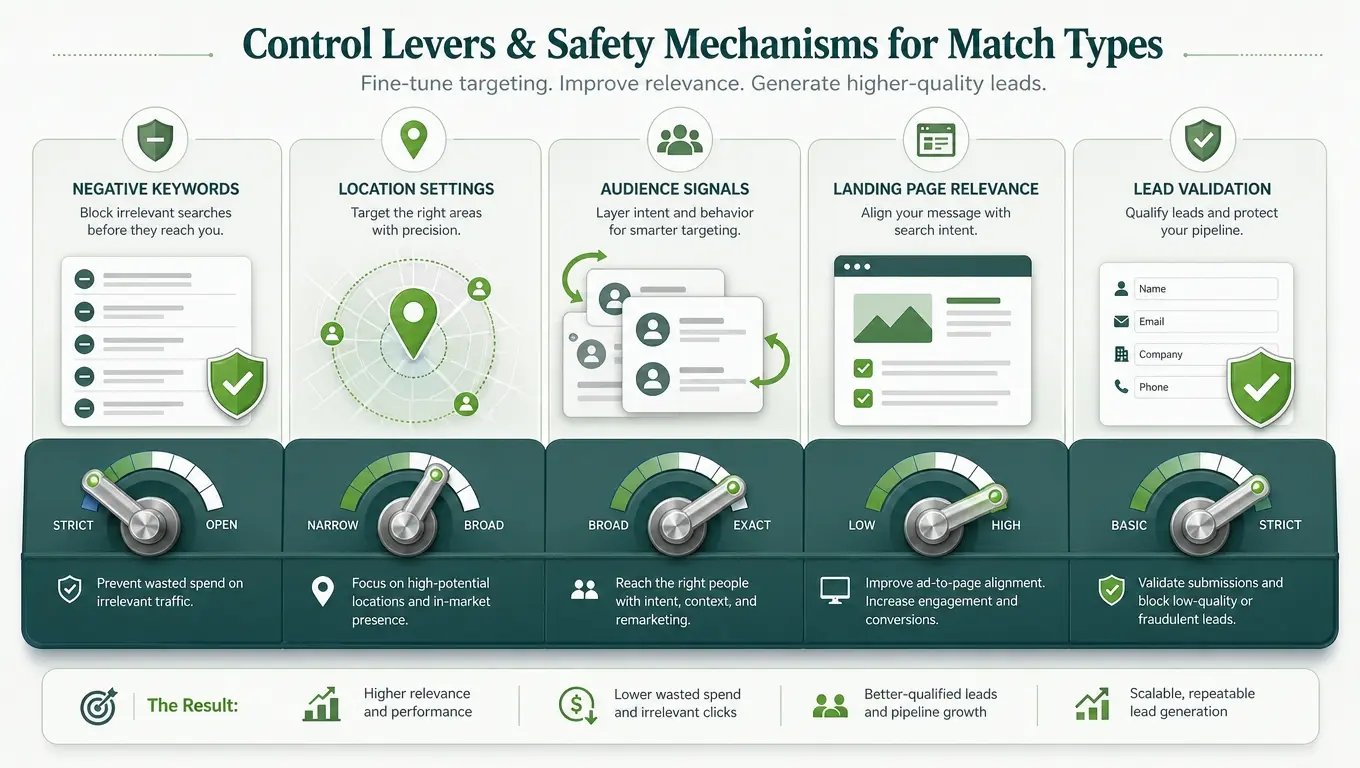
Changing a keyword from broad match to phrase match won’t fix every problem in a lead generation campaign.
Start with the Search Terms report inside Google Ads. Look for searches that are using money without bringing relevant customers. A plumbing company, for example, might identify searches related to plumbing courses, job vacancies or DIY repair instructions. Those terms may be candidates for negative keywords, depending on the services being advertised.
Next, check your location settings. A business that only serves customers in Washington, DC may want to use presence-based targeting instead of reaching everyone who shows interest in that location. Remember that Google’s geographic targeting is not perfectly accurate.
Your landing page matters too. If an advertisement offers emergency plumbing services but sends visitors to a general homepage, people may struggle to find the information they need. A dedicated page with the service details, coverage area and a visible contact option gives visitors a clearer next step.
Finally, check how conversions are recorded. Tools such as Google Tag Manager can help implement website tracking. For businesses handling leads over the phone, a suitable call-tracking solution can provide additional information about incoming calls.
Negative keywords and tighter campaign settings are useful controls, but they do not turn broad match into phrase match. Both still need regular monitoring.
Broad Match Vs Phrase Match Comparison Table
Here is how the two match types differ in a typical lead generation setup. The actual results will depend on the keywords, bidding strategy, service and quality of the conversion data.
| Factor | Broad Match | Phrase Match |
|---|---|---|
| Keyword example | emergency plumber | “emergency plumber” |
| Search coverage | Related searches, including terms with different wording or meaning | Searches that include the keyword’s meaning |
| Main advantage | Opportunity to discover additional relevant searches | More focused control over search themes |
| Main challenge | Additional searches need careful evaluation | Narrower coverage may miss useful demand |
| Conversion tracking | Accurate business outcomes are especially important | Accurate business outcomes are still necessary |
| Typical application | Exploring additional search demand | Focusing on clearly defined services |
A broader keyword is not necessarily a cheaper or more profitable one. Check the search terms and customer outcomes in your own account before deciding which approach deserves more investment.
How to Check Whether Your Google Ads Leads Are Actually Qualified
A form submission doesn’t tell you whether someone is ready to buy. The sales team usually knows more about that.
For example, a company providing commercial cleaning services might receive inquiries from office managers, homeowners, students looking for jobs and people asking for free cleaning advice. The campaign may count every form submission, but only some of those contacts are potential commercial customers.
A simple way to improve reporting is to connect the advertising data with the sales process.
Start by recording the customer’s inquiry in a CRM such as HubSpot. Assign a lead status after reviewing the request. This could include new inquiry, qualified lead, appointment booked or customer acquired.
Next, make sure your Google Ads conversion setup can distinguish meaningful business outcomes from basic contact submissions.
Google Ads supports enhanced conversions for leads and integrations through Data Manager. Depending on the configuration, businesses can import supported offline conversion events from their CRM. This provides additional measurement information about what happened after someone clicked an advertisement.
You should also compare the results of different keyword groups. A campaign that produces 15 qualified inquiries may be more valuable than one producing 40 low-quality submissions, even if the latter reports a cheaper cost per lead.
The important question is not simply how many people contacted you. It is how many of those contacts became genuine sales opportunities.
A Practical Way to Use Both Without Losing Lead Quality
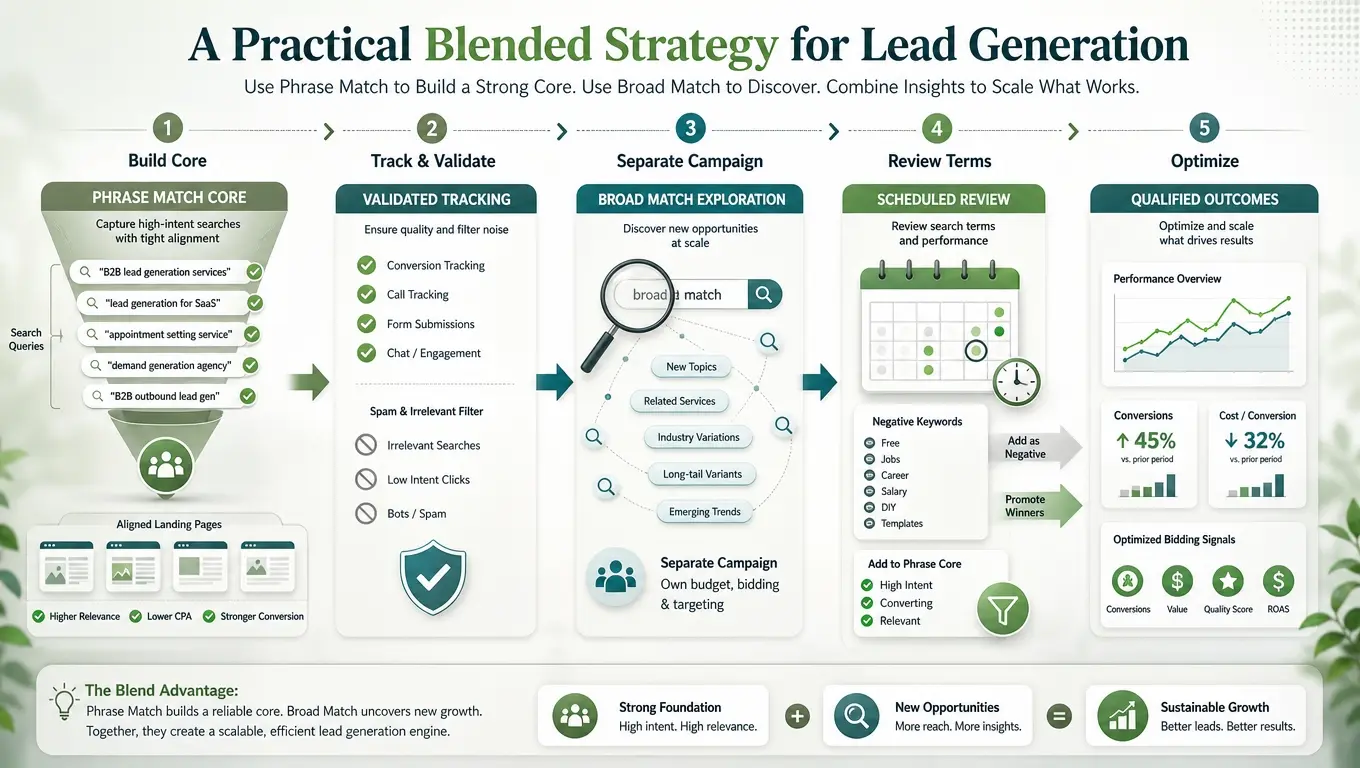
You don’t always need separate campaigns for broad match and phrase match.
Google’s Smart Bidding system works at the auction level, so separating keywords only because they use different match types is not a requirement for bidding optimization. However, a separate campaign or a controlled experiment can make sense when you want to compare approaches, manage different budgets or keep a test from affecting an established campaign.
Imagine a plumbing business already generating qualified service calls from phrase match keywords.
The first step is to check whether conversion tracking works correctly and whether the existing campaign has a reasonable performance history. Next, identify a service area or keyword theme where there may be additional demand.
At that point, the advertiser could test broad match with Smart Bidding while keeping a close eye on overall qualified lead volume and acquisition costs.
Don’t judge the test after just a few clicks. Allow enough time for conversions to be reported and for useful data to accumulate. Compare results against the existing setup, including any changes in total conversion volume or lead quality.
If broader targeting increases spending without improving meaningful business outcomes, investigate the search terms, conversion settings and bidding strategy before expanding further.
Keep the setup as simple as the business needs. More campaigns do not automatically mean more control or better performance.
Common Mistakes That Hurt Lead Generation Results
One of the easiest mistakes to make in Google Ads is assuming that every recorded conversion represents a potential customer.
Picture a home services company that receives 35 form submissions in one month. Its dashboard reports a reasonable cost per lead, and the marketing team increases the budget.
Then the sales team reviews the inquiries. Ten are from outside the service area, several are asking about jobs and others never respond to a call.
The advertising dashboard was not necessarily wrong. It counted the actions it was configured to count. The problem was assuming those actions were all valuable.
This is why lead validation matters.
A business can use its CRM to identify which inquiries meet its requirements and which eventually become customers. When those outcomes are connected to the advertising account through a supported integration, campaign reporting can move closer to actual business performance.
Another common mistake is ignoring the Search Terms report. Check relevant search activity regularly, especially when testing broader targeting. Keep in mind that Google does not disclose every individual low-volume search.
There is also the landing page problem. If a campaign advertises commercial roof repairs but the page mainly discusses residential services, unsuitable inquiries should not be surprising.
Before blaming the keyword match type, check what was advertised, who saw it, where visitors landed and how their inquiries were recorded.
Conclusion
There is no single match type that works for every lead generation business.
If you’re launching a new local services campaign, phrase match may help you concentrate spending on clearly defined search themes. If your account already produces reliable conversion data, testing broad match with Smart Bidding could help uncover additional demand.
But neither option fixes bad tracking, unsuitable locations or a weak landing page.
Start with the searches that matter to your customers. Track what happens after the click, including how many inquiries turn into actual business opportunities.
That is how you decide whether broader targeting is helping your business or simply creating more work for your sales team.
Frequently Asked Questions
Is Broad Match Too Risky For Lead Generation?
Broad match is not automatically too risky, but it needs the right setup. A campaign recording every spam form as a successful conversion can end up making poor optimization decisions. Start by checking your conversion tracking, negative keywords and search terms. Google recommends using Smart Bidding with broad match so bids can respond to auction-time signals.
Should Phrase Match Be The Default Starting Point?
It can be a useful starting point when you’re targeting a specific service with a limited budget. For example, a local electrician might begin with phrases describing emergency repairs or residential electrical services. That makes the initial keyword plan easier to review. Still, the right choice depends on your goals, bidding strategy and conversion tracking. Exact match may also be useful when you need especially focused search coverage.
How Often Should Search Terms Be Reviewed With Broad Match?
Check search terms frequently during a new test. A daily review may be useful when spending is high or when irrelevant searches are consuming a noticeable portion of the budget. For an established, lower-volume campaign, weekly reviews may be sufficient. Focus on patterns rather than excluding every unfamiliar search. Remember that Google does not display every low-volume query in its Search Terms report.