

Search Impression Share is a visibility signal that quietly shows how much demand you captured versus how much you left on the table. It does not measure clicks or conversions directly, but it often explains why lead volume plateaus even when search interest stays strong. When you read it correctly, it also highlights where competitors are winning auctions and where your own setup is limiting reach.
What Search Impression Share Really Measures?
Search Impression Share is the percentage of impressions your ads received out of the total impressions you were eligible to receive. Eligibility depends on targeting, bid strategy, budgets, ad rank, and policy or approval status. It is a visibility ratio, not a performance score.
A strong ratio can still hide weak results if the ads attract the wrong intent or land on a poor page. A weak ratio can still produce great ROI if you deliberately restrict reach to only the highest value queries. The key is understanding what is restricting eligibility and what is restricting delivery.
Why Impression Share is A Lead Indicator Not A Lead Count?
Leads come from clicks that come from impressions, so impression share sits at the top of the funnel. Losing impressions means fewer chances to earn qualified visits. That relationship is real, but it is not linear because click-through rate and conversion rate vary by query, device, and page experience.
This metric becomes most useful when lead volume changes while conversion rates stay stable. If conversion rates are steady and lead volume drops, a shrinking impression share can point to rising competition, tighter budgets, or declining rank. If impression share rises but leads do not, you may be expanding into lower intent inventory.
The Two Missed Impression Share Buckets You Must Separate
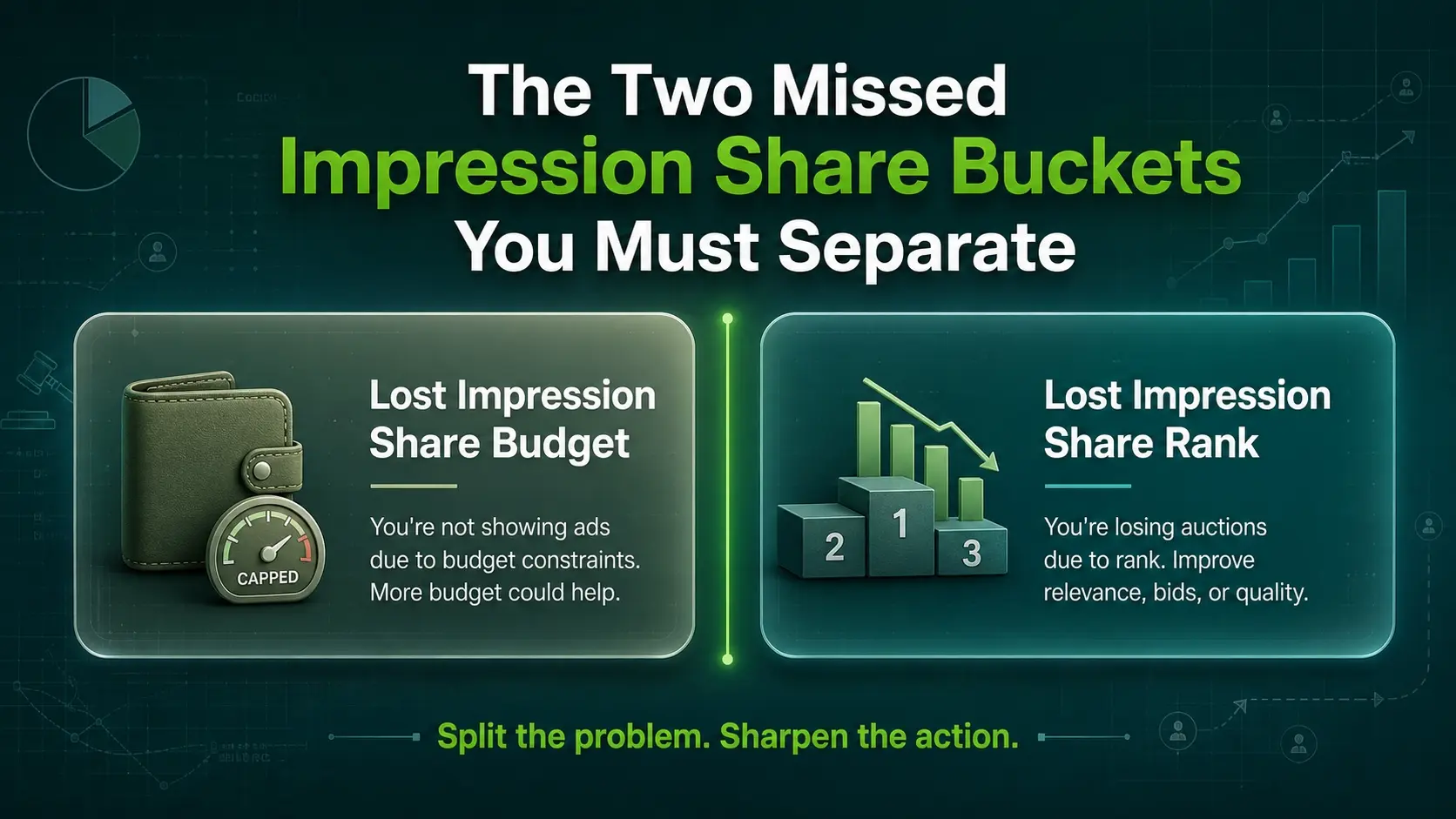
Most ad platforms split lost impression share into budget and rank. Budget means you could have shown but your daily budget ran out or was constrained. Rank means you were eligible but your ad did not win often enough due to ad rank factors.
When diagnosing lost share, look at the split before touching a single bid. If Lost IS (Budget) is over 30% on a campaign hitting its target CPL, you don’t have an ad problem, you have a capital bottleneck. Your ads simply shut off at 2:00 PM. But if Lost IS (Rank) is dominating, pouring more money into the budget will do nothing. Google is entering your ad into the auction and refusing to show it because your Quality Score is lagging or your tCPA ceiling is set too aggressively low for that keyword cluster.
How to Read it Without Being Misled?
Impression share is easiest to misuse when you chase a higher percentage without checking query quality. More visibility on the wrong searches produces more spend and fewer qualified leads. The goal is not maximum coverage, it is coverage where intent matches your offer and margins.
Start by segmenting by campaign type, brand versus non-brand, device, and location. These slices often reveal that one segment is healthy while another is bleeding visibility. That prevents blunt changes that disrupt what is already working.
Where Competitors are Really Beating You?
Competitors take share in two main ways. They either outbid you, or they earn a better ad rank at the same bid through stronger relevance and expected click performance. Both show up as lost impression share rank, but the fix differs.
Also watch how share shifts after new launches, promotions, or seasonal spikes. Competitors often raise bids during high intent periods, pushing your ads down or out. If you react only by raising budgets, you might spend more while still losing auctions due to rank issues.
Key Metrics to Pair With Impression Share
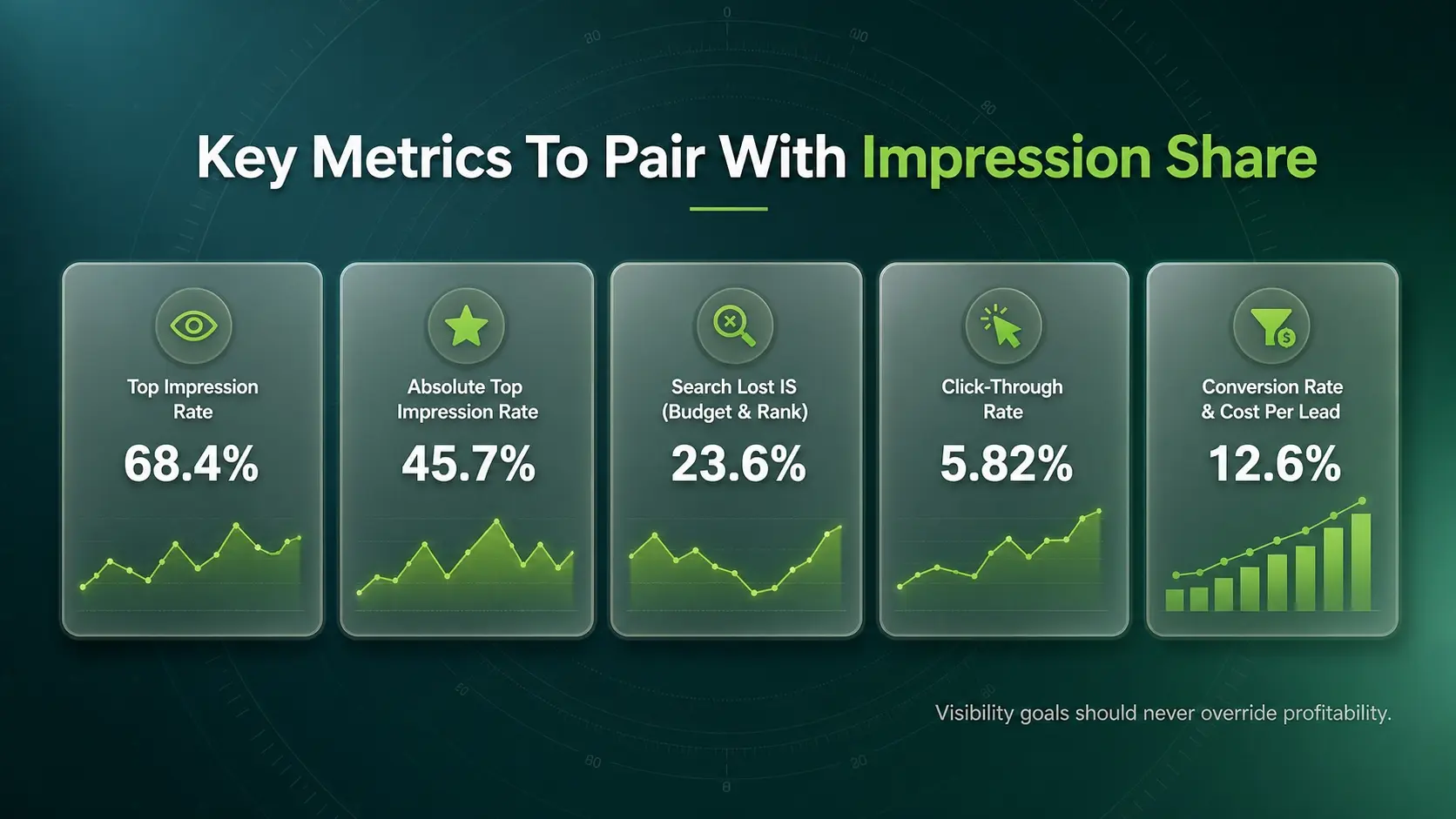
On its own, impression share is incomplete. Pair it with a few adjacent metrics to understand whether visibility losses are harming pipeline or just trimming low value traffic.
- Top Impression Rate: Indicates how often you appear above organic results when you do show.
- Absolute Top Impression Rate: Shows how often you capture the very top position, which affects high intent click volume.
- Search Lost IS Budget And Rank: Tells you whether to fix spend limits or auction competitiveness.
- Click-Through Rate: Validates whether added visibility is attracting the right users.
- Conversion Rate And Cost Per Lead: Confirms whether changes improve pipeline quality, not just traffic.
These supporting metrics prevent visibility goals from overriding profitability goals.
Impression Share Patterns That Signal Real Problems
Some patterns should trigger a deeper audit because they typically correlate with missed leads. A sudden rank-driven drop often means competitors increased bids, your quality signals weakened, or your ads lost relevance due to keyword drift. A steady budget-driven loss often means your campaign is profitable enough to spend more, but the budget has not caught up with demand.
Another red flag is high impression share paired with low top impression rate. That combination suggests you show often but not prominently, so you may be visible without being competitive. In lead generation campaigns, position and prominence can matter, especially on mobile.
A Practical Framework for Fixing Missed Leads
Work through decisions in an order that protects efficiency. Fix eligibility and tracking first, then tighten intent, then scale what proves profitable. This approach avoids spending more money to show more often on unqualified searches.
- Confirm Measurement Integrity: Check conversion tracking, lead validation, and attribution settings so you do not optimize toward noisy signals.
- Audit Search Terms And Negatives: Remove irrelevant queries, add negatives, and tighten match types to keep visibility focused on true intent.
- Resolve Policy And Asset Issues: Fix disapprovals, broken URLs, and missing assets that reduce eligibility and lower ad rank.
- Improve Auction Competitiveness: Strengthen ad relevance, landing page experience, and bidding strategy to reduce rank losses.
- Scale With Budget Only After Proof: Increase budgets where marginal cost per lead remains within targets and capacity can absorb more leads.
After you apply the framework, re-check impression share by segment to confirm that gains happen where lead quality stays strong.
Quick Reference Table for Decisions
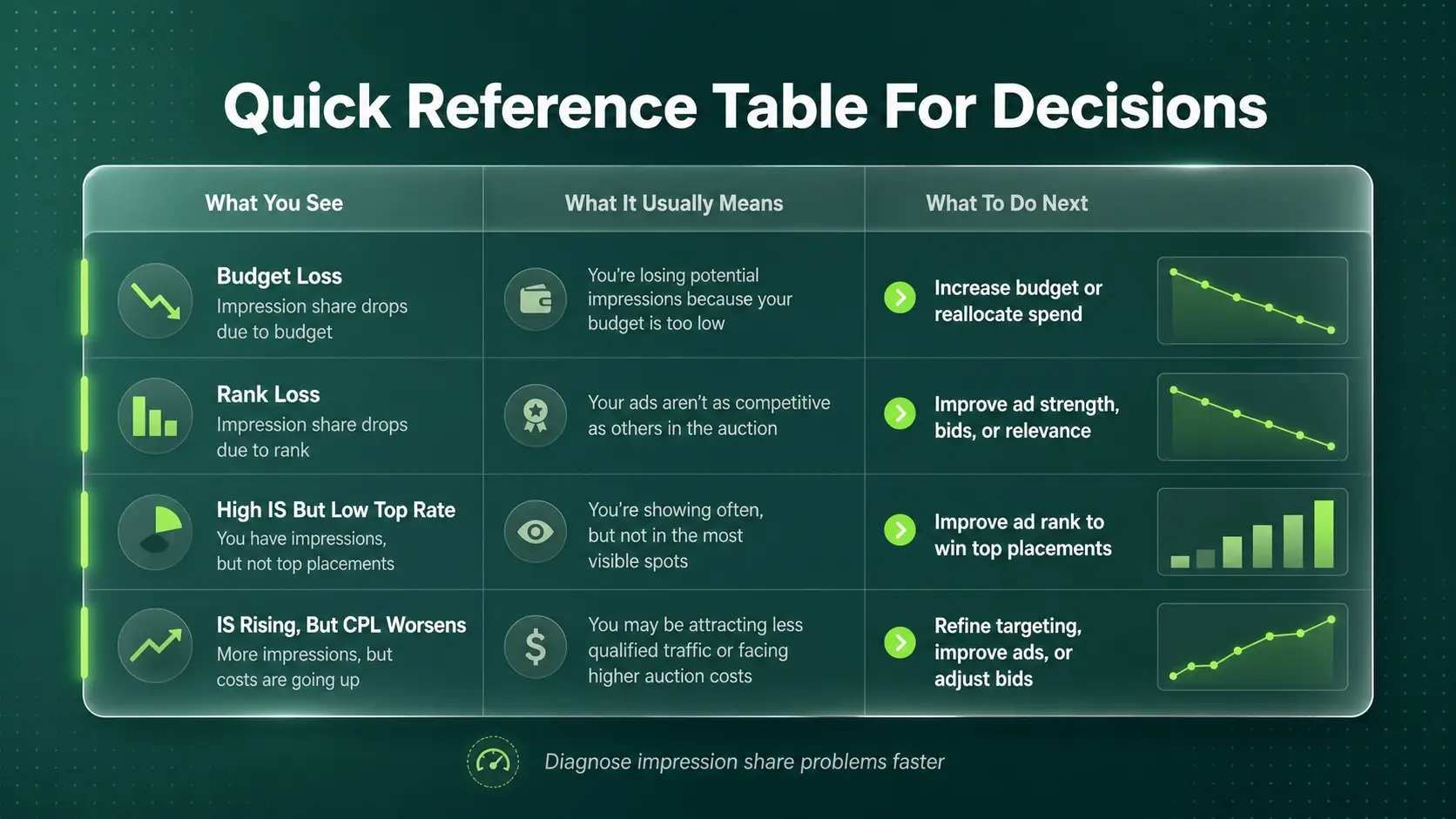
| What You See | What It Usually Means | What To Do Next |
|---|---|---|
| High Lost IS Budget | Demand exceeds daily spend limits | Raise budget on proven segments and reduce waste from low intent queries |
| High Lost IS Rank | You are losing auctions due to ad rank | Improve relevance and landing page quality, then adjust bids where needed |
| High IS But Low Top Rate | You show often but not in strong positions | Refine ads and assets, review bidding strategy, and focus on high intent keywords |
| IS Rising While CPL Worsens | More visibility is coming from weaker intent | Tighten targeting, add negatives, and reallocate spend to best converting themes |
How to Use It in Reporting Without Noise?
Impression share moves for reasons that have nothing to do with your account quality, including changes in search volume and competitor behavior. Avoid reading daily fluctuations as a performance verdict. Weekly and monthly trends are more reliable, especially when paired with lead quality checks.
Use it as a diagnostic metric in executive reporting. It answers why volume changed, where the ceiling is, and what investment would likely unlock incremental leads. It also supports more grounded discussions about competitive pressure without guesswork.
Where Expert Support Makes Impression Share Actionable?
Turning impression share into growth requires clean account structure, disciplined query control, and a consistent testing cadence. Teams often struggle to connect auction metrics to real pipeline because lead tracking, CRM feedback, and campaign segmentation are not aligned. That is where a performance partner can accelerate progress.
Imili Corp supports businesses that need more predictable lead flow from paid search and better visibility into what competitors are taking. Their approach typically centers on tightening intent, improving landing page alignment, and building reporting that ties auction constraints to qualified leads. This keeps impression share improvements tied to outcomes rather than vanity percentages.
Conclusion
Search Impression Share is a powerful indicator of missed opportunity when you treat it as a visibility constraint, not a success metric. Split losses into budget and rank, segment the data, and pair it with top rate, CTR, and cost per lead. That combination shows whether competitors are outbidding you, outscoring you, or whether your own targeting is too broad.
When you act on the right diagnosis, impression share stops being a dashboard number and starts becoming a practical map to reclaim missed leads and defend demand from competitors.
Frequently Asked Questions
What Is A Good Search Impression Share?
A good level depends on intent, margins, and your growth goals rather than a universal benchmark. Brand campaigns often target higher share because they protect demand already created. Non-brand lead generation can be profitable at lower share if the captured queries convert efficiently.
Should I Increase Budget If Lost Impression Share Budget Is High?
Increase budget only after confirming the campaign is bringing qualified leads at an acceptable cost. If search terms show irrelevant intent, raising budget simply funds more waste. Tighten targeting first, then scale budgets on segments that maintain lead quality.
How Do I Reduce Lost Impression Share Rank Without Overspending?
Start with relevance improvements that raise ad rank at the same bid, including tighter keyword to ad alignment and better landing page experience. Review assets, ad strength, and query intent to improve expected performance. Adjust bids only where higher positions are likely to produce incremental qualified leads.