
A business spending $5,000 a month on one search campaign has very different management needs from a company running $50,000 across multiple products, locations, and lead funnels. As paid search grows, the question is no longer simply who can manage Google Ads. It becomes a question of capacity, cost, access, measurement, and how quickly changes can actually get implemented.
What A Paid Search Consultant Typically Delivers?
A paid search consultant usually works closer to the account than a larger service team. In many engagements, the same person reviewing search terms on Monday is also adjusting bidding, restructuring campaigns, checking conversion tracking, and explaining the results to leadership later in the week.
That setup can work particularly well when Google Ads or Microsoft Ads is the main acquisition channel and the account has a clearly defined problem. A consultant might spend the first month rebuilding campaign structure, separating branded from non-branded traffic, cleaning up negative keywords, or correcting conversion actions before additional budget is introduced.
The trade-off is capacity. If the same specialist is expected to manage paid search, build landing pages, troubleshoot CRM data, produce creative, and report across several markets, the engagement can become constrained by one person’s available hours.
What A PPC Agency Typically Delivers?
An agency changes the operating model. Instead of relying on one specialist for every task, the account may involve an account lead, paid media specialist, analyst, designer, or tracking resource at different points during the month.
That extra coverage matters when the workload expands. A product launch may require new campaigns, fresh creative, landing-page coordination, tracking checks, and daily budget monitoring at the same time. An agency can distribute those tasks instead of placing them all in one queue.
More people do not automatically mean faster execution, however. Ask who is actually allowed to make changes in the account, whether work passes through internal quality checks, and how quickly an urgent budget or tracking problem can reach the person responsible for fixing it.
Key Differences That Affect Growth
The right choice depends on what the business needs to scale next. Most growing teams run into limits around speed, measurement, creative volume, and the ability to turn insights into decisions.
| Decision Factor | Paid Search Consultant | PPC Agency |
|---|---|---|
| Day-to-Day Access | Usually direct access to the person making account decisions | Often routed through an account manager or defined service team |
| Account Complexity | Strong fit for focused Google Ads or Microsoft Ads work | Better equipped for multiple markets, channels, campaigns, and creative needs |
| Speed of Changes | Can be fast because fewer people are involved | Can be fast, but internal approvals or QA may add steps |
| Capacity | Limited by one specialist’s available hours | Work can be distributed across several roles |
| Commercial Model | Often hourly, project-based, or monthly retainer | Commonly flat retainer, percentage of spend, or hybrid pricing |
| Main Operational Risk | Key-person dependency | Handoffs, communication layers, or junior execution |
The important difference is what happens when workload doubles: who absorbs the extra search-term reviews, tracking work, creative requests, reporting, and campaign changes?
Cost Structure And Contract Reality
Pricing becomes more important as spend increases because the management fee and the media budget are two separate costs.
Current market benchmarks provide a useful reference point. PPC agencies commonly use flat monthly retainers, hourly billing, percentage-of-spend pricing, or a combination of those models. Published 2026 pricing guides place many agency hourly rates around $100–$149, while percentage-based management commonly falls around 10%–20% of monthly ad spend. Monthly retainers can range from roughly $1,000 to $10,000 or more depending on account complexity, platforms, reporting, and additional services.
That creates a commercial question that growing businesses should ask early. If ad spend rises from $10,000 per month to $50,000, should the management fee increase at exactly the same rate? Sometimes the added spend creates significantly more work. In other cases, the campaigns, reporting requirements, and number of markets barely change. Ask whether percentage pricing steps down at higher spend levels or whether a flat fee becomes available.
A consultant may instead quote a fixed audit, an implementation project, an hourly rate, or a smaller monthly retainer. That can be efficient for a defined problem, but confirm what happens when the scope expands.
Before signing either agreement, get four items in writing: which platforms and campaigns are included, how many hours or deliverables are covered, who owns the ad and analytics accounts, and what happens during termination or handoff. Also check whether landing-page work, feed management, creative production, CRM integration, and advanced tracking are included or billed separately.
Strategy And Optimization Quality

High-quality strategy starts with business context, not just keywords and bids. Growing businesses need a plan that ties campaigns to margin, pipeline quality, and capacity constraints, especially in lead generation.
A strong consultant can push for sharp positioning, cleaner account structure, and fast iteration on search terms and negatives. A strong agency can deliver the same while running parallel experiments and building repeatable testing across multiple product lines or regions.
In practice, optimization should leave a visible trail. Early in the week, the manager may review search terms, budget pacing, impression share, CPA or ROAS movement, and recent Change History activity. Changes can then be grouped into negatives, budget adjustments, bidding changes, ad tests, and landing-page actions rather than making unrelated edits throughout the account.
The next review should ask whether those changes actually improved the intended metric. Google Ads Change History keeps account changes available for review and can be filtered by campaign, user, tool, and change type, making it possible to connect performance shifts with specific edits instead of relying on memory.
A useful partner should therefore be able to show not only what they changed, but why they changed it, what metric was expected to move, and when the result will be reviewed.
Tracking, Measurement & Data Ownership
For a lead-generation account, a form submission should not automatically be treated as the final business outcome. Ten leads at a low CPL can still be poor performance if none become qualified opportunities.
A more useful workflow connects the ad click to the CRM. The visitor clicks an ad, submits a form, enters the CRM, and is later marked as qualified, converted, won, or lost. Those downstream outcomes can then be returned to Google Ads so optimization is based on lead quality rather than form volume alone.
Google currently recommends enhanced conversions for leads for this type of setup. First-party lead information can be collected through the Google tag or Google Tag Manager, stored in the CRM, and later sent back through Google Ads Data Manager or supported integrations. Google also recommends using qualified lead or converted lead outcomes where appropriate.
This is also an ownership issue. The business should control the Google Ads account, billing access, Google Tag Manager container, analytics property, CRM connection, conversion actions, and reporting destinations. Changing providers should not mean rebuilding the measurement system from zero.
Communication, Workflow & Responsiveness
Ask the provider to describe an actual week, not simply promise “proactive communication.”
For example, Monday might cover search terms, spend pacing, rejected ads, tracking alerts, and unusual CPA or ROAS movement. Midweek can be used for campaign changes and experiments. Later in the week, CRM lead-quality data can be compared with platform conversions before the next budget decision is made.
Urgent issues need a different path. A broken form, payment problem, disapproved campaign, incorrect conversion action, or sudden inventory change should not wait for the next monthly report. Agree in advance on which issues justify same-day escalation and who has authority to pause spend.
Finally, keep account decisions documented. Google Ads Change History records account changes, but an internal test log should also explain the business reason behind important changes. That prevents the next consultant, employee, or agency team from repeating tests that have already failed.
Which Setup Fits Different Growth Stages
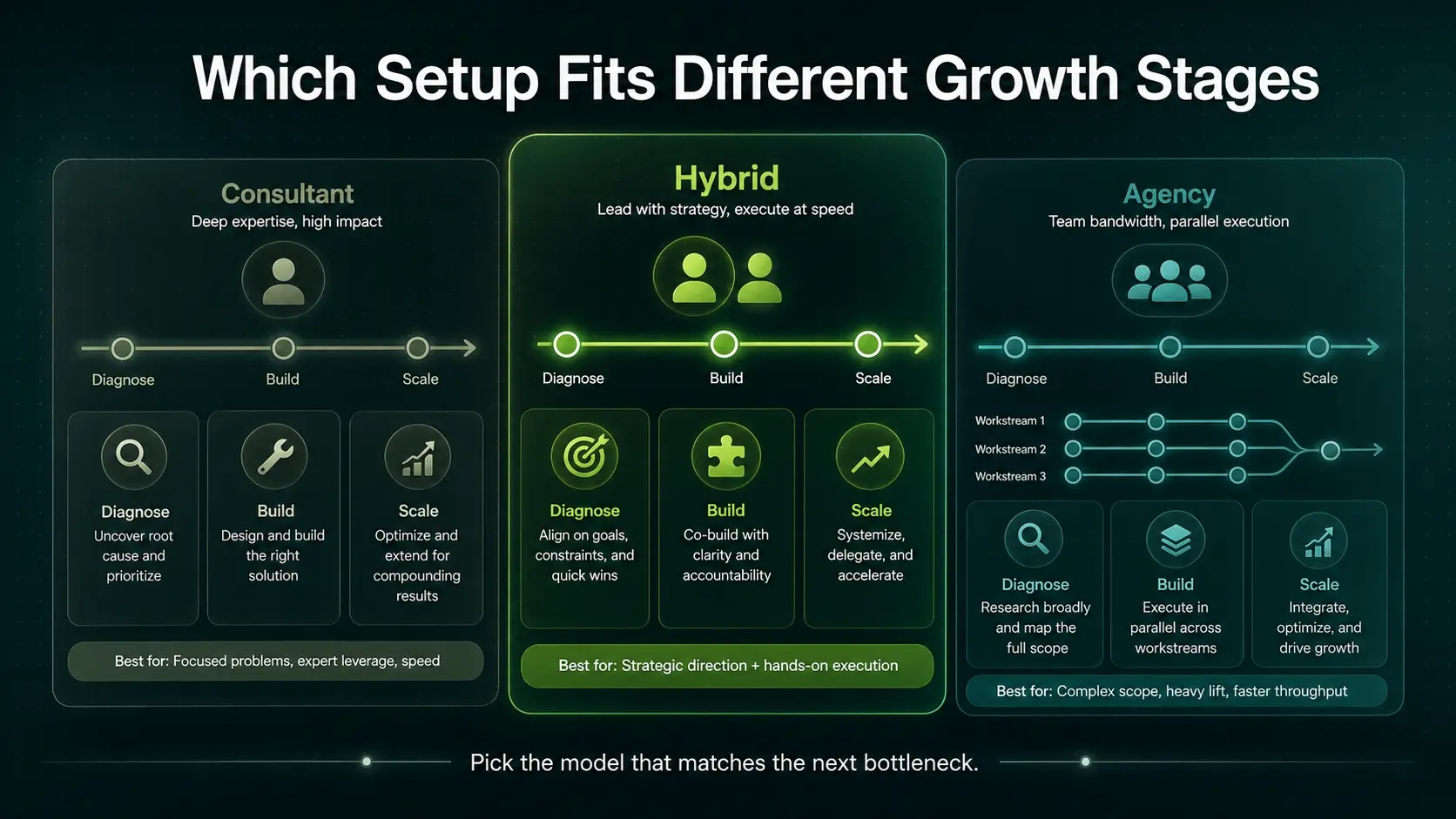
A consultant is often a strong fit when the business needs expert attention on a specific bottleneck. This includes rebuilding campaign structure, fixing tracking, tightening keyword strategy, and training an internal marketer.
An agency is often a better fit when growth requires more capacity and coordinated work across channels, landing pages, and reporting. It is also helpful when you need coverage during vacations, product launches, and high-volume test cycles.
- Choose A Consultant When: You need deep expertise, fast diagnosis, and direct collaboration with leadership or in-house marketing.
- Choose An Agency When: You need scale, redundancy, process, and multi-skill support across ongoing initiatives.
- Consider A Hybrid When: A consultant leads strategy and audits while an internal team or agency executes at volume.
Whichever route you choose, the next section helps you evaluate partners with less risk.
How to Vet the Right Partner Without Wasting Budget?
Vetting should focus on proof of process, clarity of ownership, and the ability to connect paid search to real business outcomes. You do not need buzzwords, you need transparency in how decisions will be made and measured.
- Request A Clear Audit Approach: Ask what they review first, what they ignore, and what changes they typically prioritize in the first month.
- Verify Tracking Competency: Confirm they can validate conversions, diagnose discrepancies, and align reporting with your sales funnel.
- Review Governance And Access: Ensure you retain ownership of accounts, billing, audiences, and historical data.
- Align On Success Metrics: Agree on a small set of KPIs tied to revenue quality, not only clicks and cost per lead.
- Ask About Ongoing Testing: Confirm how experiments are planned, documented, and used to guide future spend.
When these items are clear, it is easier to judge performance fairly and scale with confidence.
Where Imili Corp Can Support Growing Teams?
Some businesses do not need a full agency retainer or a single consultant working alone. They need a reliable operating partner that can combine strategy, execution support, and measurable reporting so paid search becomes predictable.
Imili Corp supports performance-focused growth by helping teams clarify objectives, tighten campaign structure, and improve conversion tracking and reporting workflows. This is especially useful when leadership wants stronger accountability and cleaner attribution before increasing spend.
If your team is scaling across products or regions, a structured engagement can also help standardize naming conventions, testing plans, and optimization routines. That reduces waste and keeps learnings usable as budgets grow.
Conclusion
Do not make this decision from the job title alone. Ask what the account will require over the next six to twelve months.
If the work is concentrated in one or two advertising platforms and the main need is senior expertise, diagnosis, or restructuring, direct access to a specialist may matter more than team size. If growth will introduce additional markets, campaigns, tracking work, creative requests, and reporting requirements, capacity and operational coverage become more important.
Before choosing either model, compare the actual fee structure, the people who will touch the account, ownership of data and advertising assets, response times, and the workflow used to turn CRM outcomes into advertising decisions.
The useful question is not “consultant or agency?” It is: what will break first when this account becomes twice as demanding as it is today?
Frequently Asked Questions
Is A Paid Search Consultant Better For Small Budgets?
It can be, especially when the goal is to fix fundamentals and avoid paying for a larger team structure. The key is ensuring the consultant can still deliver consistent optimization and reporting at the cadence you need.
Can A PPC Agency Work Well With An In House Marketing Team?
Yes, when roles are clear and the agency integrates with internal workflows for approvals, creative, and landing pages. Ask who owns strategy, who implements changes, and how quickly updates can be deployed.
What Should A Growing Business Own In Google Ads?
You should own the ad account, billing profile, conversion actions, and audiences wherever possible. Ownership protects historical learning and ensures you can switch partners without losing critical data.