

ROAS can look strong while revenue tells a different story. An attribution audit helps you verify what is being counted, where it is counted, and whether the numbers reflect real business outcomes. This guide walks through ten practical checks that reduce uncertainty before budget increases, creative pivots, or channel cuts.
What A Marketing Attribution Audit Confirms?
A marketing attribution audit is a structured review of tracking, data flow, and credit assignment across ad platforms, analytics, and your backend. It focuses on whether conversions, revenue, and customer events are recorded consistently and without inflation. It also checks whether the reporting logic matches the buying journey you actually have.
The goal is not to chase a perfect model. The goal is to reach a level of measurement confidence that supports decisions, forecasting, and profitable scaling. Once the basics are sound, more advanced incrementality work becomes easier and cheaper to run.
Pre Audit Inventory You Need

You can run the checks faster when you gather the essentials first. Keep the scope tight and include only sources that influence performance decisions. This prevents weeks of review without impact.
- Platform access: Admin or analyst access to ad accounts, analytics, tag manager, CRM, and ecommerce system.
- Tracking map: A list of pixels, tags, server events, offline imports, and where each is deployed.
- Conversion definitions: The exact events used for bidding and reporting, including revenue fields and currency.
- Business rules: Refund policy, cancellation windows, subscription upgrades, and how these are represented in data.
With inputs ready, the ten checks below become straightforward to validate and document.
Check Your Conversion Definitions Across Systems
Start by confirming that the same event means the same thing everywhere. A purchase in an ad platform should map to the same underlying order success state in your backend. If one system counts payment attempts and another counts settled orders, ROAS will drift.
Ensure you have a single source of truth for what qualifies as a conversion and when it is considered final. This matters most in businesses with refunds, chargebacks, trials, or partial payments.
Check Event Deduplication And Double Counting
Double counting is a common cause of inflated ROAS. It happens when browser pixel events and server events both record the same purchase without a shared deduplication key. It also happens when multiple tags fire on the same thank you page.
Review the event IDs used for deduplication and confirm they are consistent across browser and server. Validate that your tag manager triggers do not fire on page refreshes or repeated states such as order confirmation revisit.
Check Attribution Windows And Lookback Settings
Attribution windows determine how long platforms can claim credit after a click or view. Short windows can undercount slower sales cycles, while long windows can overstate channel impact. Lookback settings should match your typical consideration period and purchase cadence.
Align windows across platforms where possible, then document where they must differ. Differences are not automatically wrong, but unacknowledged differences create false comparisons between channels.
Check UTM Governance And Channel Grouping

UTMs are only helpful when they are consistent and enforced. A small variation in source or medium can fragment reporting, causing misallocated budget. Confirm you have naming rules, a validation process, and a plan for correcting existing inconsistencies.
Review analytics channel groupings to ensure paid social, paid search, email, affiliates, and partners are not being mixed. If necessary, create custom channel rules that reflect your media plan and reporting needs.
Check Landing Page Integrity And Redirect Chains
Redirects, cross domain hops, and tracking parameters stripped by server rules can break attribution. Even when conversions record, the session can lose its source, turning paid traffic into direct. This can make paid channels look weak while overall sales look stable.
Audit your top destination URLs for parameter retention and consistent canonical behavior. Ensure redirects preserve query strings and that mobile and app links do not drop campaign parameters.
Check Cross Domain Tracking And Payment Flows
If checkout, booking, or payment is on a different domain or subdomain, the user journey can split into multiple sessions. That can break referral exclusions and cause self referral issues. In analytics, this often shows up as a spike in referral traffic from your own payment provider domain.
Confirm cross domain tracking is configured and that referral exclusions are correct. Verify that session stitching is behaving as expected across login and payment steps.
Check Offline Conversions And CRM Integration
Attribution improves when you pass real outcomes back to platforms, especially for lead generation and high consideration offers. Without offline conversion imports, platforms optimize to low quality leads that fill forms but do not close. This inflates ROAS proxies while true revenue lags.
Confirm that lead lifecycle stages are tracked and that closed won revenue can be linked to the original click identifier. If your process is complex, a measurement partner such as Imili can help unify ad platform signals with CRM realities in a clean, governed pipeline.
Check New Versus Returning Customer Reporting
ROAS can be strong while incremental growth is weak if spend is mostly harvesting existing demand. Evaluate whether platforms over attribute to remarketing and branded search. Then compare new customer counts, first purchase revenue, and repeat purchase behavior.
Align definitions for new customer across systems. Ensure it is based on a durable identifier, not just a cookie level view of newness.
Check Data Quality In Analytics And Warehouses
Analytics data can be sampled, filtered, or blocked by consent settings. Warehouses can contain duplicates, missing fields, or mismatched currencies. These issues create reporting differences that look like attribution problems but are actually data engineering problems.
Validate that revenue, tax, shipping, and discounts are handled consistently. Confirm timezone alignment between platforms, analytics, and your backend to reduce day boundary discrepancies.
Check Platform Report Reconciliation Against Backend Revenue
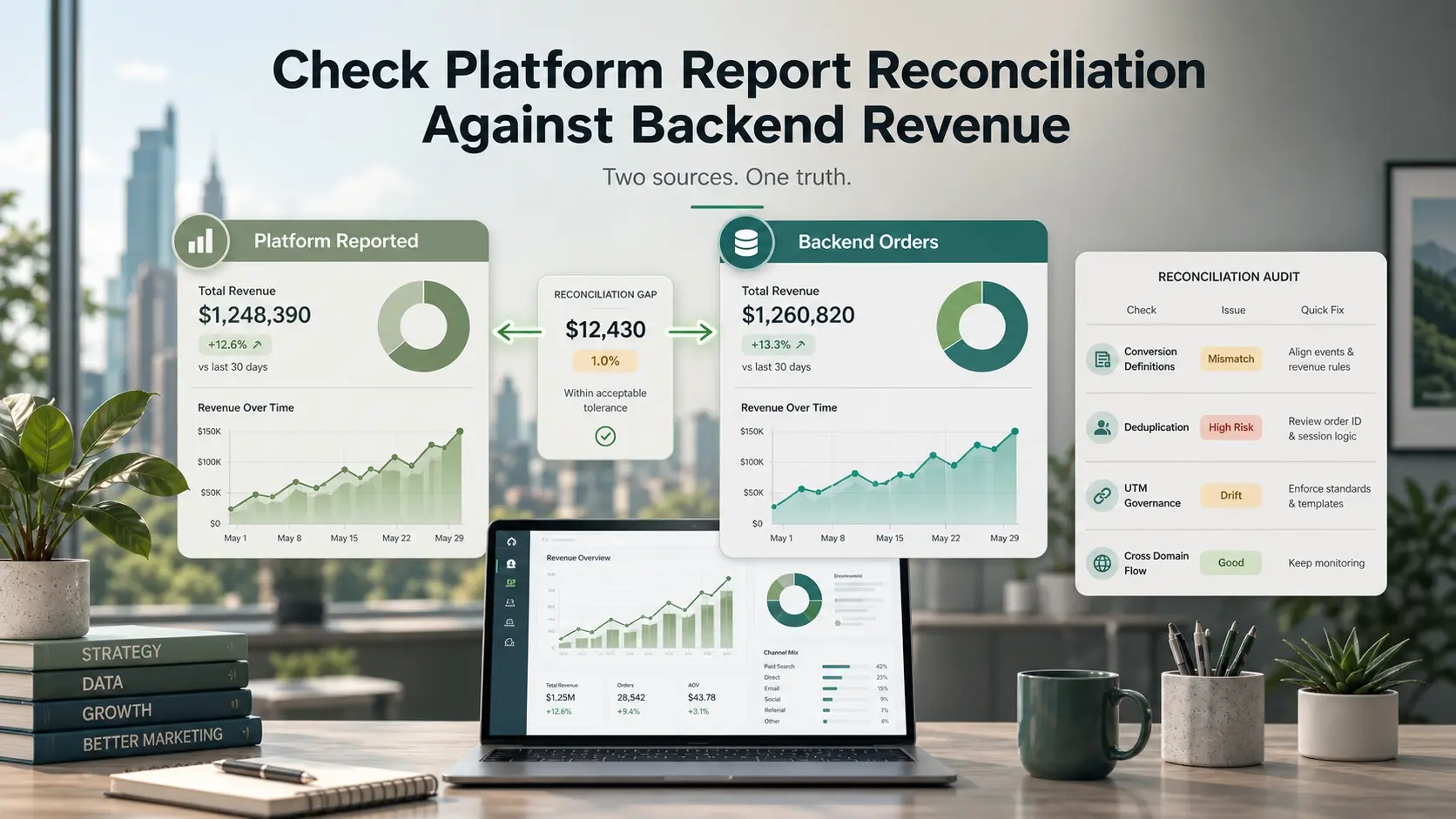
Reconciliation is the point where attribution meets the ledger. Compare platform reported revenue and conversions against backend orders, then explain the gap with known factors such as refunds, attribution windows, and tracking loss. This is where you decide what level of variance is acceptable.
Use a standard reconciliation view that the whole team trusts. When finance and marketing align on the same numbers, decision cycles shorten.
| Audit Check | Common Issue Found | What To Fix First |
|---|---|---|
| Conversion Definitions | Purchase event not tied to final order status | Map events to backend success and refund rules |
| Deduplication | Browser and server both count the same order | Implement event IDs and verify firing rules |
| UTM Governance | Inconsistent source and medium values | Enforce naming rules and repair channel grouping |
| Cross Domain Flow | Self referrals from checkout or payment provider | Configure cross domain tracking and exclusions |
This table is a quick reference, but the best audits also produce a written decision log. That log helps you keep measurement stable through site releases and campaign changes.
How To Document And Operationalize The Findings?
An audit is only valuable if it changes how you operate. Write findings in plain language, tie each issue to business impact, and assign an owner. Keep the number of priorities small so the fixes actually ship.
- Rank by impact: Fix items that materially change ROAS or conversion counts before cosmetic reporting issues.
- Define acceptance checks: Specify what success looks like, such as reconciliation variance thresholds.
- Set change control: Require tracking review during site releases, landing page builds, and checkout updates.
- Create a monthly spot check: Re test key events and parameter retention to catch regressions early.
If your team needs a repeatable system, Imili can support measurement audits, tracking governance, and ongoing performance analytics so attribution stays dependable as campaigns evolve.
Conclusion
Trustworthy ROAS requires more than a dashboard. It requires consistent conversion definitions, clean tagging, deduplicated events, aligned lookback windows, and reconciliation to backend revenue. When these foundations are in place, optimization becomes faster and budget decisions become less risky.
Run these ten checks, document what changes, and keep a lightweight monthly review cadence. Measurement confidence is a competitive advantage when it is maintained, not just installed.
Frequently Asked Questions
How Often Should You Run A Marketing Attribution Audit?
Run a full audit after major website, checkout, or CRM changes and whenever performance shifts without a clear cause. Many teams also schedule a quarterly review with monthly spot checks on critical events. The right cadence depends on how frequently your tracking environment changes.
Why Does Platform ROAS Differ From Analytics Revenue?
Differences often come from attribution windows, view through credit, and tracking loss caused by consent or browser limits. Deduplication problems and mismatched conversion definitions can also inflate platform reporting. A reconciliation process helps separate expected variance from true errors.
What Is The Fastest Way To Improve Attribution Confidence?
Start with conversion definitions, deduplication, and UTM governance because they affect every channel. Next, fix cross domain and payment flow issues that break session source. Once those are stable, align reporting to backend revenue and document the rules your team will follow.