

Lead quality tracking connects marketing intent to sales outcomes so teams stop optimizing for volume and start optimizing for revenue. The goal is simple you should know which searches, pages, and campaigns produce leads that progress, convert, and retain. When the tracking is consistent, you can improve targeting, tighten qualification, and forecast with confidence.
What Lead Quality Means In A Revenue Team?
Lead quality is the likelihood that a lead will become a healthy customer within your ideal terms. It combines fit, intent, and the ability of your process to convert that intent into a closed deal. Quality is not a single number, it is a set of signals that must be defined and measured the same way across teams.
Fit signals describe who the lead is and whether they match your ideal customer profile. Intent signals describe what the lead is doing across search, web, email, and product touchpoints. Process signals show whether the lead responds to sales outreach and progresses through stages without friction.
- Fit: Industry, company size, location, tech stack, buying role, and budget band.
- Intent: Query themes, landing pages viewed, depth of content consumed, and repeat sessions.
- Process: Speed to first response, meeting show rate, stage velocity, and reason for loss.
Once these signals are defined, tracking becomes a discipline rather than a debate.
Map The Full Journey From Search To Close
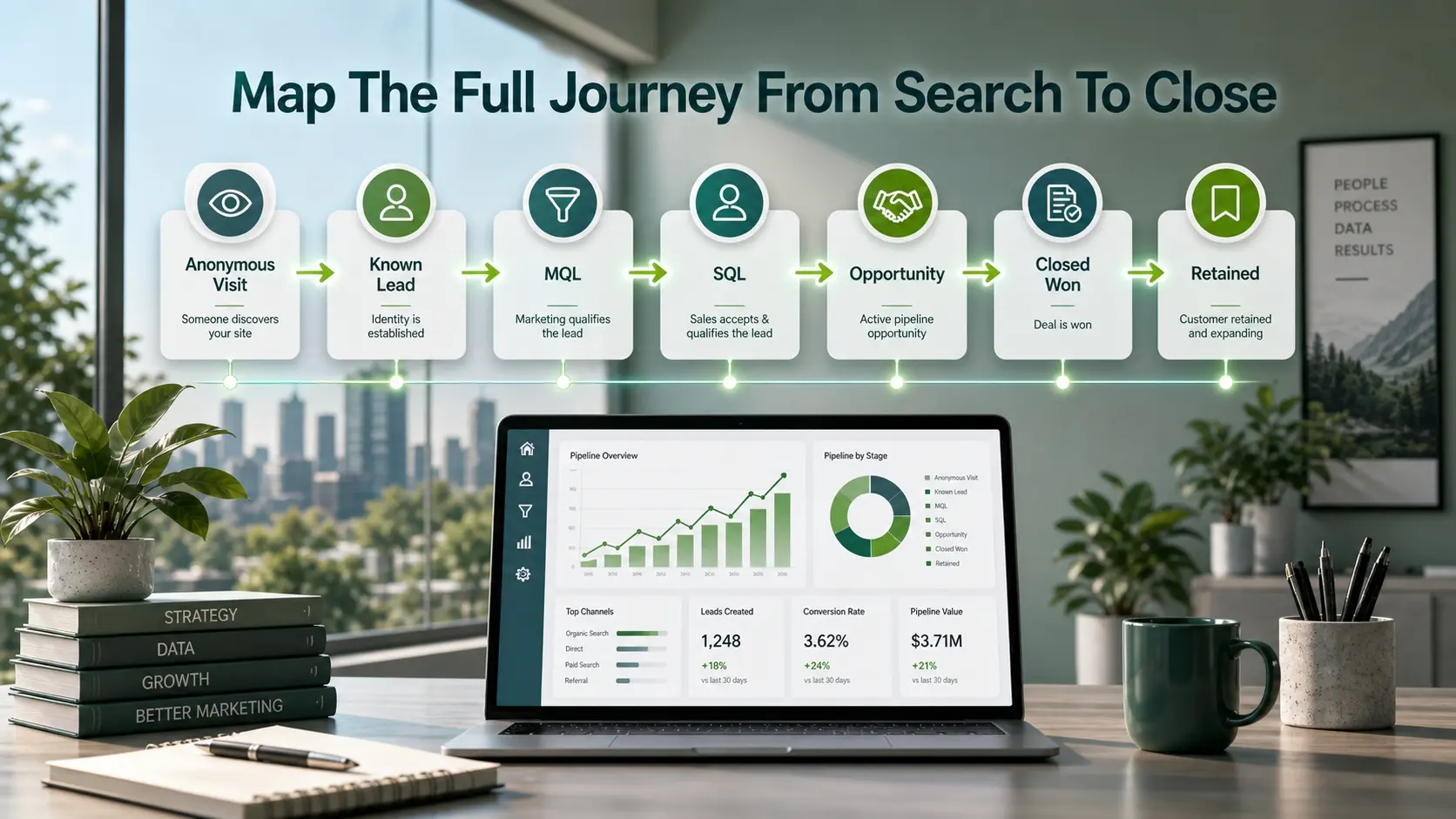
Tracking lead quality works best when you map the journey as a shared model. This model should be simple enough for sales to trust and detailed enough for marketing to act on. It should also match how your CRM stages and your funnel reporting already work.
Use a single lifecycle set that both teams agree on. Typical lifecycle points include anonymous visit, known lead, marketing qualified lead, sales qualified lead, opportunity, closed won, and retained. Each lifecycle point needs a measurable rule so reporting does not drift over time.
- Anonymous Visit: A session with a trackable source and landing page.
- Known Lead: An identity created through form, chat, call, or booking.
- MQL: A lead meeting minimum intent and fit thresholds.
- SQL: A lead accepted by sales based on a qualification rule.
- Opportunity: A deal record created with a defined next step.
- Closed Won: A signed agreement with booked revenue.
This structure makes it possible to measure quality at each handoff, not only at the end.
Set Up Clean Attribution Without Overcomplicating It
Lead quality tracking collapses when sources and campaigns are inconsistent. Start with strict naming rules and a small set of attribution views that your team can maintain. Most teams do well with first touch, last touch, and a simple multi touch model used only for directional insight.
Capture source data as early as possible and keep it immutable. First touch should be locked when the lead becomes known, while last touch can update until opportunity creation. Store both at the contact level and at the opportunity level so you can report on pipeline quality and closed deal quality.
- UTM Governance: Standardize source, medium, campaign, and content values across channels.
- Landing Page Capture: Store first landing page and query theme when available.
- Channel Grouping: Roll up granular sources into a small set of channels for dashboards.
- Offline Matching: Connect calls, events, and referrals to the same lifecycle model.
With clean attribution, quality reporting becomes stable and the team can trust trend lines.
Define Lead Quality Metrics That Sales And Marketing Share
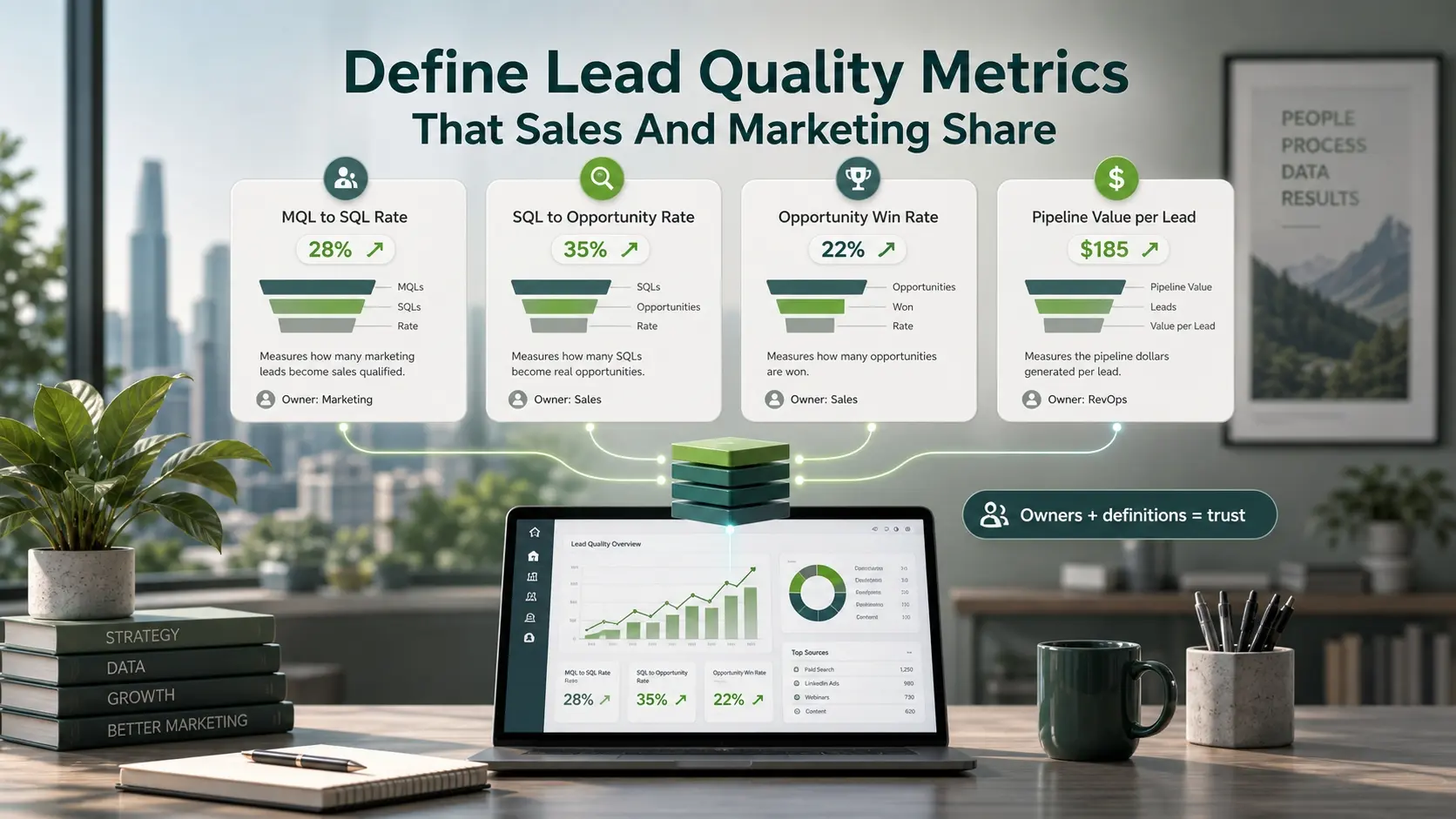
Lead count is a volume metric, not a quality metric. Quality metrics measure progression and value. Pick a small set of core metrics and use them consistently for weekly reviews and quarterly planning.
Start with conversion rates between lifecycle points, then layer in time based and value based metrics. Each metric should have an owner and a definition stored in your reporting documentation. If a metric cannot be explained in one sentence, simplify it.
| Metric | What It Measures | Why It Matters |
|---|---|---|
| MQL To SQL Rate | Acceptance of marketing qualified leads by sales | Shows whether scoring and targeting match sales reality |
| SQL To Opportunity Rate | Creation of qualified pipeline from accepted leads | Signals real buying intent and good discovery |
| Opportunity Win Rate | Closed won deals as a share of opportunities | Validates that pipeline is not inflated and improves forecasting |
| Pipeline Value Per Lead | Pipeline amount attributed to each new lead | Connects top of funnel to revenue outcomes |
When these metrics move, you can pinpoint whether the issue is targeting, qualification, or sales execution.
Build A Practical Lead Scoring Model
Lead scoring helps you prioritize, but it must be grounded in outcomes. Use two dimensions, fit scoring and intent scoring. Keep the ranges simple so stakeholders can interpret the score without training.
Fit scoring should come from firmographic and role data. Intent scoring should come from actions that correlate with progression, such as high intent page views, pricing interest, demo bookings, and repeat visits. Scoring is not a replacement for sales judgment, it is a sorting tool.
- Fit Inputs: Job role, company size band, service area, and required capabilities.
- Intent Inputs: Topic depth, key page visits, booking actions, and return frequency.
- Negative Signals: Students, competitors, irrelevant regions, and spam patterns.
Review the model monthly and validate it against opportunity creation and win rate rather than lead count.
Connect CRM Stages To Quality Signals
Your CRM is where lead quality becomes measurable in pipeline terms. If stages are loose, reporting will be loose. Define clear entry and exit criteria for each stage, and require a next step for deals that remain open.
Also standardize the loss and disqualification reasons. This is one of the fastest ways to improve lead quality because it turns sales feedback into structured data. With consistent reason codes, marketing can adjust targeting and messaging without guessing.
- Stage Hygiene: Require close dates, amounts, and next activity to prevent stalled deals.
- Reason Codes: Use a short list that captures fit, timing, budget, authority, and competition.
- Activity Logging: Track calls, emails, and meetings in one system to avoid blind spots.
These rules make pipeline quality measurable and improve the accuracy of both scoring and attribution.
Track Keyword And Content Signals Without Chasing Vanity Rankings
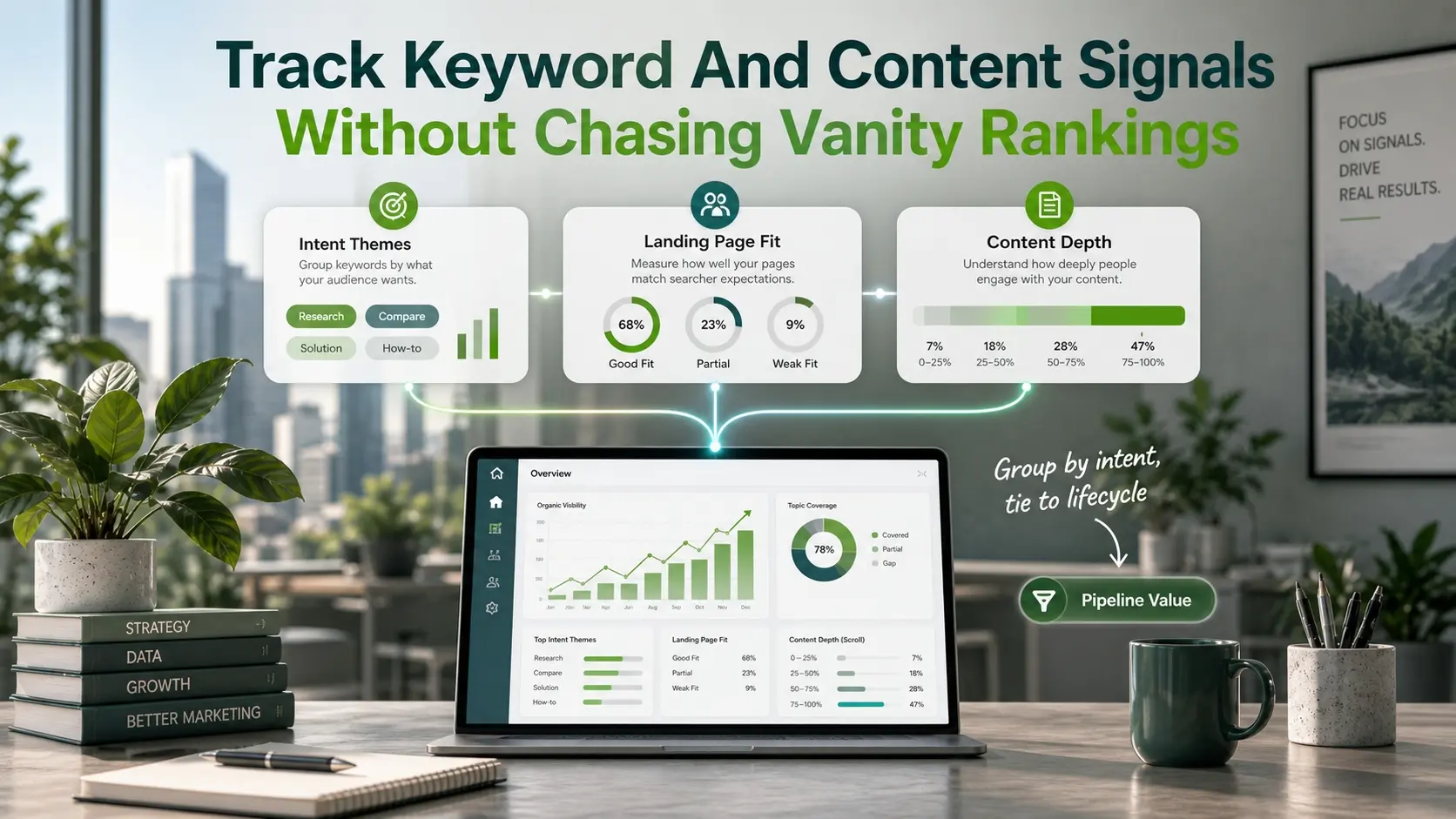
Search is often the first touch, but keyword reporting is only useful when tied to lifecycle outcomes. Group queries by intent themes rather than tracking hundreds of individual terms. Align each theme to a set of landing pages, content assets, and conversion paths.
Measure which themes drive known leads that become SQLs and opportunities. If a theme drives traffic but poor progression, it may be informational and not aligned to your offering. If a theme drives fewer visits but strong pipeline value per lead, it deserves more investment.
- Intent Themes: Group queries by problem, solution, and comparison intent.
- Landing Page Fit: Ensure the page matches the query and includes a clear next action.
- Content Depth: Track scroll depth and key clicks as intent indicators.
This approach keeps SEO aligned with revenue and reduces noise in reporting.
Improve Quality With Feedback Loops And Operational Discipline
Lead quality improves when data becomes a weekly habit. Hold a short revenue meeting that reviews the core quality metrics, recent disqualification reasons, and any scoring adjustments needed. Keep the agenda focused on changes that can be implemented quickly.
Operational discipline also means maintaining your tracking stack. Audit UTMs, forms, routing rules, and lifecycle definitions regularly. If you work with a partner, choose one that can connect SEO, analytics, and CRM reporting into a single view.
For organizations that need a tighter connection between search performance, on site behavior, and revenue outcomes, IMILI Corp supports SEO strategy and performance measurement that aligns content and campaigns with qualified pipeline. This is most useful when you want attribution and lifecycle reporting to guide decisions across marketing and sales.
- Weekly Review: Monitor conversion rates and stage velocity to catch issues early.
- Monthly Validation: Compare scores and sources against opportunity and win outcomes.
- Quarterly Cleanup: Refresh definitions, remove broken fields, and simplify dashboards.
These feedback loops make lead quality improvement continuous rather than reactive.
Conclusion
Tracking lead quality from first search to closed deal requires clear lifecycle rules, clean attribution, and metrics that both teams share. When fit and intent are measured consistently, scoring becomes actionable and CRM stages become reliable. The result is better prioritization, stronger pipeline, and fewer debates about where growth is coming from.
Frequently Asked Questions
How Do I Know If My Lead Scoring Is Accurate?
Validate scores against downstream outcomes such as SQL to opportunity rate, win rate, and pipeline value per lead. If high scores do not produce better progression, reduce complexity and adjust the inputs tied to real buyer behavior. Review the model on a regular cadence so it stays aligned with your market.
Should I Use First Touch Or Last Touch Attribution For Lead Quality?
Use both because they answer different questions. First touch shows what creates demand and brings the right people in, while last touch shows what drives conversion at the point of action. Comparing both against pipeline quality prevents over investing in channels that only look good at the top.
What Is The Fastest Way To Improve Lead Quality Without More Spend?
Standardize disqualification reasons and review them weekly with marketing and sales. Then tighten targeting and routing rules based on the most common fit gaps and timing issues. This improves conversion rates without increasing traffic or budget.