
Demand does not come from one big campaign. It comes from a clear brand, a customer journey that reduces friction, and content that keeps attention long enough to earn trust.
A strong brand strategy agency USA connects these moving parts so teams stop guessing and start building repeatable growth. That integration matters most when awareness, conversion, and retention teams share the same goals and language.
What A Brand Strategy Agency USA Actually Delivers
A brand strategy agency is not a logo shop or a messaging sprint. It creates a decision system that guides how the business shows up across channels, products, and lifecycle touchpoints.
When the work is done well, brand becomes a performance lever. It shortens evaluation, improves conversion efficiency, and supports customer engagement after the sale.
- Positioning and differentiation. Clear category context, competitive distance, and the strongest reasons to believe.
- Messaging architecture. A hierarchy that ties the core narrative to product value, proof, and use cases.
- Brand voice and tone rules. Practical guidelines that make content sound like one company, not many authors.
- Visual identity system. Components that scale across web, ads, video marketing, and sales materials without constant redesign.
- Go-to-market alignment. Shared definitions for audiences, intent stages, and the customer journey that reduce internal churn.
This foundation becomes the standard that lifecycle marketing and video teams can execute without re-litigating strategy every quarter.
Brand Awareness That Supports Demand Generation
Brand awareness should not be treated as a vanity goal. The goal is memory, preference, and clearer associations that make downstream demand generation cheaper and faster.
That requires consistency in what is promised, how it is proven, and what is repeated over time. A brand strategy agency USA will usually map awareness to specific buying triggers and barriers, then define how messaging resolves them.
- Category clarity. Prospects should understand what you do in seconds without reading a long explainer.
- Distinctive cues. Repeated visual and verbal signals that make content recognizable across platforms.
- Credibility signals. Proof points, expertise, and outcomes framed in the language buyers trust.
- Focused distribution. The channels where target buyers actually spend time and form opinions.
When awareness work is structured this way, it feeds pipeline quality rather than just reach.
Lifecycle Marketing Across The Customer Journey
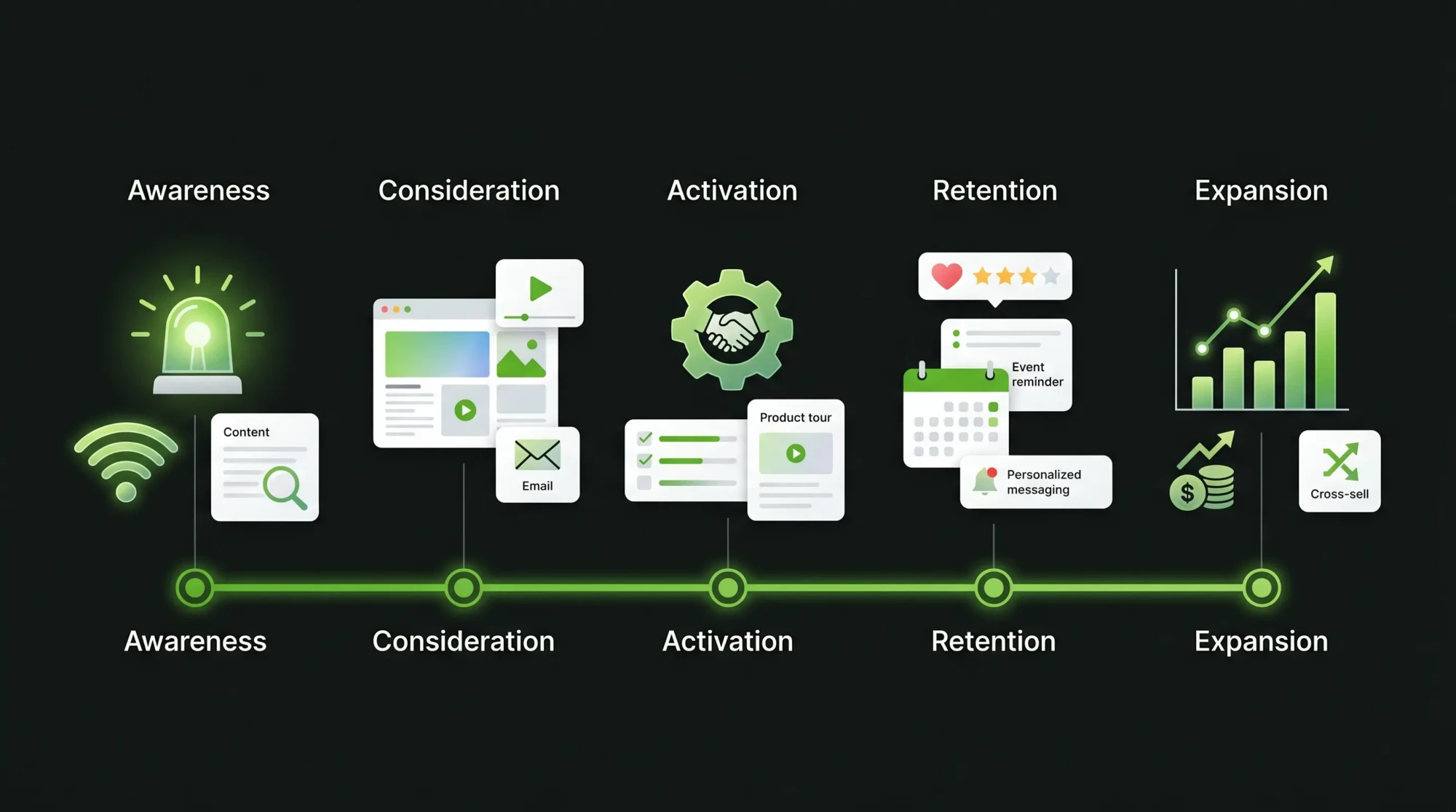
Lifecycle marketing connects brand promises to real user experiences. It ensures that acquisition messages match onboarding, onboarding matches product value, and retention programs feel helpful instead of pushy.
The most effective lifecycle marketing is behavior-led. It reacts to intent, usage, and context while keeping brand voice consistent across email, SMS, in-app, and paid retargeting.
Where Lifecycle Marketing Wins
Most teams see their biggest lift when they stop treating automation as a batch schedule. They build journeys that resolve uncertainty and remove effort at the exact moment it appears.
- Activation. Reduce time to first value with clear guidance, not more announcements.
- Adoption. Expand usage with timely education tied to feature discovery and outcomes.
- Retention. Prevent churn by detecting risk signals early and responding with useful options.
- Expansion. Introduce higher tiers or add-ons only when the user has earned the context.
Brand strategy keeps these touchpoints cohesive so each message feels like the next chapter, not a new story.
Video Marketing That Drives Customer Engagement
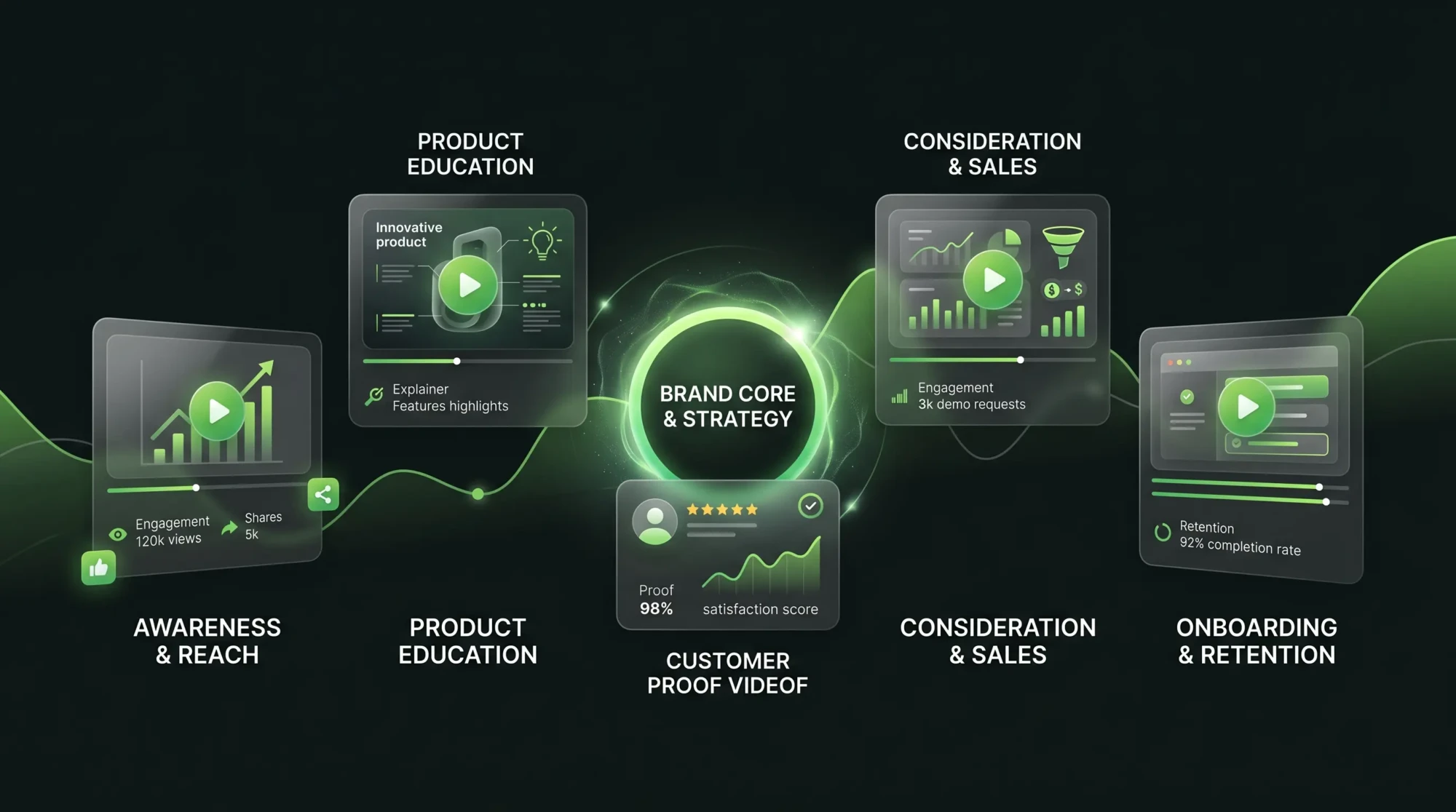
Video marketing works because it compresses meaning. It can show value fast, demonstrate credibility, and reduce the effort required to understand complex offers.
To support demand generation, video must be planned as a system, not a one-off asset. It needs a clear role at each part of the customer journey.
- Top of funnel attention. Short, distinctive videos that build recognition and communicate the core problem you solve.
- Consideration education. Product explainers and proof-led narratives that answer objections with clarity.
- Conversion support. Sales enablement clips that shorten calls and align stakeholders on outcomes.
- Post-purchase value. Onboarding and how-to libraries that reduce support load and improve adoption.
Strong brand standards make video faster to produce and easier to scale across platforms.
How Agencies Connect Brand Strategy And Demand Generation
The integration point is planning. A brand strategy agency USA typically starts with a unified view of audience intent, then chooses what the brand must own and what performance channels must prove.
Execution improves when teams share the same language for stages, conversion goals, and creative rules. That reduces internal debates and makes measurement more reliable.
- Align on the buying context. Define who buys, why they switch, and what they must believe before they act.
- Build a messaging hierarchy. Connect the core narrative to segment-specific value and proof so every channel stays consistent.
- Design the journey framework. Map acquisition, activation, retention, and expansion touchpoints to real user needs.
- Plan the content system. Assign roles to formats like video marketing, landing pages, and email sequences across the funnel.
- Operationalize measurement. Choose KPIs that reflect brand awareness, pipeline quality, and customer engagement without conflicting incentives.
Once these pieces are in place, teams can produce more assets with less friction while keeping the brand sharp.
Core Metrics That Tie Brand And Performance Together
Brand and performance teams often track different dashboards, which creates competing priorities. A better approach links leading indicators like brand awareness to lagging indicators like revenue and retention.
The goal is not to measure everything. The goal is to measure the few signals that show whether the customer journey is becoming easier and more persuasive.
| Objective | Primary Metrics | What Good Looks Like |
|---|---|---|
| Brand Awareness | Share of search, direct traffic trend, ad recall lift | More branded demand and repeat exposure with stable frequency |
| Demand Generation | Qualified pipeline rate, CAC payback, win rate | Higher intent leads and improved efficiency across channels |
| Lifecycle Marketing | Activation rate, retention rate, expansion revenue | Faster time to value and stronger customer engagement |
| Video Marketing | View-through rate, completion rate, assisted conversions | Clear lift in consideration and lower drop-off in key steps |
This table helps teams agree on outcomes before they debate creative. It also clarifies which metrics matter at each stage.
What To Look For In A Brand Strategy Agency USA
Choosing the right partner is less about a flashy portfolio and more about operating discipline. You want an agency that can turn strategy into a system your team can run.
Look for evidence of cross-functional thinking that connects brand strategy agency work to lifecycle marketing and video marketing execution.
- Strategy depth. Clear approach to positioning, messaging, and differentiation grounded in real buyer intent.
- Journey competence. Ability to map the customer journey into campaigns, flows, and touchpoints that reduce friction.
- Creative systems. Templates, guidelines, and production workflows that make quality repeatable.
- Measurement maturity. KPIs tied to demand generation and customer engagement, not only channel-level vanity metrics.
- Enablement. Deliverables that help internal teams maintain consistency across web, sales, product, and support.
These signals usually predict whether the work will stick after the kickoff phase ends.
Common Failure Points And How Agencies Prevent Them
Most brand programs fail in execution, not ideation. They create a strong narrative but do not embed it into daily marketing operations.
A capable brand strategy agency USA prevents this by building constraints and workflows that keep teams consistent under pressure.
- Strategy that stays abstract. Convert narrative into channel-ready rules, sample structures, and review checklists.
- Channel silos. Use one messaging architecture across paid, organic, lifecycle marketing, and sales enablement.
- Inconsistent creative. Define a small set of distinctive assets and cues that are reused across video marketing and design.
- Misaligned incentives. Balance short-term conversion KPIs with measures of brand awareness and journey health.
With these guardrails, teams move faster and the brand gets stronger with every campaign.
Conclusion
Brand strategy, lifecycle marketing, and video marketing work best when they are designed as one demand system. Brand creates clarity and trust, lifecycle programs deliver value in sequence, and video accelerates understanding and engagement.
A brand strategy agency USA can unify these efforts into a coherent customer journey with shared standards and measurable outcomes. When the system is consistent, demand generation becomes more predictable and customer engagement becomes easier to sustain.