

Why Your Website Sets The Ceiling For Campaign Results
A campaign can buy attention, but your website must earn action. When pages load slowly, messaging feels unclear, or forms create friction, paid and organic traffic becomes wasted spend.
A web design and digital marketing agency treats the site as the conversion engine behind every channel. That approach tightens alignment between ads, email, SEO, and onsite journeys so each click has a clear path forward.
Web Design Agency And Digital Marketing Agency Goals Must Match
Design teams often focus on visual polish while marketing teams focus on acquisition and attribution. When those priorities are disconnected, the site can look modern but still underperform against campaign goals.
Alignment starts with shared outcomes such as qualified leads, purchases, bookings, and pipeline quality. It continues with shared definitions for what a conversion is, which pages support it, and how success is measured.
When one partner owns both sides, tradeoffs become clearer. A web design and digital marketing agency can balance brand, usability, and tracking so creative choices improve results instead of hiding issues.
User Experience Shapes Trust And Decision Speed
User experience is not a design trend. It is the sum of clarity, speed, accessibility, and confidence signals that help people decide quickly.
Navigation should match how visitors think, not how internal departments are organized. Copy should reduce uncertainty by answering key questions near the top of the page and supporting claims with proof points.
Consistency also matters for trust. When ad messaging promises one thing and the page delivers another, bounce rates rise and campaign costs follow.
- Clarity: Strong page hierarchy guides scanning and prevents visitors from missing the primary action.
- Credibility: Reviews, certifications, and transparent policies reduce hesitation and increase form starts.
- Accessibility: Keyboard support, readable contrast, and descriptive labels broaden reach and reduce drop offs.
These improvements create a smoother journey across every traffic source without changing the media budget.
Website Performance Controls Cost Per Click Efficiency
Website performance affects both user patience and platform outcomes. Slow pages increase abandonment, but they can also depress quality signals that raise acquisition costs.
Performance work should prioritize the pages that campaigns send traffic to, not only the homepage. Landing pages, pricing pages, and key service pages are where most conversions start or end.
Useful performance work usually includes image optimization, script reduction, caching, font loading discipline, and server responsiveness. The goal is a fast first view and quick interaction on mobile.
| Website Factor | What It Impacts | Marketing Outcome |
|---|---|---|
| Mobile Load Speed | Bounce rate and engagement | Lower cost per lead and stronger ad performance |
| Clear Page Structure | Scanning and comprehension | Higher click through to key actions |
| Form Usability | Completion rate | More qualified inquiries from the same traffic |
| Tracking Reliability | Attribution accuracy | Better budget decisions across digital marketing campaigns |
This connection between speed, clarity, and measurable outcomes is where design and marketing stop competing and start reinforcing each other.
Landing Page Design Connects Click Intent To Action
Landing page design should match the intent of the traffic source. A person clicking a product ad needs different information and pacing than someone arriving from a branded search.
High performing landing pages reduce choice overload and keep one primary action dominant. Supporting content should remove objections in the order people typically consider them, such as fit, price, risk, and effort.
Layout discipline matters as much as copy. Headlines, subheads, and scannable sections should lead the eye toward proof and then toward the call to action without distractions.
- Message Match: Align headline language with the ad or email promise to confirm visitors are in the right place.
- Friction Control: Minimize required fields and avoid unnecessary account creation for early stage conversions.
- Proof Placement: Put testimonials, stats, and guarantees near the point of decision, not buried at the bottom.
When landing pages are built as part of the campaign plan, conversion rates improve without expanding reach.
Conversion Rate Optimization Turns More Traffic Into Revenue
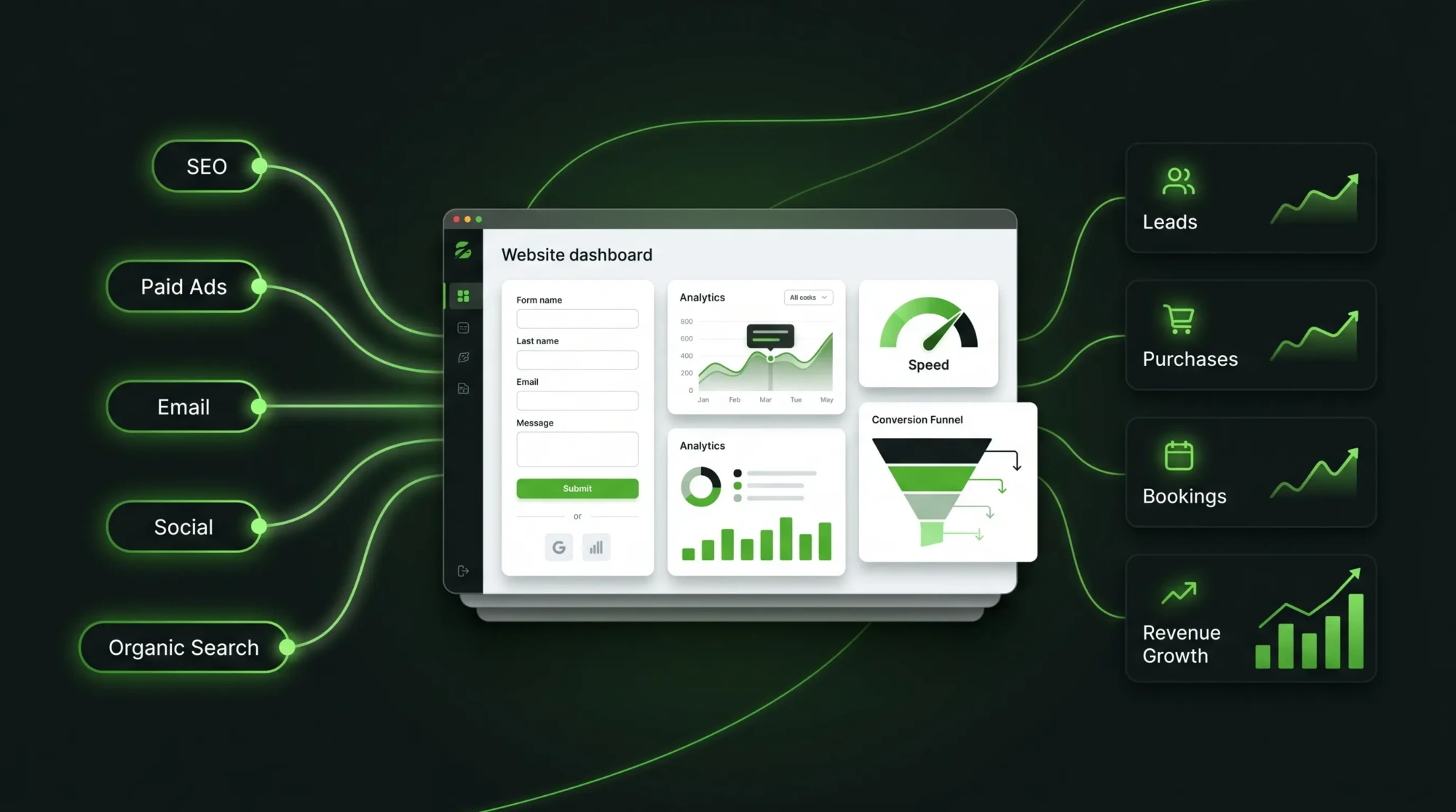
Conversion rate optimization is a disciplined way to improve results with testing, analytics, and iteration. It focuses on removing uncertainty and reducing effort at the moment someone considers taking action.
CRO should start with a clear measurement plan and clean data. If analytics tags misfire or events are inconsistent, tests can mislead teams into keeping changes that only appear to work.
A web design and digital marketing agency can connect the right skills to the right tasks. Designers shape the interface, marketers shape the offer and messaging, and developers ensure the experience is fast and measurable.
- Define The Primary Conversion. Choose one main action per page and set a clear success metric.
- Audit The Journey. Review the path from ad to page to form or checkout and identify drop off points.
- Prioritize High Impact Fixes. Start with issues that affect many visitors such as page speed, clarity, and form friction.
- Test With Guardrails. Run experiments long enough for stable results and avoid changing multiple major variables at once.
- Roll Out And Monitor. Ship winners, document learnings, and watch performance after deployment.
This process builds a steady improvement loop that supports every channel, including SEO, paid search, paid social, and email.
Digital Marketing Campaigns Depend On Clean Analytics
Many campaign problems are measurement problems. If tracking is incomplete, teams optimize toward the wrong pages, the wrong audiences, or the wrong offers.
Strong measurement starts with consistent events across the site, reliable consent handling, and naming conventions that teams can follow. It also requires thoughtful conversion mapping so micro conversions support the main goal.
Attribution should be realistic, not perfect. The practical aim is to make better decisions week to week by understanding what drives qualified actions, not only raw clicks.
- Event Coverage: Track key actions such as form starts, submissions, calls, and checkout progress.
- Data Hygiene: Filter internal traffic and reduce duplicate conversions from refreshes or validation errors.
- Audience Signals: Use onsite behaviors to refine remarketing and nurture sequences.
When analytics is dependable, budgets move toward what works and away from what only looks busy.
Choosing A Web Design And Digital Marketing Agency That Scales
The right partner should treat your site as a living platform, not a one time project. That means planning for content growth, technical upkeep, and ongoing experimentation.
Look for an agency that can explain decisions in plain language and show how design choices tie to campaign outcomes. Processes matter more than promises because they reveal how work is prioritized and reviewed.
- Strategy First: Clear positioning, audience definitions, and offer structure before wireframes or ad builds.
- Cross Functional Delivery: Design, development, SEO, paid media, and analytics working from one plan.
- Performance Discipline: A focus on website performance, accessibility, and maintainable code.
- Testing Mindset: Conversion rate optimization embedded into monthly work, not treated as a separate add on.
- Transparent Reporting: Reporting tied to outcomes such as revenue, leads, and pipeline quality rather than vanity metrics.
These traits protect campaign efficiency and keep improvements compounding over time.
Conclusion
Your website influences how every campaign performs because it controls trust, speed, clarity, and measurement. When any of those elements are weak, even strong targeting and creative cannot deliver consistent returns.
A web design and digital marketing agency that integrates user experience, landing page design, website performance, and conversion rate optimization gives campaigns a stronger foundation. With that foundation in place, digital marketing campaigns become easier to scale and simpler to optimize.
FAQ’s
-
Why is a website important for digital marketing campaigns?
A website is important because every ad click, email visit, social media user and search visitor usually lands there. If the website is slow, confusing or hard to trust, marketing traffic may not convert into leads or sales. A strong website helps capture demand and turn visitors into real business results.
-
How can web design improve conversion rates?
Web design improves conversion rates by making the visitor journey clear and easy. Fast-loading pages, simple navigation, strong calls to action, clear messaging, trust signals and short forms can reduce friction. When users understand what to do next, they are more likely to take action.
-
What should a web design and digital marketing agency focus on?
A web design and digital marketing agency should focus on user experience, site speed, technical SEO, content structure, tracking and conversion optimization. The goal is not just to create a good-looking website but to build a performance-focused site that supports ads, SEO, email marketing and analytics.