

Returning customers can be a valuable source of business growth, but identifying which marketing channel influenced their next purchase is not always straightforward. A customer may discover a product through social media, receive an email reminder, search for the brand, and return to buy weeks later. Each interaction may play a different role in the decision. Understanding these journeys helps businesses compare marketing channels, measure customer retention, and make better budget decisions. However, attribution reports show how credit is assigned, while controlled experiments provide stronger evidence of whether marketing actually caused additional purchases.
Why Returning Customers Are Hard To Attribute?
Returning behavior can be triggered by a mix of memory, timing, product experience, and brand trust. Marketing often plays a supporting role that is easy to miss in last-click reporting. If attribution is oversimplified, budget shifts can punish the channels that actually protect long-term revenue.
Retention is also delayed. A customer might re-order weeks after seeing a reminder email, reading a blog post, or hearing about a new release through social. That time gap creates measurement blind spots unless your tracking is designed for longer cycles.
What Marketing Channel Credit Really Means?
Channel credit is an attribution decision, not a fact. Businesses distribute value across marketing touchpoints based on their sales process, customer buying cycle, and available tracking data. A channel can play an important role even if it rarely appears as the final click. However, receiving attribution credit does not necessarily mean the channel caused the purchase. Our attribution vs. incrementality guide explains why reported advertising performance and actual incremental impact are different.
Useful crediting answers three questions. Which channel helped restart intent, which channel supported evaluation, and which channel removed friction at purchase. When you separate those roles, your reporting becomes much more actionable.
For example, imagine a customer who bought from an online store last month. The customer later reads a helpful blog article, receives a product reminder by email, searches for the brand on Google, and places another order. A last-click report may give the final search most of the credit, even though the email and article appeared earlier in the journey. Looking at multiple touchpoints provides a fuller picture of how the customer returned.
To test whether the email created additional purchases, the business could randomly divide previous customers into two groups. One group receives the email, while the other does not. If the emailed group has a higher repeat-purchase rate, the business can estimate the campaign’s incremental effect, provided the experiment is properly designed and the result is statistically reliable.
Customer Return Paths That Commonly Get Misread
Branded search can receive too much credit when customers use Google to find a business they already know. Earlier interactions, such as social media campaigns, email reminders, or helpful content, may have influenced their decision before they searched. Direct traffic can also appear close to repeat purchases, although Google Analytics 4 generally excludes direct visits from last-click credit when another eligible channel appears in the conversion path. These patterns show why businesses should examine earlier interactions instead of assuming the final visit caused the purchase.
Another common issue is over-crediting discount-driven campaigns. Promotions can pull orders forward, but they can also train buyers to wait. If you only look at short windows, you may reward a channel that weakens margin and long-term repeat rates.
Attribution Models That Fit Repeat Purchases
Marketing attribution models assign conversion credit to different customer interactions. Some models focus on the final click, while others distribute credit across multiple touchpoints. For businesses using Google Analytics 4, it is important to understand the models currently available instead of relying on older attribution options. Comparing supported models can reveal how reporting assumptions change the apparent performance of each marketing channel.
- Data-Driven Attribution: Uses available conversion-path data to distribute credit among eligible marketing interactions. In Google Analytics 4, this model helps businesses understand how different touchpoints contribute to key events, including purchases.
- Paid and Organic Last Click: Assigns credit to the final eligible interaction before a conversion, generally excluding direct traffic when another eligible interaction exists. It is useful for identifying the channel that completed the recorded journey, but it may undervalue earlier marketing activity.
- Google Paid Channels Last Click: Gives credit to the last eligible Google paid advertising interaction. When no Google Ads interaction exists, GA4 uses its paid and organic last-click fallback. This model can be useful for Google advertising analysis, but it does not independently establish incremental impact.
- Traditional Attribution Models: First-click, linear, time-decay, and position-based models remain useful concepts for understanding how different crediting rules work. However, Google Analytics 4 removed these models in November 2023. Businesses should not expect to select them in current GA4 reporting, although other analytics systems or custom analyses may support similar approaches.
Once you pick a baseline model, keep it stable for at least a full buying cycle. Then layer experiments and incrementality work on top, instead of changing the model every time results feel uncomfortable.
Businesses using Google Analytics 4 should review Google’s official GA4 attribution-model settings to understand which reporting models are currently supported. Checking these settings also helps teams understand how changes to attribution rules can affect reported conversion credit.
Data You Need Before You Decide Who Gets Credit

Reliable customer-level attribution depends on consistent campaign tracking, accurate conversion events, and a way to connect eligible customer interactions across sessions. When the same person browses on a phone but completes a purchase on a computer, fragmented tracking can make the journey difficult to understand. Our guide to cross-device attribution explains how website analytics, customer records, and appropriate identity-matching methods can help businesses understand these journeys while respecting privacy requirements.
- Consistent Campaign Tagging: Use consistent campaign parameters to identify traffic from advertising, email, SMS, and partner promotions. Keep naming rules standardized across campaigns so reports do not split the same source into different categories. The official Google Analytics UTM tagging guide explains how parameters such as utm_source, utm_medium, and utm_campaign help identify marketing traffic. Avoid tagging links between pages on your own website as separate acquisition campaigns.
- Clean Conversion Events: Track purchases, refunds, subscriptions, and key retention actions such as repeat orders or renewals.
- Customer Identity Resolution: Connect customer interactions using consistent first-party identifiers, such as an account ID or CRM customer ID. This helps businesses recognize repeat activity across eligible sessions and devices. Identity matching must follow applicable privacy requirements and platform policies, and personally identifiable information should not be sent directly to standard analytics tracking fields.
- Channel Definitions: Document what counts as paid social, organic social, referral, affiliate, and direct so reporting is consistent.
Customer data collection must also respect privacy requirements and analytics platform policies. Businesses should avoid sending personal details, such as email addresses or phone numbers, through ordinary analytics events, page URLs, or UTM parameters. Google’s guidance on avoiding personally identifiable information explains important restrictions for analytics implementations. Teams should also review applicable consent requirements before combining customer information from different marketing systems.
With those basics in place, you can interpret channel credit with far more confidence. The next step is to evaluate performance with retention-specific metrics, not just first-time conversions.
Retention Metrics That Reveal True Channel Impact
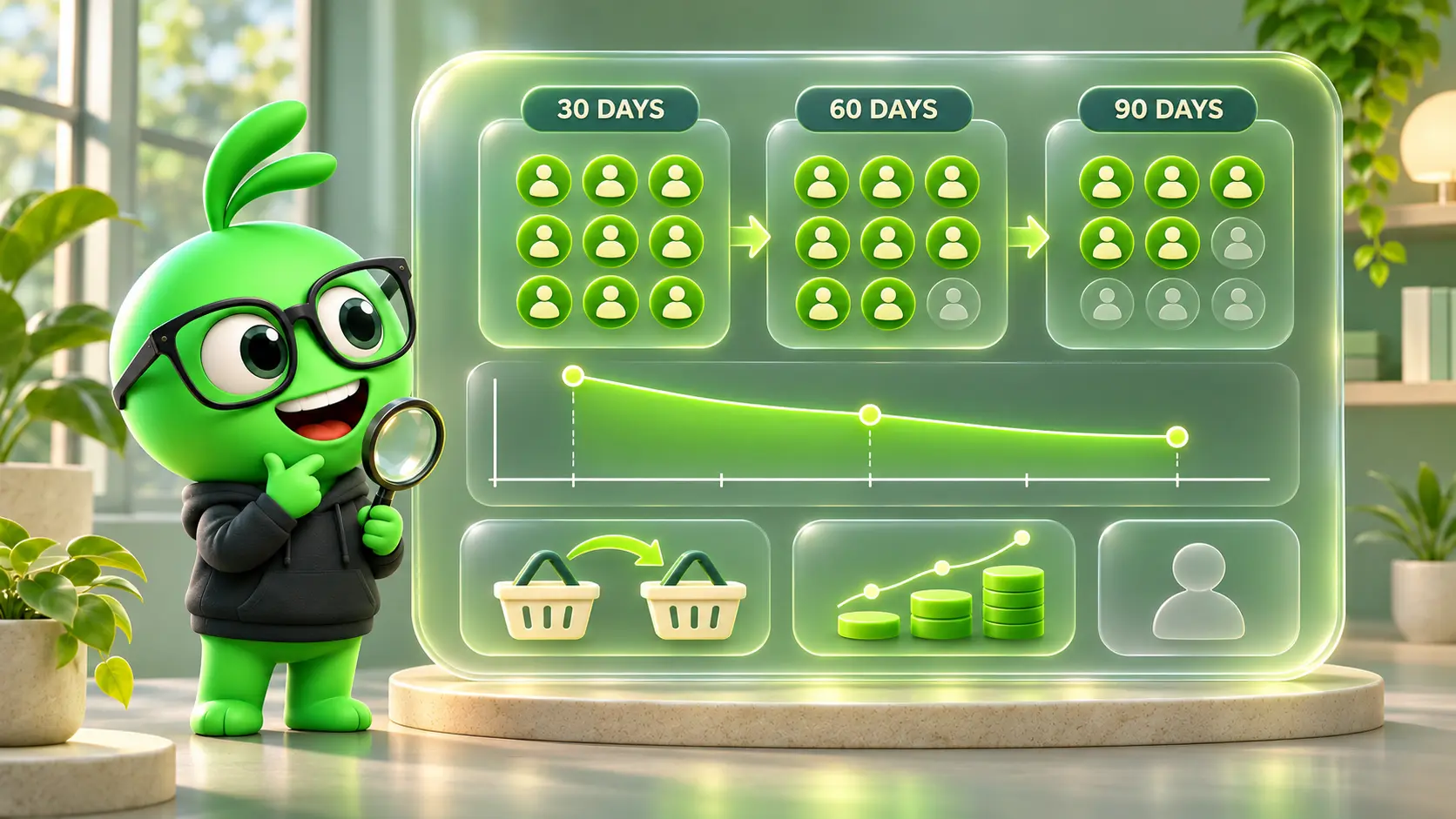
Customer retention can be evaluated by analyzing cohorts, which are groups of customers who share a common starting point or characteristic. Comparing these groups over equal periods helps businesses understand repeat purchases and long-term customer behavior. Google’s GA4 cohort exploration guide explains how to examine returning activity over time. However, GA4 cohort exploration has device-based limitations, so businesses needing confirmed cross-device repeat-purchase rates should also use reliable customer and order records. Cohort differences reveal patterns but do not automatically prove that a marketing channel caused them.
- Repeat Purchase Rate: The percentage of customers in a defined group who make at least one additional purchase within a specified period, such as 30, 60, or 90 days. Choose a measurement window that matches the normal buying cycle, and include only customers who have had enough time to complete that window.
- Time To Second Purchase: The number of days between a customer’s first completed order and second completed order. Comparing this metric across customer groups can reveal differences in buying behavior, but faster repeat purchases do not automatically prove that a marketing campaign caused them.
- Customer Lifetime Value: Total contribution over time, ideally margin-adjusted, so expensive channels do not look better than they are.
- Retention By Acquisition Source: Cohort-level retention split by first known touchpoint, then reviewed alongside assisted touches.
- Churn Or Lapse Rate: The share of customers who stop buying after a normal purchase interval, tracked by segment and channel mix.
Always compare customer groups over equivalent periods. For example, customers who made their first purchase 90 days ago should not be directly compared with customers acquired only seven days ago when measuring a 60-day repeat purchase rate. Customer groups also need enough observations to produce meaningful results. Keeping the measurement period, customer eligibility rules, and purchase definitions consistent makes channel comparisons more reliable.
These metrics help you distinguish between channels that drive one more order and channels that build habits. That distinction should guide your budget and your creative strategy.
How to Compare Channels Without Falling for Last Click?
A fair comparison uses multiple lenses. Pair attribution with incrementality thinking, then validate with experiments when possible. The goal is to avoid rewarding channels that only harvest demand.
- Map the Touchpoints: Pull a path report showing common sequences that lead to repeat purchases and identify the channels that appear early versus late.
- Set A Lookback Window: Choose a window that matches your repurchase cycle so you do not undercount the influence of slower channels.
- Separate New Versus Returning: Report performance for returning customers as its own view so you can see what actually drives reorders.
- Compare Model Outputs: Run at least two attribution models and review how channel credit shifts before making budget moves.
- Validate With Controlled Tests: Use customer holdout groups, geographic experiments, or other properly designed incrementality studies to estimate whether marketing actually generated additional purchases. For eligible advertisers, Google Ads Conversion Lift provides a way to compare outcomes between exposed and control groups. Check experiment eligibility, sample size, and statistical reliability before making major budget decisions.
This approach reduces noise and makes channel credit a repeatable process. It also helps your team agree on changes because the logic is visible and documented.
Channel Patterns That Often Drive Repeat Customers
Repeat behavior is commonly influenced by channels that maintain relationship and reduce friction. That does not mean paid channels do not matter, but it changes how you measure their job. Look for channels that create useful reminders, education, reassurance, and loyalty.
- Email Marketing: Strong for reactivation and replenishment when segmentation and timing are aligned to customer behavior.
- SMS and Messaging: High immediacy for time-sensitive reminders, but it needs frequency controls to protect trust.
- Organic Search and Content: Builds confidence and answers questions that reduce churn, especially when buyers compare options before repeating.
- Paid Retargeting: Useful for bringing back high-intent visitors, but it can be over-credited if view-through rules are too generous.
- Loyalty and Referral Programs: Encourages habit and advocacy, but it should be measured on incremental lift, not just participation.
The right marketing mix depends on the business category, purchase frequency, customer behavior, and profit margins. Some channels focus mainly on acquiring customers, while others support loyalty, repeat purchases, and long-term growth. Understanding the difference between performance marketing and growth marketing can help businesses decide whether they should focus on immediate campaign results or improve performance across the entire customer journey. Each channel should be evaluated according to the role it plays in attracting and retaining customers.
A Practical Channel Credit Scorecard
A scorecard helps you review channels with the same standards every month. It also prevents one metric from dominating decision-making. Keep it simple enough that it gets used.
| Channel | Best Signal For Repeat Behavior | Common Attribution Pitfall |
|---|---|---|
| Repeat purchase rate among targeted customer segments | Crediting all purchases after an email campaign without checking how many would have happened anyway | |
| Paid Search | Incremental lift on branded and non-branded split | Brand terms absorbing credit from upstream awareness |
| Paid Social | Cohort LTV for exposed versus unexposed | View-through windows inflating contribution |
| Organic Content | Repeat visits, assisted purchases, and retention by acquisition source | Under-crediting earlier organic interactions when later marketing touches receive conversion credit |
Review this scorecard alongside contribution margin, customer acquisition costs, and overall marketing efficiency. A channel may generate frequent repeat purchases without producing enough profit to justify its cost. Our MER vs. ROAS comparison explains how channel-level advertising returns differ from overall marketing efficiency. Combining these measures with customer retention data can help businesses make more balanced budget decisions.
Where ImiliCorp Fits in A Smarter Attribution Setup
Channel credit improves quickly when tracking, reporting, and CRM data work together. ImiliCorp supports organizations that want marketing operations that are measurable, structured, and aligned to revenue outcomes. When your customer data is organized and your marketing workflows are standardized, retention reporting becomes far less ambiguous.
If your team is dealing with inconsistent campaign tagging, fragmented customer records, or unclear funnel reporting, connecting these systems can make marketing performance easier to measure. Better data organization also supports customer segmentation, retention campaigns, and more reliable marketing experiments. Businesses that need support with customer journeys, re-engagement, and marketing automation can explore ImiliCorp’s lifecycle marketing and CRM services to understand the available service options.
Conclusion
When valuable customers return, the last click may be only one part of their journey. Understanding which marketing channels deserve credit requires examining the interactions that renewed customer interest, supported purchase decisions, and made buying easier. However, receiving attribution credit does not automatically prove that a particular channel caused the purchase. Reliable marketing decisions depend on accurate tracking, suitable attribution models, and retention metrics that go beyond last-click reporting.
Pick a baseline attribution approach, measure repeat performance through cohorts, and validate with controlled tests where possible. When channel credit is consistent and defensible, budget decisions get simpler and retention becomes a managed system instead of a mystery.
Frequently Asked Questions
Which Attribution Model is Best for Returning Customers?
There is no single attribution model that works best for every business. In Google Analytics 4, data-driven attribution is a useful starting point because it distributes credit across eligible marketing interactions based on available conversion-path data. Comparing it with last-click reporting can help reveal how channel credit changes. Businesses should also use customer retention metrics and controlled experiments when possible to validate whether marketing campaigns generate additional repeat purchases.
Why Does Branded Search Get So Much Credit for Repeat Purchases?
Branded search often acts as the final navigation step after other channels create interest. If earlier touches are not tracked well, branded search absorbs the value in last-click reports. Comparing multiple attribution models and using incrementality tests helps prevent over-crediting it.
What is the Fastest Way to Improve Channel Credit Accuracy?
Start by standardizing UTM tagging, validating purchase events against order records, and connecting eligible customer interactions through privacy-compliant identifiers. Separate reporting for new and returning customers, and select attribution lookback windows that match the normal repurchase cycle. These improvements can make channel comparisons more reliable, while controlled experiments can provide stronger evidence about which marketing activities actually increase repeat purchases.