

First-party attribution helps small businesses understand which marketing efforts drive revenue using data they directly collect from customers and website visitors. It reduces reliance on third-party cookies, improves measurement accuracy, and builds a cleaner path from click to conversion. This guide focuses on practical, low-lift steps that create trustworthy reporting you can actually use.
What First Party Attribution Means For Small Businesses?
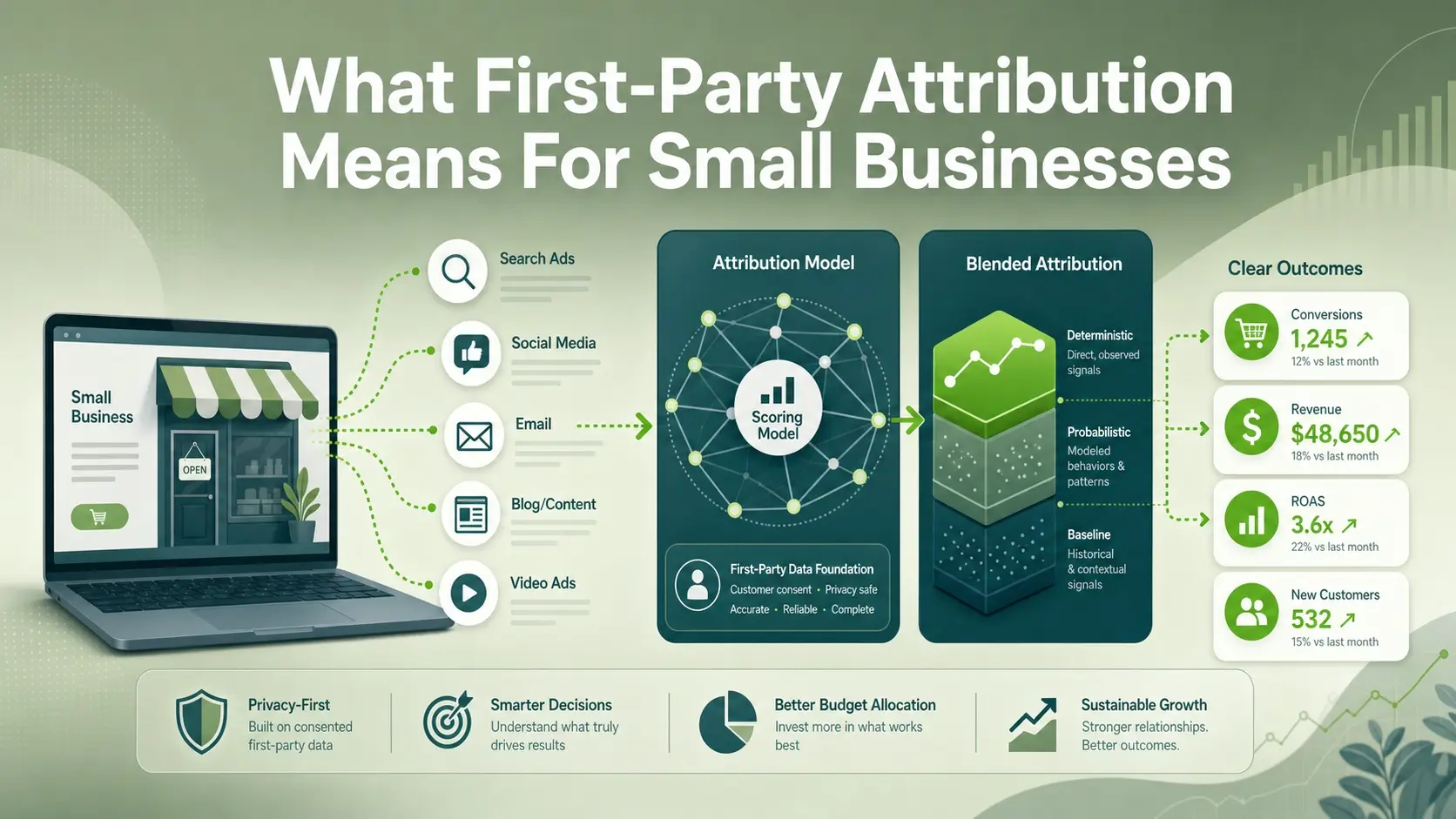
First-party attribution is the practice of connecting marketing touchpoints to outcomes using first-party data such as website events, form submissions, call tracking outcomes, and purchase history. Instead of depending on opaque ad platform reports alone, you create a consistent dataset you own and can audit. The goal is not perfect tracking, but dependable decision-making.
For small teams, the most useful view is usually a blended model that combines deterministic signals like logged-in sessions and submitted forms with probabilistic signals like modeled conversions. Done well, this becomes a stable measurement layer that supports budgeting, creative testing, and sales alignment.
Why Traditional Attribution Breaks Down?
Many small businesses try to measure performance using last-click reports from ad platforms or basic analytics dashboards. Those views can be incomplete because they struggle with cross-device behavior, privacy restrictions, ad blockers, and browser limitations. The result is a patchwork of numbers that do not match across tools.
Another common issue is inconsistent naming and tracking standards. When UTM parameters, channel groupings, and conversion definitions are not governed, reports drift and comparisons become unreliable. First-party attribution works best when definitions stay stable over time.
Start With Measurement Goals And A Single Source Of Truth
Attribution fails when the business cannot agree on what success looks like. Define the outcomes that matter most, then decide where those outcomes will be recorded as the source of truth. For many small businesses, a CRM or ecommerce platform is the most reliable place to confirm revenue and lead quality.
Keep the initial scope tight so the system is maintainable. A small set of high-value conversions is better than dozens of loosely tracked micro-events that create noise.
- Primary outcome: A closed sale, paid invoice, or completed purchase that represents real revenue.
- Qualified lead: A lead that meets agreed criteria such as budget, timeline, and fit, confirmed by sales or operations.
- Key intent action: Actions that strongly indicate buying intent such as a quote request, booking, or pricing page submission.
- Supporting engagement: Lower-intent events like newsletter sign-ups that you track for nurturing, not final ROI decisions.
Once these are defined, keep the language consistent across analytics, ad platforms, and the CRM. That consistency is what makes attribution useful month after month.
Collect High Quality First Party Data
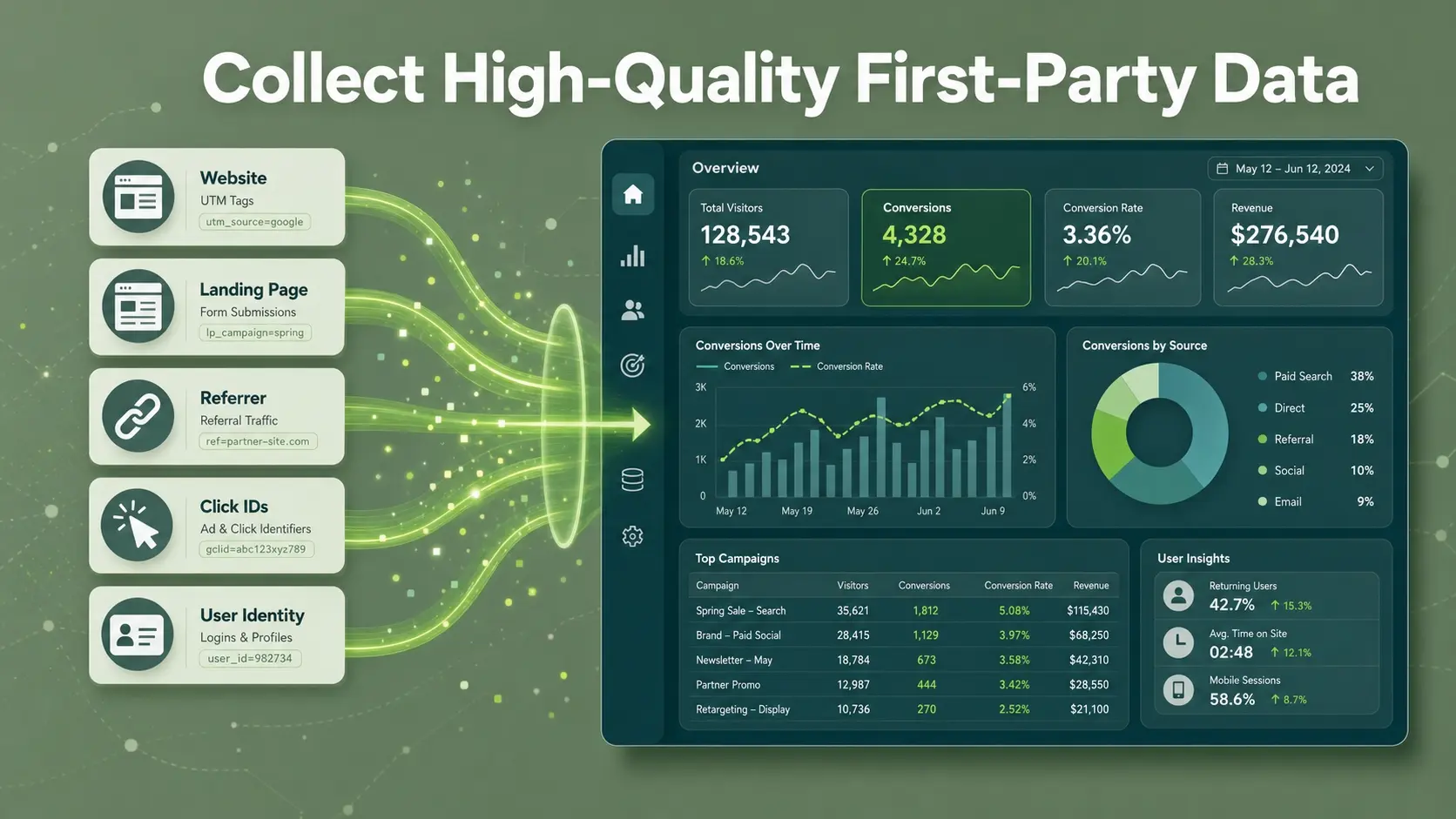
First-party attribution depends on collecting data in a privacy-aware and consistent way. That usually means server-side or first-party cookie approaches where possible, plus careful consent handling. It also means capturing the marketing context at the moment a lead or order is created.
Prioritize the fields that help you tie demand to outcomes. Capture source, medium, campaign, landing page, and a stable identifier that can be matched later.
- UTM governance: Create a simple naming standard so campaigns and channels roll up cleanly in reports.
- Landing page and referrer: Store both, since referrers can be lost and landing pages reveal intent.
- Click IDs where allowed: Preserve platform click identifiers when consent permits, since they improve matching.
- Identity and deduplication: Use email, phone, or account ID to merge duplicate leads and avoid inflated conversion counts.
To operationalize this without building everything in-house, many small businesses use a measurement partner that can implement tracking, tag governance, and reporting in a single roadmap. IMILI Corp can support this kind of foundational setup through analytics implementation and data strategy services, especially when a team needs clarity without adding internal headcount.
Choose An Attribution Approach You Can Maintain
Small businesses benefit from attribution methods that are transparent and stable. A simple model that is consistently applied will outperform a complex model that changes every month. Start with one primary model and one supporting view for context.
| Attribution Approach | Best Fit | Main Tradeoff |
|---|---|---|
| Last Click | Fast reporting and simple optimization | Undervalues earlier touchpoints |
| First Click | Understanding demand generation sources | Overcredits discovery channels |
| Linear | Longer consideration cycles and multiple touches | Can flatten the impact of key steps |
| Position Based | Balancing discovery and conversion moments | Weights are still a simplification |
Pick one model as the reporting default, then use another model as a sense-check. This reduces debates and keeps decision-making focused on action.
Implement Tracking With Clear Conversion Definitions
Before adding new tags, document what counts as a conversion and where it is recorded. Include the exact trigger, the success page or event name, and the business rule that qualifies it. Then validate the full path from click to record in your CRM or order system.
When you instrument events, keep the taxonomy stable. Stable event names and parameters allow you to compare performance across weeks without constant rework.
- Audit current tracking: List every tag, pixel, and event and identify duplicates, gaps, and conflicting definitions.
- Define conversions: Choose a small set of conversions tied to revenue or lead quality, then document triggers and rules.
- Standardize UTMs: Publish naming rules and enforce them in campaign creation workflows.
- Connect to the CRM: Ensure each lead or order record stores acquisition fields and can be matched to marketing data.
- Validate end to end: Test multiple paths and confirm that analytics, ads, and CRM totals reconcile within an expected range.
After the baseline is live, focus on reducing data loss rather than adding more events. Fewer, stronger signals improve attribution quality.
Use Consent And Privacy Practices That Protect Trust

First-party data is powerful because it is based on a direct relationship with the customer. That relationship depends on transparent consent flows and reasonable data handling. Ensure your consent banner behavior matches what is actually firing on the site.
Limit access to sensitive datasets, document retention rules, and store only what you need for measurement. Clear governance protects your customers and reduces operational risk.
- Consent mapping: Tie each tag category to the correct consent state and verify it with testing.
- Data minimization: Avoid collecting unnecessary personal data when aggregate measurement is enough.
- Access controls: Restrict admin rights and log changes to tagging and reporting configurations.
These controls also make your reporting more credible when stakeholders ask how the numbers are produced.
Turn Attribution Into Budget And Creative Decisions
Attribution is only valuable if it changes what you do next. Build a simple rhythm where you review performance, decide actions, and track outcomes. Over time, you can move from channel-level decisions to campaign-level and creative-level learning.
Focus on a few decision questions that directly impact spend and pipeline. This keeps reporting from becoming a dashboard that no one uses.
- Channel allocation: Shift budget toward channels with stable cost per qualified lead or cost per purchase.
- Message-market fit: Identify which offers and landing pages produce higher conversion rates and lower refund or churn risk.
- Sales follow-up quality: Track lead-to-opportunity and opportunity-to-close rates by source to improve routing and scripts.
- Retention impact: Connect acquisition sources to repeat purchase rate or renewal rate where applicable.
If you want these insights without heavy internal analysis work, IMILI Corp can help create reporting that ties acquisition data to CRM outcomes and keeps the measurement layer clean as campaigns scale.
Common Pitfalls And How To Avoid Them
Most attribution problems are process problems, not tool problems. Teams change UTMs, rename events, or swap landing pages without updating documentation. Small issues compound until reports stop matching reality.
Set guardrails early so you do not need a rebuild later. A light governance checklist is often enough to keep measurement reliable.
- Too many conversions: Track fewer outcomes and tie them to revenue or qualified pipeline.
- Uncontrolled UTMs: Enforce naming rules and block unknown values in reporting where possible.
- CRM mismatch: Ensure lead status definitions are consistent and deduplication is working.
- Overreliance on platform reports: Use ad platform attribution for optimization, but trust your first-party dataset for business decisions.
With these guardrails, attribution becomes a durable system rather than a recurring troubleshooting project.
Conclusion
First-party attribution for small businesses starts with clear goals, a reliable source of truth, and disciplined data collection. Choose a model you can maintain, document conversion definitions, and connect marketing context to CRM or purchase outcomes. When the basics are solid, you can confidently adjust budgets, improve creative, and build a measurement practice that holds up as privacy changes continue.
If you need a structured path from setup to reporting, working with a specialist team like IMILI Corp can help you implement tracking, governance, and attribution workflows without overcomplicating the stack.
Frequently Asked Questions
Do I Need A CRM For First Party Attribution?
A CRM is not required, but it makes attribution far more useful because it confirms lead quality and revenue. If you do not have a CRM, use your ecommerce platform or invoicing system as the source of truth. The key is having one place where outcomes are recorded consistently.
How Long Does It Take To See Reliable Attribution Data?
You can start seeing directional insights within weeks once tracking is stable and UTMs are consistent. More reliable patterns emerge after you collect enough conversions to smooth out daily volatility. The best signal quality comes from consistent definitions and clean deduplication.
What Should I Track If I Have A Low Conversion Volume?
Prioritize a small number of high-intent actions that are closest to revenue, then supplement with qualified lead indicators from sales notes or status fields. Avoid tracking many low-intent events that create noise. Over time, combine these signals with longer windows to detect trends without overreacting.