
Branded and non-branded organic traffic can both look like SEO wins, but they do not mean the same thing. The difference matters when you are proving growth, prioritizing content, and forecasting pipeline impact.
What Branded Organic Traffic Means?
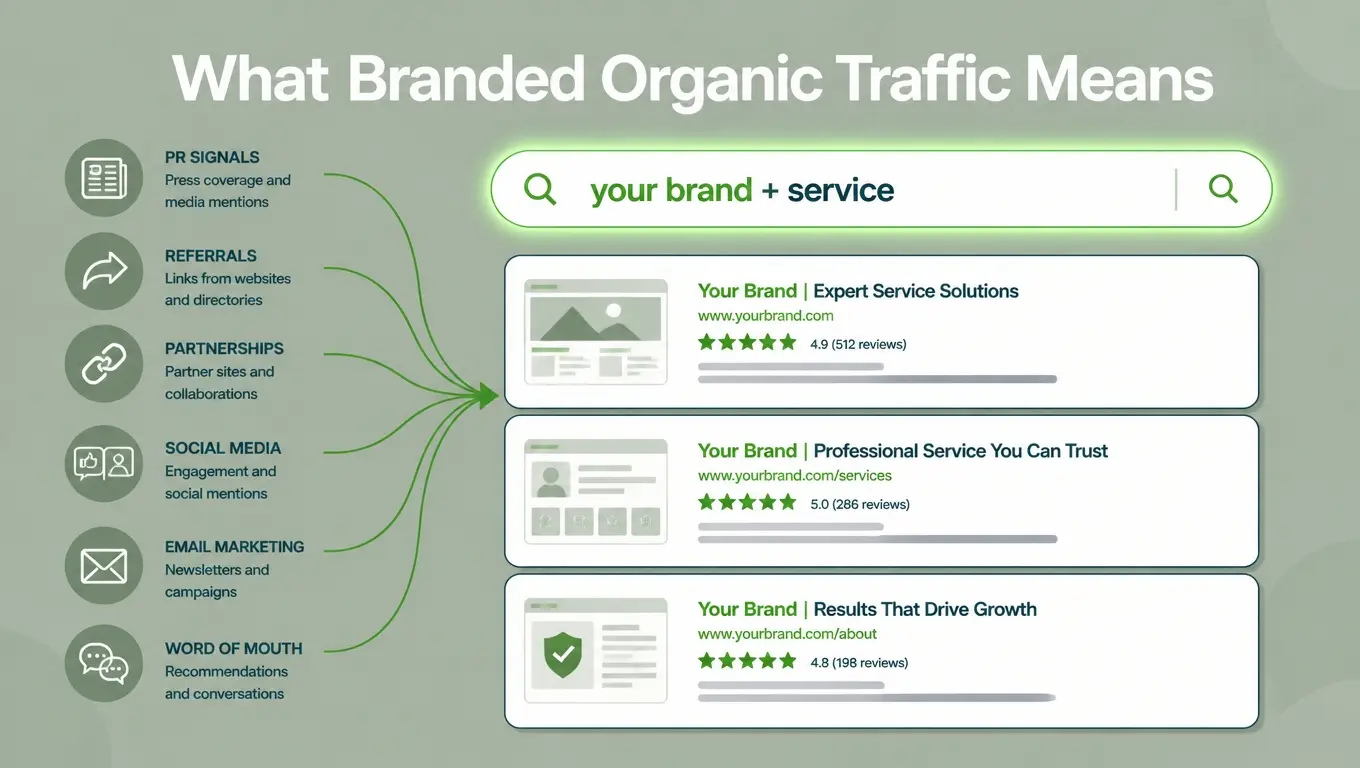
Branded organic traffic comes from searches that include your brand name, brand variations, or branded product and service names. These queries usually come from people who already know you, have heard of you, or have been influenced by other channels.
Branded traffic is often high intent and converts well, especially for service businesses where trust is a deciding factor. It can also rise quickly due to PR, referrals, partnerships, social, email, offline marketing, and word of mouth.
What Non Branded Organic Traffic Means?
Non branded organic traffic comes from searches that do not include your brand name. It reflects discovery demand, meaning people are looking for a solution, category, or problem answer and find you without already knowing you.
This traffic is typically the clearest signal of improved visibility across topics and keywords you want to own. It also supports long-term growth because it expands the number of people entering your funnel for the first time.
Why The Difference Matters For Real SEO Growth?
Real SEO growth is not only about more sessions. It is about gaining market share in search results for valuable queries, improving qualified demand, and increasing conversions that are attributable to organic discovery.
Branded traffic can be a lagging indicator of brand awareness rather than an outcome of ranking improvements. Non branded traffic is closer to a leading indicator of stronger topical authority and better alignment with search intent.
When Branded Traffic Shows Meaningful SEO Progress?
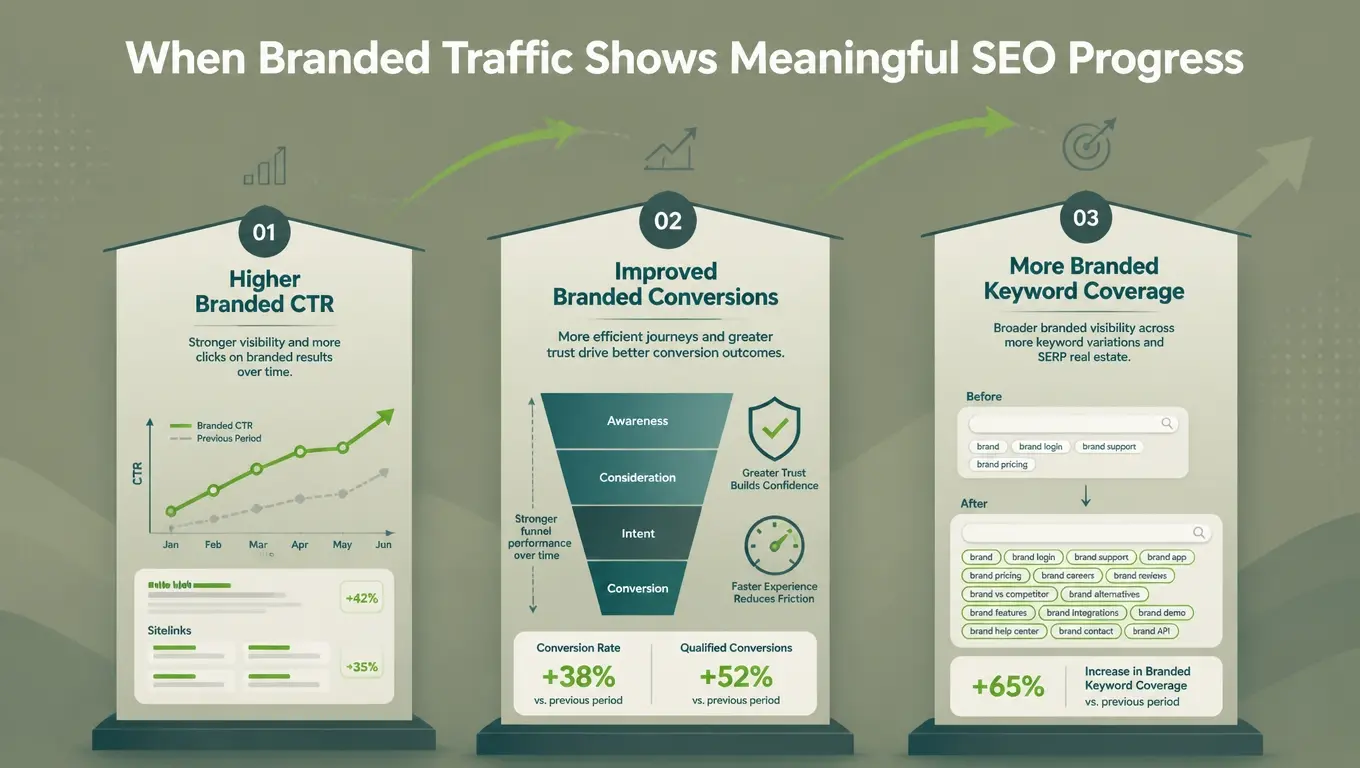
Branded traffic can still reflect SEO progress when your site improves its ability to capture branded demand. This happens when technical SEO issues are resolved, brand SERP coverage improves, and key branded pages become clearer and faster.
It also matters when the goal is demand capture for bottom-funnel queries such as your brand plus service, brand plus pricing, or brand plus reviews. Stronger branded rankings protect conversions from competitors bidding on your name and from SERP features that push organic results down.
- Higher branded click through rate: Better titles, sitelinks, and brand messaging lift clicks without changing overall demand.
- Improved branded conversions: Faster pages, clearer value propositions, and stronger trust signals increase leads from the same volume of searches.
- More branded keyword coverage: Ranking for branded services, locations, and product lines reduces leakage to directories and aggregators.
Branded traffic is valuable, but it needs context so it does not mask weak non branded visibility.
When Branded Traffic Can Mislead Reporting?
Branded traffic can spike due to factors that have little to do with SEO execution. A viral mention, a webinar, a press hit, or a paid campaign can raise branded searches and create a short-term organic lift.
If SEO reports focus on total organic sessions only, that lift can hide flat growth in non branded rankings. This is a common reason teams feel surprised when pipeline does not match traffic charts.
Which One Shows Real SEO Growth Most Reliably?
Non branded organic traffic is the most reliable indicator of real SEO growth because it reflects improved discovery. It tells you whether your content is earning visibility for new audiences and whether your site is building topical relevance.
Branded organic traffic still matters because it correlates with trust and conversion, but it is better treated as a supporting metric. The strongest SEO programs grow both, with non branded leading and branded following over time.
How To Segment Branded And Non Branded Traffic Correctly?
The most dependable way is to segment by query data in Google Search Console. You can then validate it against landing page patterns in analytics to ensure the classification matches user behavior.
- Define your brand set: Include brand name, common misspellings, and flagship service or product names that are uniquely tied to the brand.
- Filter queries in Search Console: Create a branded query filter using contains logic for each brand variation, then export and save a repeatable view.
- Create a non branded view: Use the same query list to exclude branded terms so non branded performance is not diluted.
- Check landing pages: Confirm that branded queries land on brand, about, homepage, and high-intent service pages as expected.
- Review anomalies monthly: Add new misspellings, new product names, and partner co-branded terms that begin appearing.
Once segmentation is stable, trend lines become much more actionable.
Metrics That Prove Growth Beyond Sessions
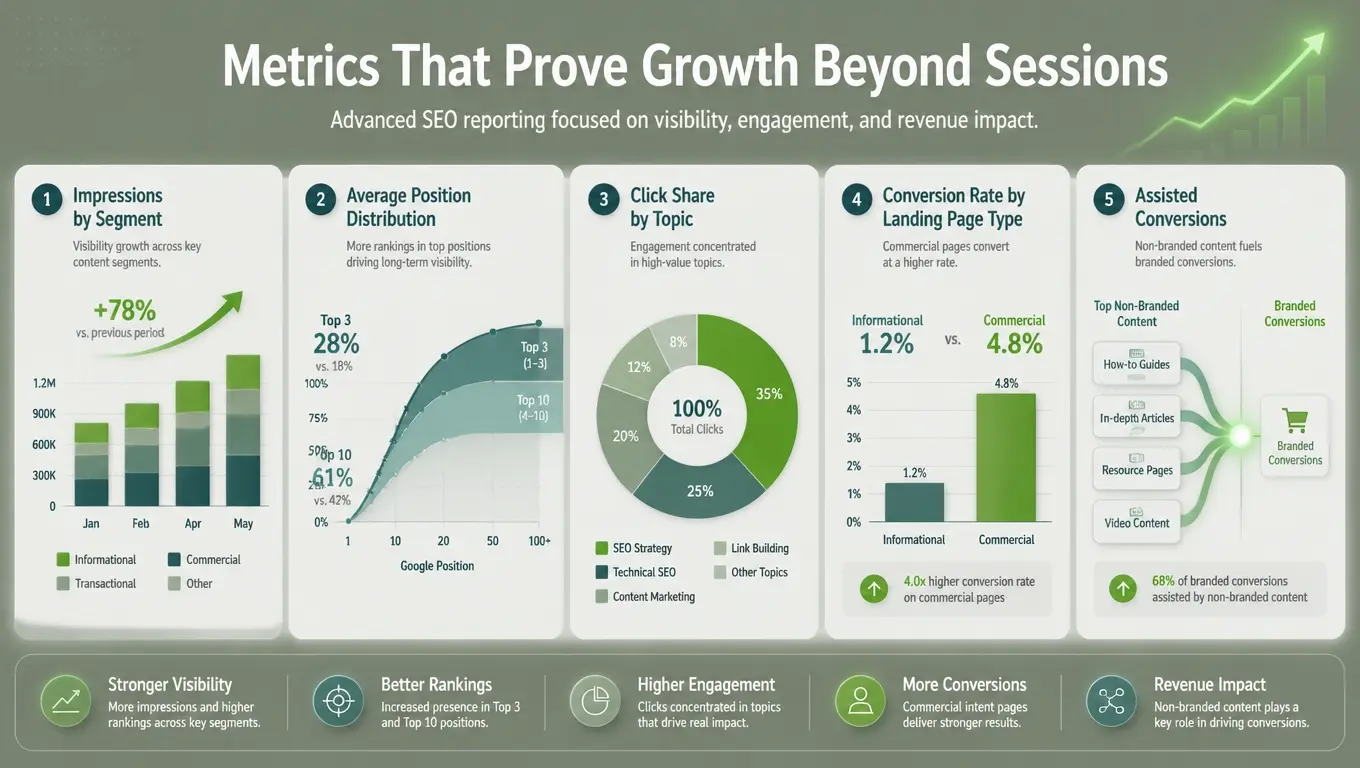
Sessions are a starting point, not the proof. Strong reporting shows whether visibility, engagement, and conversion are improving in the segments that matter.
- Impressions by segment: Non branded impression growth signals broader keyword coverage even before clicks rise.
- Average position distribution: Track how many non branded queries move into the top 10 and top 3 rather than relying on a single average.
- Click share by topic: Compare performance across service lines, locations, or content clusters to spot where authority is compounding.
- Conversion rate by landing page type: Separate informational pages from commercial pages to avoid misleading blended conversion rates.
- Assisted conversions: Non branded content often assists later branded conversions, especially for complex B2B decisions.
These metrics make it easier to connect SEO work to revenue outcomes without over-claiming.
How To Read The Data When Both Are Rising?
When both branded and non branded traffic rise together, the pattern is usually healthy. Non branded growth suggests better discovery, and branded growth suggests that awareness and trust are increasing as more people remember the brand.
Look for a time-lag where non branded impressions rise first, then non branded clicks, and finally branded searches. That progression often indicates that content is reaching new audiences who later return with brand intent.
Common Causes Of Non Branded Growth Plateaus
Non branded traffic can stall even when you publish content regularly. The most frequent causes are technical friction, weak topical coverage, and content that does not match the intent Google is rewarding for the query set.
- Thin topic clusters: A few isolated pages rarely build authority for competitive categories.
- Indexation and crawl issues: Important pages not being discovered or refreshed can cap visibility.
- Overlapping pages: Keyword cannibalization spreads signals and prevents a clear ranking winner.
- Weak internal linking: Orphan pages struggle to gain prominence and distribute authority.
- Unclear commercial paths: Informational pages that do not guide users to the next step waste demand.
Fixing these issues usually unlocks more sustainable non branded growth than publishing more pages alone.
Branded Vs Non Branded Traffic Comparison Table
This table summarizes what each segment typically indicates, what to watch, and how to use it in reporting.
| Traffic Type | What It Usually Signals | What To Track Closely |
|---|---|---|
| Branded organic | Existing awareness and demand capture | Branded CTR, brand SERP ownership, conversions on core service pages |
| Non branded organic | Discovery and market share growth | Non branded impressions, top 10 keyword count, topic cluster performance |
| Branded plus service | High-intent evaluation and comparison | Rank stability, review content strength, competitor outranking risk |
| Non branded informational | Early-stage education and qualification | Engagement, assisted conversions, internal click paths to commercial pages |
Use it as a quick check when stakeholders ask why total organic traffic moved up or down.
How To Report Real SEO Growth To Stakeholders?
Stakeholders want clarity on what improved and why it matters. A strong report separates branded from non branded, ties performance to business outcomes, and explains what actions will drive the next lift.
- Lead with non branded visibility: Show impressions and clicks by topic areas linked to services or products.
- Explain branded demand changes: Note whether branded shifts align with campaigns, PR, seasonality, or site changes.
- Connect to conversions: Attribute conversions to landing page groups and call out assisted paths when the first visit is informational.
- Highlight priority fixes: Identify one to three constraints such as internal linking gaps, content consolidation needs, or technical cleanup.
When reporting follows this structure, the SEO story stays consistent even when demand fluctuates.
Where IMILI Corp Fits In A Growth Focused SEO Approach?
Many teams need more than traffic charts to make SEO decisions. IMILI Corp supports growth-focused SEO by helping align keyword targeting, content structure, and technical foundations so non branded discovery improves without sacrificing branded conversion performance.
This approach works best when strategy, content, and site performance are treated as one system. It also makes branded and non branded segmentation useful for planning, not just reporting.
Conclusion
Non branded organic traffic is the clearest signal of real SEO growth because it reflects discovery and broader keyword reach. Branded organic traffic remains essential for conversion and trust, but it should be interpreted alongside campaign activity and brand awareness shifts.
Segment both, track visibility and conversions separately, and report in a way that shows what changed, what caused it, and what you will do next. That is how organic growth becomes predictable and defensible.
Frequently Asked Questions
Is branded organic traffic bad for SEO measurement?
No, branded organic traffic is valuable and often converts strongly. It becomes a problem only when it is blended with non branded metrics and used as the main proof of SEO progress. Separating the two makes performance clearer and decisions easier.
How do I classify branded searches if my brand name is also a common word?
Use a combination of query filters and landing page patterns. Include brand plus modifiers such as product names, locations, or official terms that strongly indicate brand intent. Review query lists regularly to refine the filter and reduce misclassification.
What should I prioritize if non branded traffic is flat but branded traffic is rising?
Prioritize non branded visibility improvements through stronger topic clusters, internal linking, and intent-matched content updates. Also check indexation, cannibalization, and page performance issues that can cap rankings. Keep branded pages optimized so high-intent demand continues converting while discovery is rebuilt.