

Before increasing your advertising budget, make sure your target customers understand what your business offers and why they should choose it. An unclear brand message can lead to wasted clicks, confused visitors, and missed conversions, even when targeting and campaign settings are well managed. Brand message testing helps you evaluate whether real potential customers understand your value proposition, find your claims credible, and know what action to take next. This guide explains how to test brand messaging through customer interviews, first-impression tests, structured feedback, and controlled advertising experiments before investing more money in campaigns.
What Does Brand Message Testing Measure?
A brand message test checks whether people can quickly grasp what you do, who it is for, and why it matters. It also uncovers whether your words trigger the right expectations or create confusion. The goal is not to win a debate internally, but to earn clarity externally.
A useful brand message test measures more than whether customers like a headline or slogan. Ask participants to explain your offer in their own words, identify who it serves, describe its main benefit, and explain what they would do next. Similar answers across qualified participants can indicate that the message is clear, while inconsistent interpretations highlight areas that need improvement. However, strong comprehension does not automatically guarantee higher conversion rates. Use customer feedback to refine the wording, then validate the most promising message through controlled tests and actual campaign performance.
How to Create a Brand Message Testing Hypothesis
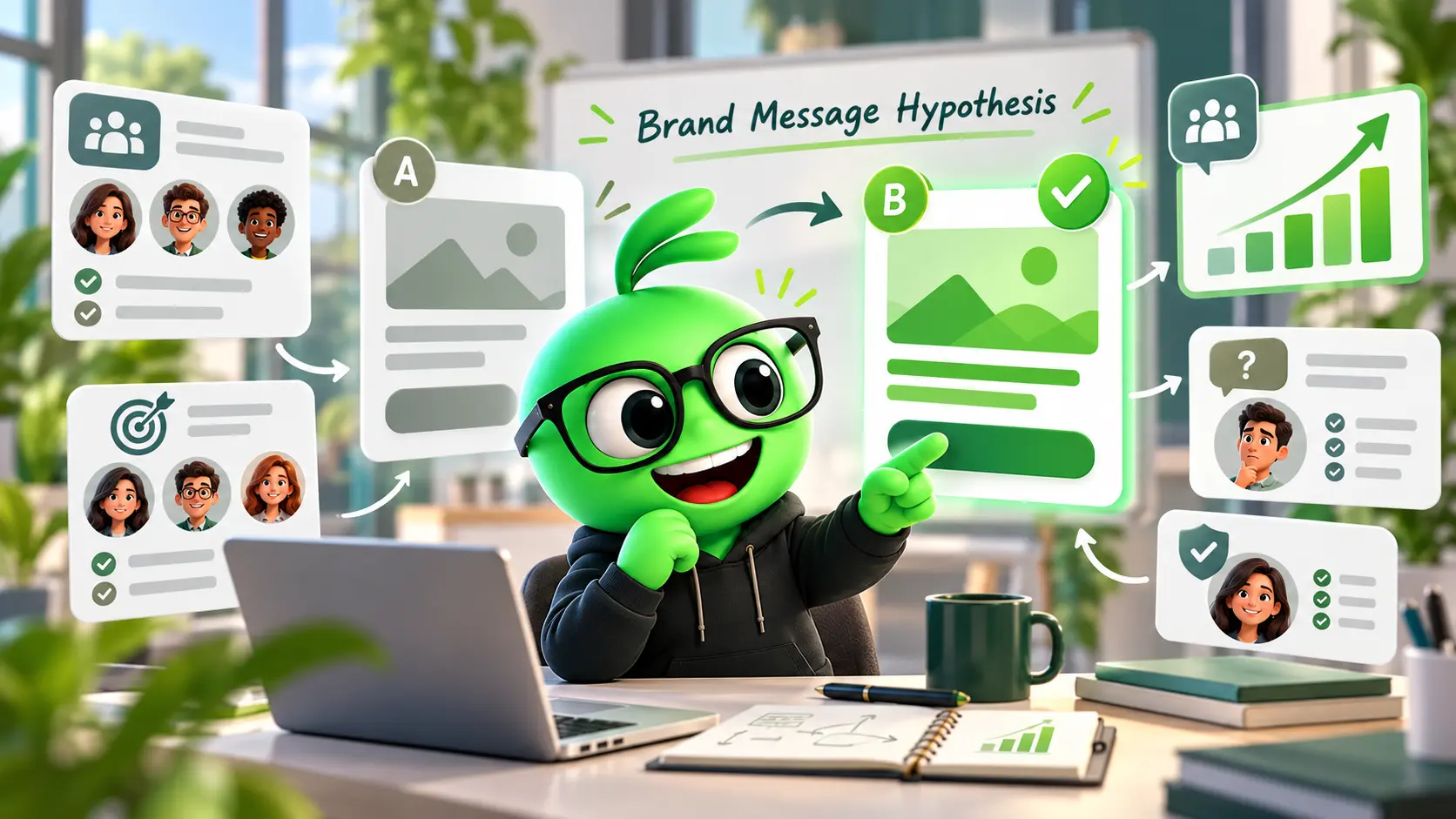
Brand message testing works best when you begin with a specific hypothesis about your intended audience and the value your business provides. For example, a B2B company might test whether emphasizing qualified lead generation creates clearer expectations than a broad promise about digital marketing growth. This matters because effective advertising messages should attract customers who match the offer, not simply generate more clicks. Our guide on how to qualify B2B leads in Google Ads explains how audience fit, advertising copy, landing pages, and conversion signals work together to improve lead quality.
Write one primary message and a few variants that change only one element at a time. Keep the core offer consistent so you can isolate what drives better understanding. This makes the results actionable instead of vague.
- Audience Definition: A tight description of who you serve and who you do not serve.
- Core Outcome: The measurable result customers want, stated in plain language.
- Proof Point: The simplest credibility signal you can support with real evidence.
- Primary Objection: The main reason a qualified buyer might hesitate to believe you.
Once these elements are explicit, you can test them directly instead of relying on general reactions.
Example of a Brand Message Testing Hypothesis
Suppose a B2B marketing agency wants to communicate how its services help businesses improve lead quality.
- Original Message: “We provide innovative digital marketing solutions for growing companies.”
- Alternative Message: “We help B2B companies generate more qualified leads through data-driven Google Ads campaigns.”
The alternative identifies the intended audience, describes the service more precisely, and highlights a measurable business outcome.
A useful hypothesis would be:
- Hypothesis: B2B decision-makers will understand the agency’s service and intended audience more accurately when the message focuses on qualified lead generation instead of general digital marketing services.
To evaluate this hypothesis, show each message to comparable participants without explaining it first. Ask them what the company does, whom it serves, and what results they expect. Compare the accuracy of their answers and note any repeated misunderstandings.
This example illustrates how to structure a test. It does not establish that the second message will perform better without actual customer evidence.
How to Recruit the Right Customers for Message Testing
Message testing fails when the wrong people give feedback. You want participants who match your target buyer profile and are close enough to the problem to judge relevance. Avoid over-relying on employees, friends, or existing loyal customers who already understand your offer.
Recruit participants who match your intended audience, including people unfamiliar with your brand and those actively researching solutions. Start with a manageable qualitative testing group to identify repeated confusion and objections, then expand testing when responses are inconsistent or important audience segments differ. Nielsen Norman Group’s guidance on how many users to test explains why small qualitative usability studies can reveal valuable problems without requiring large initial samples. However, message testing results from a small group should be used to discover patterns rather than make statistically representative claims about the entire market.
- Fit First: Screen for role, industry, budget range, and the problem you solve.
- Decision Context: Confirm they influence or make buying decisions, not just casual observers.
- Fresh Eyes: Include a portion of participants who have not interacted with your website or ads.
With the right mix, you can spot patterns that translate into better campaign performance.
Customer Feedback Methods for Testing Brand Messaging
Customers rarely study marketing copy the way teams do in reviews. They skim, decide, and move on. Your testing method should match that reality and capture what people notice first and what they ignore.
Use a consistent testing procedure so responses can be compared fairly across participants. Begin by showing the message in a realistic setting, such as a homepage headline, Google search advertisement, or landing page. Allow a brief first impression without providing additional explanation, then ask open-ended questions about the offer, audience, expected benefit, and credibility. Record the answers in the participant’s own words rather than correcting or guiding them during the session. Keep the presentation time, questions, and scoring approach consistent when comparing different message versions.
- First-Read Recall: Show the message for a few seconds, remove it, then ask what it was about and who it is for.
- Meaning Check: Ask participants to restate the promise in their own words and note mismatches.
- Relevance Score: Have them rate how well it fits their needs and explain the rating briefly.
- Trust Trigger: Ask what makes the claim believable or unbelievable based on the wording.
- Next Action: Ask what they would do next, such as seek pricing, request a demo, or leave.
This structure keeps feedback grounded in behavior rather than opinion.
Where to Test Your Brand Message Across Marketing Channels
Customers encounter your message in multiple places, and each one changes how it is understood. Test your core message on the surfaces that shape first impressions and conversions. Consistency matters, but channel fit matters too.
Prioritize messaging on the pages and channels that influence customer decisions, including your homepage, paid advertisements, and landing pages. Test the message in its actual context because a headline that works in search advertising may not communicate enough information on a homepage. Alongside direct customer feedback, tools such as Microsoft Clarity’s session recordings can help you observe how visitors navigate pages, interact with content, and encounter possible points of confusion. These behavioral observations can identify opportunities for further testing, but they should not be treated as direct proof that visitors correctly understand your message.
- Homepage Hero: Checks immediate clarity and reduces bounce from confused visitors.
- Paid Search Headlines: Validates intent match and whether your wording maps to how people search.
- Paid Social Primary Text: Reveals whether your promise stops the scroll and feels credible.
- Landing Page Subheads: Tests whether supporting points remove doubt or add friction.
- Email Subject Lines: Confirms whether your value is compelling enough to win attention.
After you identify the strongest phrasing, align these touchpoints so buyers experience one coherent story.
How to Measure Brand Message Testing Results
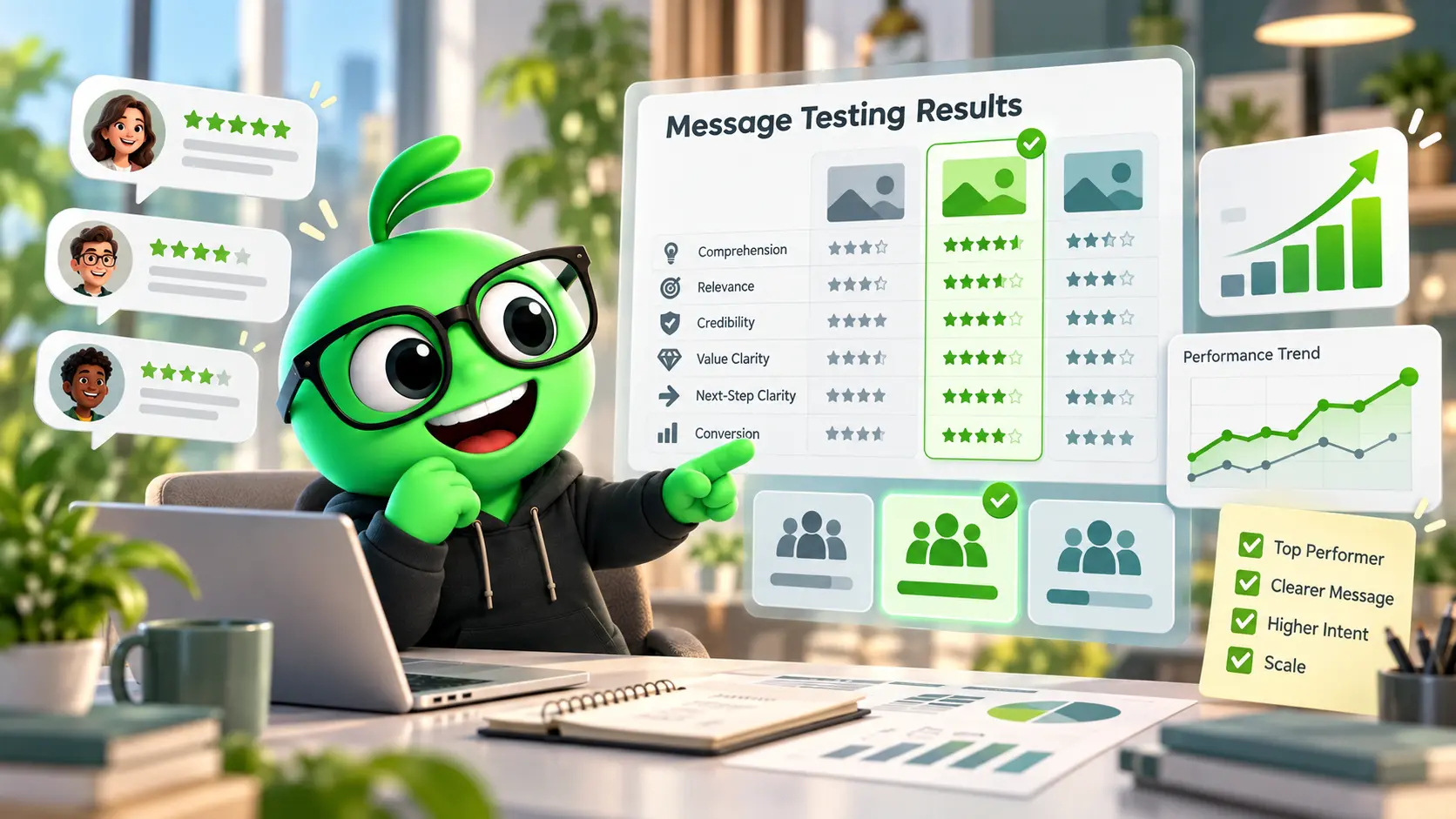
Raw notes can be misleading if you treat every comment equally. You need a consistent way to translate feedback into decisions about wording and positioning. Define a few signals that indicate message strength, then score each variant.
Look for convergence, not consensus. A strong message produces similar interpretation across different participants. A weak message produces scattered interpretations even if it sounds good internally.
| Testing Metric | What to Measure | Suggested Method | How to Interpret Results |
|---|---|---|---|
| Message Comprehension | Whether participants understand the offer and audience | Ask them to explain the message in their own words | Repeated correct interpretations suggest stronger clarity |
| Audience Relevance | Whether the message addresses a genuine customer problem | Ask for a relevance rating and explanation | Specific problem-related responses indicate stronger perceived fit |
| Credibility | Whether the main claim seems believable | Ask what evidence would support the promise | Repeated requests for proof reveal trust gaps |
| Value Proposition Clarity | Whether customers can identify the main benefit | Ask what makes the offer different or useful | Consistent answers suggest the benefit is recognizable |
| Next-Step Clarity | Whether participants know what action to take | Ask what they would do after seeing the message | Clear intended actions suggest an understandable user journey |
| Conversion Performance | Whether the revised message improves meaningful outcomes | Run a controlled test and compare qualified conversions | Interpret changes using adequate data and the selected success metric |
A consistent message-testing scorecard helps teams compare customer feedback without giving excessive weight to isolated opinions. However, qualitative scores should eventually be evaluated alongside commercial results such as qualified conversions, customer acquisition costs, and revenue outcomes. Our comparison of blended CAC vs platform CPA explains why platform-reported acquisition costs and broader customer acquisition measurements can lead to different budget decisions. Combining customer understanding with business-level performance data makes messaging improvements more useful for long-term advertising strategy.
Common Brand Message Testing Mistakes to Avoid
Message testing can backfire when the process is loose. Small setup issues can distort results and lead you to scale the wrong message with more confidence. Avoid the traps that create false positives.
- Leading Prompts: Questions that push people toward a preferred answer mask confusion.
- Over-Explaining: Adding context that customers would not have in the wild changes the outcome.
- Too Many Variables: Testing multiple changes at once makes it impossible to identify the driver.
- Wrong Participants: Feedback from non-buyers creates noise and dilutes real objections.
- Cherry-Picking Quotes: Isolated comments should not override patterns across participants.
Improve test reliability by keeping participant screening, message exposure, questions, and scoring consistent. Document the sample size and audience characteristics so findings are not interpreted more broadly than the evidence supports. Qualitative interviews are useful for finding repeated confusion and identifying objections, but small samples should not be treated as statistically representative of the full market. Before making a major advertising investment, validate the most promising messages with suitable performance measurements and a controlled testing process.
How to Validate Winning Messages Before Scaling Ads

A promising brand message should be validated with actual advertising performance before receiving a larger budget. Begin with controlled changes to the most important advertisements or landing pages, then compare qualified conversions, acquisition costs, and lead quality against the previous version. Improving messaging is only one part of deciding whether additional spending is justified. Our guide on Google Ads Limited by Budget explains how to evaluate campaign restrictions, performance efficiency, and optimization opportunities before increasing advertising investment.
Before increasing advertising spend, compare the revised message with your existing version through a controlled experiment. Google Ads’ official Experiments guidance explains how eligible campaigns can test changes against a baseline using assigned traffic and performance measurements. Select a primary success metric before launching, such as qualified leads, conversion rate, or cost per acquisition, and keep unrelated campaign changes limited during the test. Evaluate the results over a suitable period and avoid declaring success based on a small number of clicks or conversions. Increase the budget gradually only when the evidence supports improved business performance.
- Update Core Pages: Refresh homepage hero, top landing pages, and primary navigation labels.
- Align Ad Creative: Mirror the winning promise in headlines and primary text to reduce mismatch.
- Adjust Proof: Add the minimum viable proof points customers asked for most often.
- Run A/B Tests: Test message variants against the current baseline with clean measurement.
- Scale Gradually: Increase budget only after stable lift in conversion rate and lead quality.
This approach protects your budget while still moving quickly.
When to Get Professional Help With Brand Messaging
Message testing often stalls because teams lack a repeatable system for recruiting, running sessions, and translating feedback into copy. A partner can help you move from scattered notes to a focused message framework that supports ads, landing pages, and sales collateral. The best support combines strategy, research discipline, and conversion-focused writing.
Businesses preparing to scale their advertising may benefit from reviewing brand positioning, campaign messaging, landing page experience, and conversion tracking together. IMILI Corp’s digital marketing services provide a starting point for exploring how strategic planning and execution can support these objectives. Before increasing your budget, identify which parts of the customer journey need improvement and establish measurable goals for campaign performance. This can help align the message shown in advertisements with the experience customers receive after clicking.
Conclusion
Testing your brand message before increasing advertising spend can help identify unclear promises, missing proof, and gaps between what your business intends to communicate and what potential customers actually understand. Begin with a clear message hypothesis, recruit relevant participants, and use consistent questions to evaluate comprehension, relevance, credibility, and next-step clarity.
After improving the message based on customer feedback, test it through appropriate advertising or landing page experiments. Compare meaningful conversion outcomes rather than relying only on positive opinions or click-through rates. This combination of customer research and performance measurement can help businesses make more informed advertising decisions and reduce the risk of scaling an ineffective message.
Frequently Asked Questions
How Many Customers Do I Need to Test a Brand Message?
You can often identify major clarity issues with a small group if participants match your target buyer profile. Focus on pattern detection, not statistical certainty, and expand the sample if feedback is inconsistent. A second round after revisions is usually more valuable than overloading the first round.
What Should I Do if Customers Misunderstand My Offer?
Start by tightening the audience and outcome language, then remove jargon and internal terms. Add one proof point that supports the promise without adding complexity. Re-test with fresh participants to confirm the new wording improves comprehension.
Should I Test Brand Messaging or Offer Messaging First?
Test the message that drives the first decision point in your funnel. If people are not sure what you do, start with brand messaging clarity. If they understand what you do but do not convert, prioritize offer messaging and proof that reduces hesitation.