
App ratings and reviews affect App Store Optimization (ASO) by influencing both app discoverability and users’ decisions to install. Apple confirms that ratings and reviews influence App Store search rankings, while Google Play treats authentic user feedback as an important indicator of app quality. However, neither platform provides a complete public formula showing how much each review-related factor contributes to rankings. For developers and brands, improving ratings is therefore about more than earning five stars: it means strengthening trust, addressing product issues, and improving store listing performance.
Developers and brands often treat reviews as a support or reputation task. In reality, they are a discoverability and conversion lever that interacts with keywords, creatives, and retention signals.
How App Stores Use Ratings and Reviews In ASO
App stores use several signals to help users discover relevant, high-quality applications. Ratings and reviews contribute to this process, but their documented role differs between Apple’s App Store and Google Play.
Apple explicitly states that ratings and reviews influence app rankings in search results. It also displays summary ratings on product pages and in search results, helping users evaluate applications before downloading. Google Play recognizes ratings and reviews as measures of app quality and prohibits artificial manipulation of these signals. However, the precise ranking weight assigned to ratings, review volume, or review recency is not publicly established across both platforms.
Developers should therefore evaluate ratings alongside keyword relevance, app stability, listing conversion, user retention, and other performance indicators rather than assuming that higher star ratings automatically produce higher rankings.
Apple’s official guidance on creating an App Store product page confirms that ratings and reviews play a role in search rankings and user engagement. This provides a documented basis for discussing rating-related discoverability without assuming a fixed relationship between star ratings and search position.
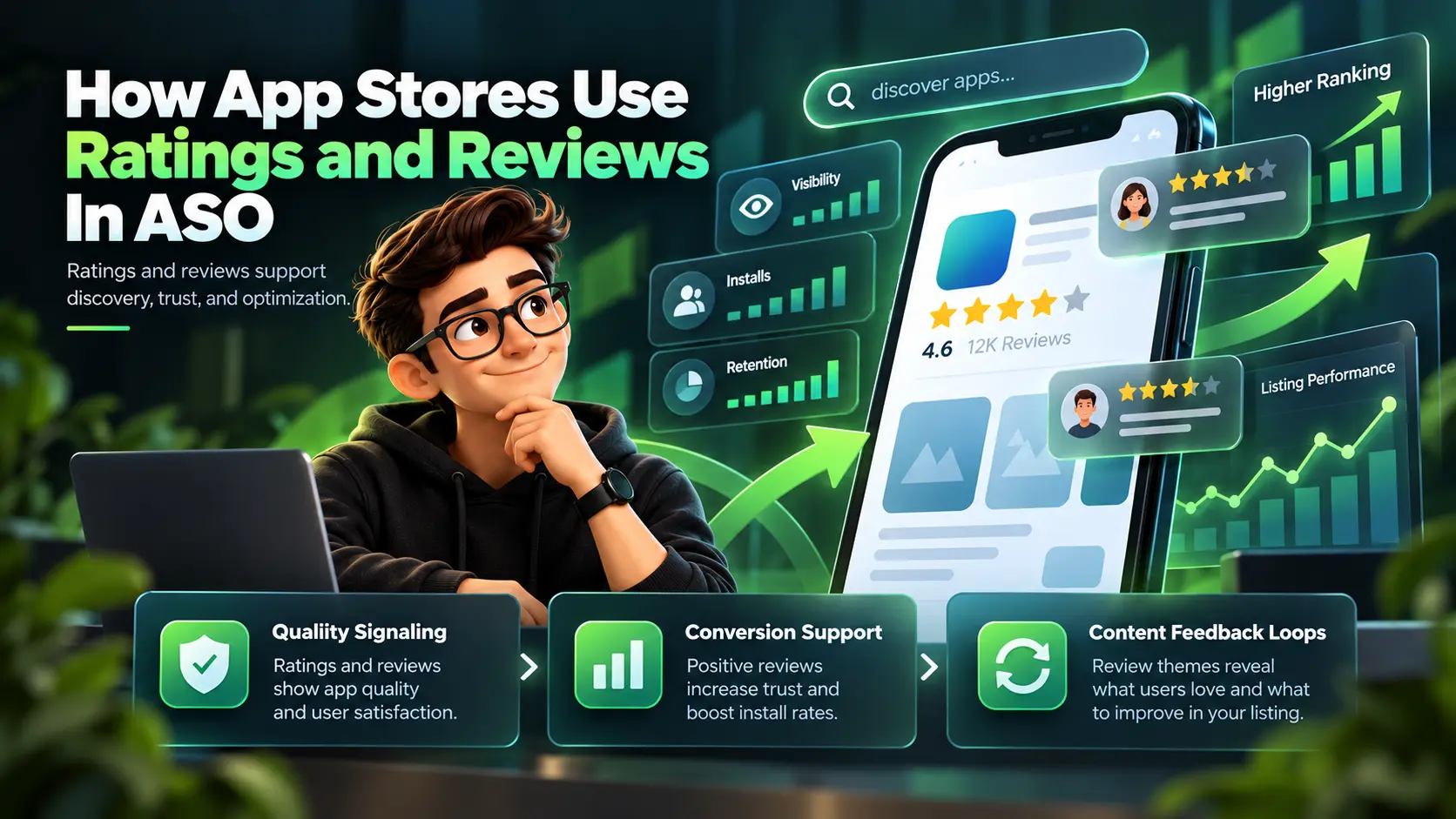
Ratings and reviews influence ASO through three main paths.
- Quality signaling: A strong average rating can reinforce that an app is reliable and well maintained.
- Conversion support: Positive sentiment reduces hesitation, improving store listing conversion rate from page views to installs.
- Content feedback loops: Review text gives language that can guide metadata, screenshots, and feature prioritization.
These signals are most valuable when they are consistent over time. Spikes in negative feedback can quickly pull down the average rating and reduce conversion, even if rankings remain temporarily stable.
Ratings As A Ranking Signal Versus A Conversion Signal
App ratings and reviews can contribute to ASO in two related but different ways: search visibility and store listing conversion. Understanding this distinction helps developers avoid confusing stronger user trust with guaranteed ranking improvements.
Ranking Impact: Apple confirms that ratings and reviews influence how applications rank in App Store search results. However, Apple does not disclose the precise weighting used in its ranking system. Google Play also evaluates app quality and user feedback, but developers should not assume that a specific rating threshold or review count guarantees better placement.
Conversion Impact: Ratings provide visible evidence of user satisfaction. An application with recent, detailed, and generally positive feedback may appear more trustworthy to potential users. However, the effect on installs depends on the app category, audience, pricing, competing applications, and overall store listing quality.
For example, improving an app’s average rating from 3.6 to 4.2 stars may strengthen user confidence, but the actual effect should be measured rather than assumed. Compare store listing visitors, first-time installers, conversion rates, and review sentiment before and after improvements while accounting for other changes in acquisition traffic or listing creatives.
The most reliable ASO strategy considers rankings and conversions separately, then uses performance data to determine whether review improvements are contributing to meaningful growth.
Improving app store performance should also support the broader customer journey. More installations do not automatically produce sustainable growth if users abandon the application shortly afterward. Our comparison of a performance marketing agency vs. growth marketing agency explains why acquisition, activation, retention, and customer value need to be considered together.
How Review Velocity and Recency Affect ASO
Review velocity describes how frequently users submit new ratings or reviews, while review recency describes how recently that feedback was published. Both metrics help developers understand changing user sentiment, but they should not be treated as guaranteed ranking factors.
Recent reviews can be especially useful to prospective users because they may reflect the app’s current performance after updates, bug fixes, or feature releases. An application with older positive reviews and newer complaints may need closer investigation, even when its overall star rating remains relatively high.
What Developers Should Monitor
- Review Frequency: Track how many authentic reviews arrive over a consistent period, such as weekly or monthly, to identify unusual changes in feedback activity.
- Recent Review Sentiment: Compare positive and negative themes in newer reviews to understand current user satisfaction.
- Changes After App Updates: Examine ratings, crash reports, and review topics following releases to identify possible regressions.
- Rating Differences Across Markets: Compare ratings by country or territory where reporting is available, because displayed scores and user expectations can differ.
- Unusual Review Spikes: Investigate sudden increases in positive or negative feedback instead of assuming they represent sustainable improvement.
A healthy review process focuses on providing a stable, useful application and giving eligible users appropriate opportunities to share honest feedback. The goal is not to manufacture a particular review frequency but to understand satisfaction trends and identify problems before they affect more users.
How Reviews Influence Keyword Strategy and Store Listing Relevance?
Review text can reveal how users describe the app in their own words. Those phrases often differ from internal product language, and they can highlight high intent terms that should be tested in metadata.
Reviews also expose feature confusion. If users repeatedly mention missing functionality, pricing frustration, or onboarding issues, those themes should inform the store listing copy and creative messaging.
Strong ASO ties review insights to iteration cycles.
- Metadata Alignment: Analyze recurring words and phrases in genuine customer reviews to understand how users describe app features. Test relevant terms in platform-supported metadata fields, such as the App Store app name, subtitle, and keyword field or Google Play listing text, while following each store’s metadata requirements.
- Creative prioritization: Use screenshots and preview video to address common objections found in reviews.
- Feature roadmap: Fix recurring bugs and friction points that drive low star ratings after new releases.
Review text is valuable for understanding customer language, but developers should not assume that every word in a review directly influences keyword rankings. Apple’s App Store product page guidance explains how app names, subtitles, and keyword fields contribute to discovery. Use review insights to inform relevant metadata and creative improvements rather than adding keywords indiscriminately.
This turns reviews into a continuous discovery engine rather than a passive comment stream.
The Hidden Relationship Between Support Quality and Star Ratings
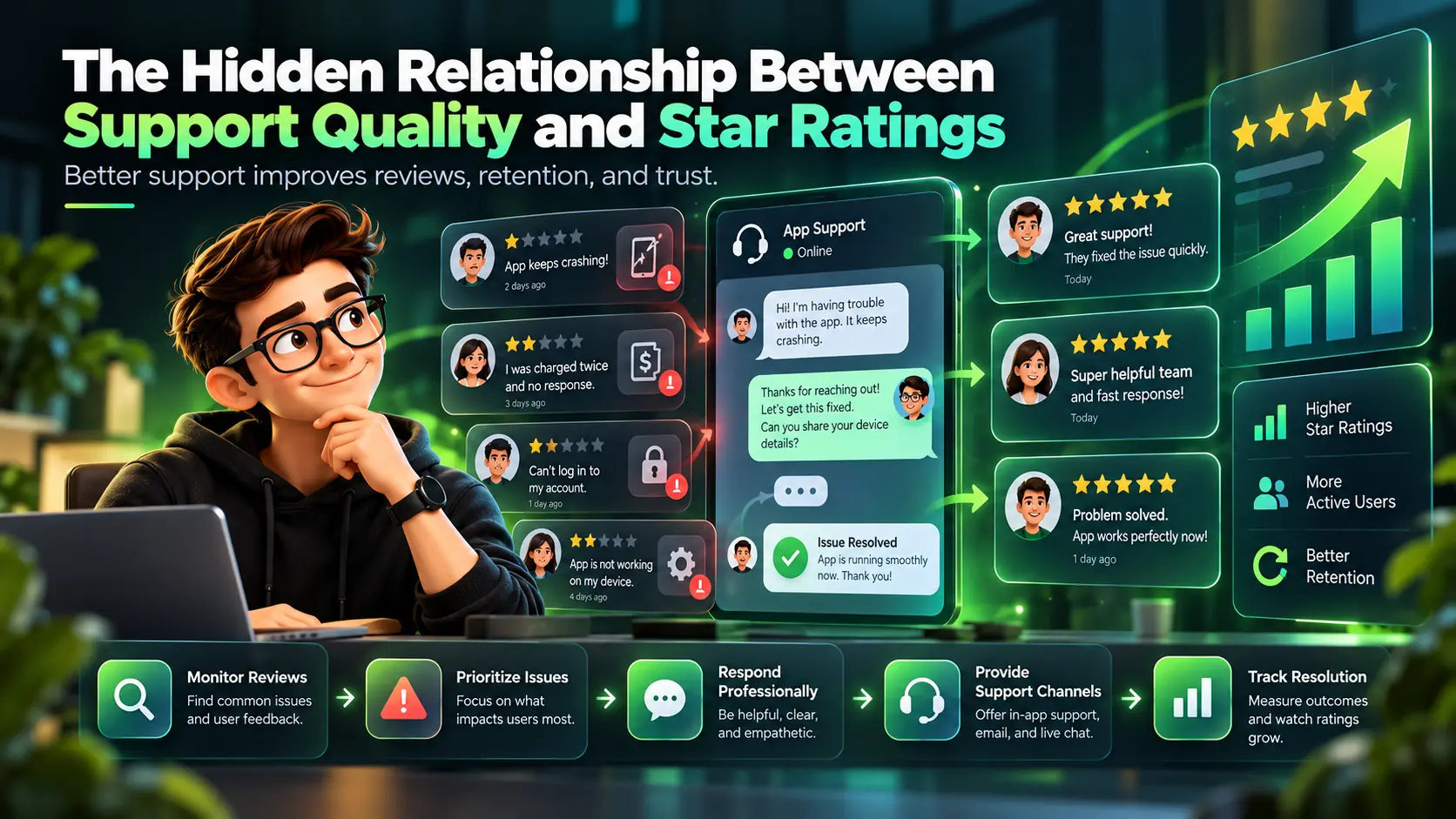
Customer support quality can affect app ratings because users frequently leave negative feedback after experiencing crashes, billing problems, login failures, or unresolved technical issues. Reviews provide a valuable source of feedback, but developers should address the underlying problem rather than focusing only on changing the star rating.
A practical review management workflow should include the following actions:
- Monitor New Reviews: Review recent feedback regularly and identify repeated complaints.
- Prioritize Serious Issues: Escalate crashes, payment failures, security concerns, and widespread login problems to the appropriate teams.
- Respond Professionally: Acknowledge the user’s experience, provide a useful next step, and avoid revealing personal information.
- Provide Support Channels: Make it easy for users to report problems privately without restricting their ability to leave public reviews.
- Track Resolution: Connect frequently reported issues to product fixes and monitor feedback after releasing improvements.
Google Play allows developers to manage public review responses through Play Console, as explained in its ratings and reviews management guide.
For growing applications, support operations should also connect with retention and engagement strategies. ImiliCorp’s lifecycle marketing services explain how customer engagement and retention can support growth beyond initial acquisition.
Common Rating Problems That Harm ASO Performance
Most rating declines come from predictable operational patterns. Fixing the pattern is more effective than trying to out prompt users for new reviews.
- Prompting at the wrong moment: Asking for a rating before value is delivered leads to low stars and resentment.
- Releases without stability gates: A buggy update can trigger a wave of one star reviews within hours.
- No review response process: Unanswered complaints signal neglect and reduce the chance of rating recovery.
- Mismatch between creatives and reality: If screenshots promise features that are not available, negative sentiment accelerates.
Each of these issues is measurable with release monitoring, crash analytics, and review sentiment tracking.
Practical Ways to Improve Ratings Without Risky Tactics
Improving app ratings requires better user experiences and ethical feedback collection. Both Apple and Google Play prohibit attempts to manipulate ratings through fake reviews, incentives, or other deceptive practices.
Google’s User Ratings, Reviews, and Installs policy explains the restrictions on rating manipulation, while Apple’s App Review Guidelines establish requirements for honest feedback and review requests.
Five Practices For Sustainable Rating Improvements
- Request Reviews at Appropriate Moments: Ask users for feedback after they have had enough experience to evaluate the app. Completing a meaningful task or reaching a natural stopping point may provide an appropriate opportunity. Avoid interrupting onboarding or important activities.
- Use Official In-App Review Tools: For Apple platforms, use the supported StoreKit review-request functionality. For Android applications distributed through Google Play, follow the official In-App Review API guidance. Both systems control how requests are displayed, so developers should not assume that every request will show a prompt.
- Avoid Review Gating and Incentives: Do not offer rewards for favorable ratings, screen users based on whether they are likely to leave positive feedback, or redirect dissatisfied users away from public review options. Support should remain available to everyone without restricting honest reviews.
- Respond to Reviews Professionally: Acknowledge useful feedback, investigate complaints, and provide relevant support information. Never pressure users to revise ratings, disclose private details, or promise fixes that cannot be delivered.
- Improve Stability and Product Quality: Monitor crashes, loading problems, payment failures, and other recurring issues. Test updates before release and evaluate changes in ratings and feedback after major product improvements.
Apple’s review-request documentation explains its system-controlled prompt limits, including a maximum of three displays within 365 days. Google Play applies its own frequency restrictions, described in the Google Play In-App Reviews API guide.
A sustainable rating strategy focuses on app quality, user satisfaction, honest feedback, and timely issue resolution. Better ratings may follow those improvements, but no prompting strategy can guarantee a particular average score or ranking position.
How Imili Corp Supports ASO Through Review and Reputation Workflows?
Strong app ratings result from collaboration between marketing, product development, analytics, and customer support. An effective ASO strategy connects user feedback with better app store listings, technical improvements, and measurable acquisition outcomes.
ImiliCorp helps businesses plan digital growth strategies through its digital marketing and ASO services. For app-focused businesses, this can involve reviewing discoverability challenges, analyzing customer feedback, identifying conversion opportunities, and connecting acquisition performance with longer-term user engagement.
If your app is receiving negative feedback, experiencing inconsistent listing performance, or struggling to turn visibility into installations, contact the ImiliCorp team to discuss your app growth challenges and suitable optimization priorities.
Key Metrics to Track Alongside Ratings and Reviews
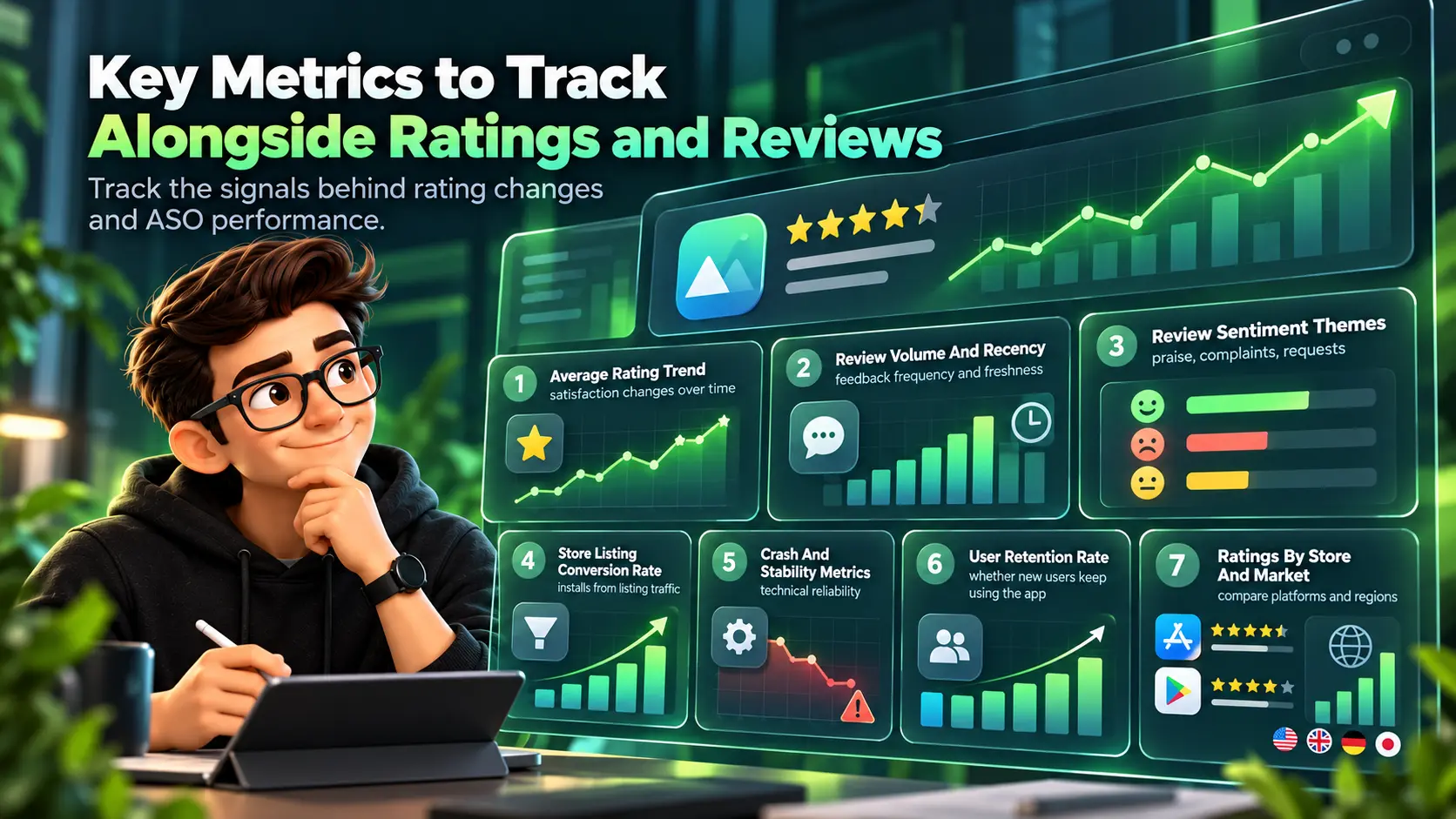
Ratings and reviews are most meaningful when paired with metrics that explain why they change. Tracking a small set of indicators helps teams diagnose root causes and defend performance after releases.
| Metric | What It Indicates | How To Use It In ASO |
|---|---|---|
| Average Rating Trend | Changes in reported user satisfaction | Track rating movements following updates and significant product changes |
| Review Volume And Recency | Frequency and freshness of user feedback | Identify unusual increases or decreases and investigate recent feedback patterns |
| Review Sentiment Themes | Common praise, complaints, and feature requests | Improve listing messaging and prioritize recurring product issues |
| Store Listing Conversion Rate | How effectively relevant listing traffic produces installs | Compare installation performance after metadata, screenshot, or rating changes |
| Crash And Stability Metrics | Technical reliability and user experience problems | Investigate crashes, and monitor Android ANRs where applicable |
| User Retention Rate | Whether newly acquired users continue using the app | Assess whether the experience meets expectations after installation |
| Ratings By Store And Market | Differences in feedback across platforms and territories | Prioritize localized improvements and compare market-level performance |
These metrics are most useful when reviewed together rather than in isolation. A higher average rating may be encouraging, but developers should also check whether listing conversion, app stability, and user retention are improving. For businesses looking to connect acquisition and customer behavior with wider performance reporting, ImiliCorp’s marketing analytics services provide a relevant framework for understanding measurable growth.
Conclusion
App ratings and reviews contribute to ASO through both store discovery and user decision-making. Apple confirms that ratings and reviews influence App Store search rankings, although their precise weight is not disclosed. Genuine user feedback also helps potential users evaluate app quality and can influence installation decisions. Developers should measure changes in search visibility, conversion, retention, and app stability instead of assuming that a higher rating guarantees growth.
The most reliable approach is operational. Deliver stable releases, prompt for ratings after value is delivered, respond to reviews with discipline, and feed review insights back into ASO and product planning.
Frequently Asked Questions
Do Higher Ratings Always Lead to Better Rankings?
No. Higher ratings can support app discoverability and improve potential users’ confidence, but they do not guarantee better rankings. Apple confirms that ratings and reviews influence App Store search rankings without publishing their exact weighting. Developers should also evaluate metadata relevance, product quality, listing conversion, and user behavior when interpreting ASO results.
How Often Should a Team Respond to App Reviews?
Consistency matters more than volume. Aim for a predictable cadence that covers critical issues quickly and acknowledges positive feedback regularly. Fast responses during buggy releases can limit rating damage and improve user trust.
Can Requesting Ratings Hurt ASO?
Yes. Poorly timed or excessive rating requests can frustrate users and negatively affect their experience. Developers should use official review-request tools, respect platform-imposed frequency limits, and avoid fake, incentivized, or selectively filtered reviews. The goal should be collecting genuine feedback without disrupting normal app usage.