
Search engine optimization (SEO), answer engine optimization (AEO), and generative engine optimization (GEO) are three closely related approaches to improving how businesses are discovered online. SEO focuses on organic search visibility, AEO emphasizes clear answers in search and assistant experiences, and GEO focuses on how brands and information appear in generative AI responses.
For growing businesses in 2026, the real challenge is deciding where to invest limited marketing resources. Rather than treating SEO, AEO, and GEO as completely separate strategies, businesses should strengthen their technical foundations, publish useful content, and measure visibility across search and AI-assisted discovery. This guide explains their differences, shared requirements, and practical priorities for sustainable growth.
What SEO Means Now?
SEO is the practice of earning visibility in organic search results through technical health, relevant content, and authority signals. It still drives predictable demand capture when people already know what they need and are comparing options. It also creates durable assets because well-built pages can rank and convert for months or years.
Modern SEO has shifted toward usefulness and credibility over mechanical keyword tactics. Pages that resolve a query quickly, show proof of expertise, and load fast tend to win. Strong internal linking, clean information architecture, and indexable content remain non-negotiable.
For a practical overview of these fundamentals, Google’s SEO Starter Guide explains how website structure, helpful content, internal links, and search accessibility support organic discovery.
What AEO Focuses on?
AEO targets answer-first surfaces, including featured snippets, People Also Ask, voice assistants, and other direct-response modules. These experiences reduce clicks, but they increase brand exposure and can influence the decision before a user reaches a website. AEO is about being the clearest and most trustworthy source for a specific question.
Answer optimization favors tight structure, explicit definitions, and scannable formatting. It also benefits from strong entity signals such as consistent brand naming, author credibility, and unambiguous terminology. When a search engine can confidently extract an answer, your content becomes a candidate for answer slots.
Google’s official featured snippets documentation explains how these answer-focused search results work. Website owners can improve content clarity and relevance, but Google determines whether a page is selected for a featured snippet.
What GEO Actually Optimizes?
Generative engine optimization (GEO) focuses on making a business, its expertise, and its content easier to discover, understand, and reference in generative AI experiences. These experiences may include AI-generated search summaries, conversational assistants, and research tools that synthesize information from multiple sources. Depending on the platform, a business may appear through a cited webpage, a brand mention, or a suggested solution.
Effective GEO practices include publishing original information, maintaining accurate business and service details, presenting verifiable evidence, and ensuring important website content can be discovered and interpreted. However, AI platforms use different retrieval and response-generation methods, so no single optimization technique guarantees mentions, citations, or recommendations. Businesses should treat GEO as an extension of their broader content and search strategy rather than a replacement for traditional SEO.
For additional technical context, Google’s guidance on AI features and website visibility explains how eligible webpages may appear in AI Overviews and AI Mode, and why established SEO practices remain relevant to generative search discovery.
SEO Vs AEO Vs GEO Key Differences
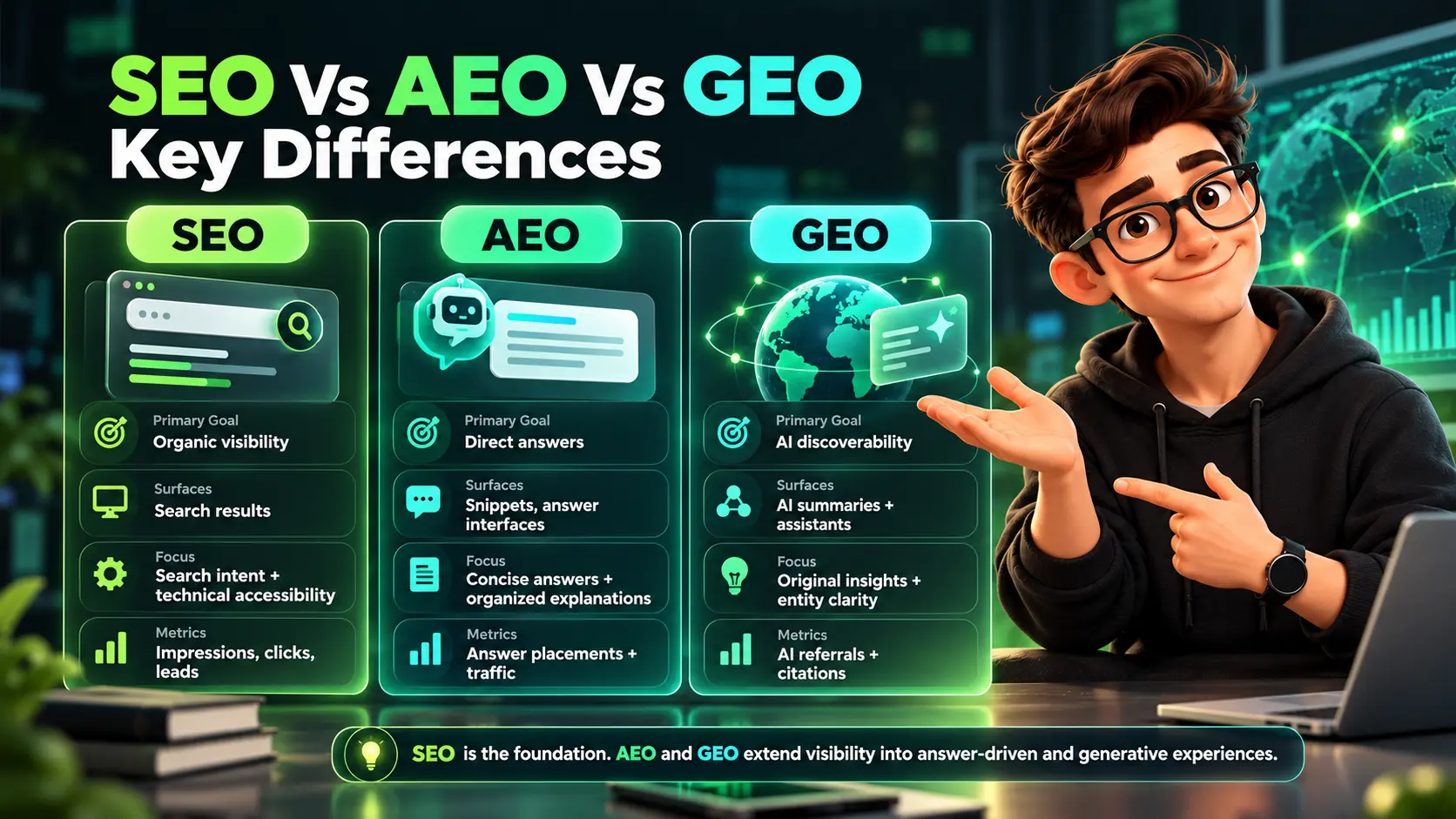
These approaches overlap, but they are optimized for different outcomes and different interfaces. SEO aims for rankings and organic traffic. AEO aims for extracted answers and high-intent visibility. GEO aims for inclusion in AI-generated guidance and shortlists.
| Dimension | SEO | AEO | GEO |
|---|---|---|---|
| Primary Goal | Improve organic search visibility | Make content useful for direct-answer experiences | Improve discoverability and referenceability in generative AI experiences |
| Common Surfaces | Traditional search results | Featured snippets, question modules, and answer interfaces | AI-generated search summaries and conversational assistants |
| Content Focus | Search intent, relevant content, technical accessibility | Concise answers, definitions, and organized explanations | Original insights, verifiable information, and clear entity details |
| Technical Foundation | Crawlability, indexing, internal links, page experience | Search accessibility and extractable content | Accessible content and platform-dependent retrieval |
| Performance Indicators | Organic impressions, clicks, qualified leads, conversions | Observable answer placements and associated traffic | AI referrals, observed citations, brand mentions, and resulting conversions |
| Main Limitation | Rankings and clicks are not guaranteed | Answer placements can change or produce no clicks | AI mentions may fluctuate and be difficult to measure reliably |
SEO, AEO, and GEO are not isolated marketing channels. They overlap in technical requirements, content quality, and user intent. SEO provides an important foundation, while AEO and GEO describe additional ways to make useful information available through answer-driven and generative experiences. The right combination depends on where customers research products or services and how those interactions contribute to business results.
How to Decide What to Prioritize?
A growing business should prioritize based on demand type, sales cycle, and how prospects research. If your revenue relies on bottom-of-funnel searches, SEO is the first lever. If prospects ask many pre-sales questions or compare solutions across many pages, AEO and GEO deserve early investment.
Use these criteria to set the order of operations.
- Search Intent: Identify whether your highest-value queries are transactional, informational, or comparison-based. Prioritize pages that serve those intentions and connect them to measurable business outcomes.
- Customer Research Behavior: Determine whether prospects primarily use search results, comparison websites, direct-answer features, or AI assistants during their decision process.
- Sales Cycle Length: Businesses with longer buying journeys may benefit from detailed educational content, comparison resources, and credible information that supports research across multiple channels.
- Website Readiness: Before expanding content production, check whether important pages can be crawled, indexed, navigated, and understood easily.
- Budget And Content Capacity: Start with a manageable number of high-value pages that can support traditional search visibility, answer extraction, and AI-assisted discovery without sacrificing accuracy or usefulness.
Once priorities are clear, the next step is building a single content system that supports all three.
SEO, AEO, and GEO Priorities By Business Type
Different business models need different levels of search and AI visibility. A local service company may depend on high-intent organic searches, while a B2B software provider may need detailed educational resources that influence longer research journeys.
The following examples illustrate possible starting priorities rather than fixed rules.
| Business Type | Initial Priority | Supporting Opportunity | Practical Action |
|---|---|---|---|
| Local Service Business | SEO | AEO | Improve location and service pages, then answer common customer questions |
| E-commerce Store | SEO | AEO and GEO | Optimize product information, category pages, and useful comparison content |
| B2B Software Company | SEO and AEO | GEO | Publish implementation guides, product explanations, and evidence-backed comparisons |
| Professional Services Agency | SEO | AEO and GEO | Strengthen service pages, explain processes, and publish credible expertise |
| New Startup | SEO Fundamentals | AEO and GEO as needed | Fix technical problems, clarify positioning, and develop high-value content |
Businesses should validate these priorities using search demand, customer interviews, conversion data, and available AI discovery evidence. The objective is not to maximize activity across every channel but to invest in improvements that support meaningful customer acquisition.
Shared Foundations That Make All Three Work
SEO, AEO, and GEO fail most often because the fundamentals are weak. Fixing those basics usually unlocks gains across every surface. This is also where businesses waste the least effort because improvements compound.
- Information Architecture: Create clear service, industry, and resource hubs so engines understand your site hierarchy and topical authority.
- Technical Health: Ensure fast load times, clean indexing, mobile usability, and stable templates across all key pages.
- Entity Consistency: Keep brand, service names, and positioning consistent across pages so algorithms connect the dots confidently.
- Evidence and Proof: Add credentials, process details, outcomes, and limitations so your content reads like real operational knowledge.
- Content Maintenance: Review key pages on a schedule so facts, features, and messaging stay aligned with what you actually deliver.
These shared foundations align with Google’s guidance on creating helpful, reliable, people-first content, which emphasizes usefulness, original information, and trustworthy presentation. Following these principles supports overall content quality, although visibility in search results or AI-generated responses is never guaranteed.
Practical On Page Moves For SEO
On-page SEO is still the easiest place to improve performance quickly. The goal is relevance without repetition and clarity without bloat. A page should demonstrate that it matches the intent and that your business is qualified to deliver on it.
- Intent Matched Headings: Use headings that reflect how people search, then answer in the first paragraph of each section.
- Internal Linking Paths: Link from educational pages to service pages and from service pages to supporting FAQs and proof pages.
- Conversion Clarity: Make next steps obvious with concise CTAs, simple forms, and trust cues near decision points.
These improvements also help AEO and GEO because they make extraction, summarization, and evaluation easier.
Businesses that need support with technical audits, keyword research, and organic content planning can explore Imili Corp’s search engine optimization services to understand how these improvements can fit into a broader growth strategy.
Content Structure That Supports AEO
AEO favors content that answers questions with minimal interpretation. That does not mean thin content. It means each section should be self-contained, direct, and easy to quote without losing context.
- Definition First Writing: Open key sections with a one or two sentence answer, then add detail below for depth.
- Clear Question Headings: Use question-style headings where appropriate, then follow immediately with a direct response.
- Scannable Supporting Points: Use short bullet lists to summarize criteria, requirements, or comparisons.
If your pages already rank, this structure can increase your chance of appearing in answer modules without creating new content from scratch.
Signals That Improve GEO Visibility
Improving visibility in generative AI experiences begins with publishing information that accurately represents your business and is useful to potential customers. Clear service descriptions, original insights, consistent organization details, and credible supporting evidence can help make content easier for people and retrieval systems to understand. However, these practices should be treated as quality and discoverability improvements rather than guaranteed AI ranking factors.
- Service Page Precision: Specify deliverables, timelines, inputs required, and what success looks like in measurable terms.
- Topical Depth: Build clusters around your core offerings, including implementation, pricing drivers, and common pitfalls.
- Trust and Transparency: Publish policies, leadership info, and clear contact details to support legitimacy signals.
For businesses that want one partner to execute across these areas, IMILI can help align technical SEO, content strategy, and on-site trust signals into a single roadmap that supports both classic search and AI discovery.
Measurement That Avoids Vanity Metrics

Measuring SEO, AEO, and GEO requires more than tracking rankings or website sessions. Businesses should distinguish directly observable performance from estimated influence because search engines and AI platforms do not provide the same reporting capabilities.
A practical measurement framework should track the following:
- Organic Search Performance: Monitor impressions, clicks, click-through rate, and search query trends using Google Search Console.
- Qualified Leads and Conversions: Measure form submissions, purchases, calls, or other valuable actions generated by organic visitors.
- Answer Feature Visibility: Review relevant searches for observable featured snippets or answer placements, recognizing that these features can change by query, location, and time.
- AI Referral Traffic: Review available analytics referral data for visits from AI-powered platforms. Treat this as partial visibility because some AI-assisted interactions may not produce identifiable referral sessions.
- Brand Mentions And Citations: Periodically review selected AI research queries to understand whether the business appears as a source or recommendation. Record the platform, query, date, and result for comparison.
- Assisted Conversions: Use analytics and customer journey information to investigate how educational content contributes to later conversions, while recognizing that attribution models cannot establish causation by themselves.
These indicators should be reviewed together rather than treated as interchangeable metrics. Google Search Console includes eligible AI search-feature traffic within its broader Search performance reporting, so it should not be presented as a complete standalone measurement of GEO performance. Likewise, changes in brand searches or direct traffic may reflect several marketing activities and cannot automatically be attributed to AI visibility.
The goal is to connect available visibility data with qualified business outcomes, document measurement limitations, and improve decisions without overstating return on investment.
To establish a consistent organic search reporting process, review Google’s Search Console Performance report guide, which explains how to analyze impressions, clicks, click-through rates, queries, and landing-page performance.
For businesses struggling to connect website visits with meaningful customer outcomes, Imili Corp’s marketing analytics services can help establish clearer reporting, attribution frameworks, and cross-channel performance analysis.
Marketing attribution also has important limitations when evaluating business growth. Our guide to attribution vs. incrementality explains why reported conversions and attributed revenue do not always prove that a marketing activity created additional sales.
What A Growing Business Should Do First?
The best sequencing is to stabilize SEO fundamentals, then format priority content for answers, then expand the knowledge footprint for generative recommendations. This avoids the common trap of chasing AI visibility with a site that is hard to crawl, hard to trust, or unclear in its offers.
- Days 1–30: Audit SEO Foundations. Review indexing, crawl accessibility, website structure, important landing pages, internal links, and conversion tracking. Identify the issues most likely to affect search visibility or business results.
- Days 31–45: Improve High-Value Pages. Strengthen priority service and product pages with clearer descriptions, relevant search intent, useful evidence, and conversion opportunities.
- Days 46–60: Strengthen Answer-Focused Content. Update important educational pages with direct explanations, descriptive headings, relevant examples, and clear supporting information.
- Days 61–75: Improve AI Discovery Readiness. Review business information consistency, publicly accessible content, expertise signals, and the quality of comparison or research resources.
- Days 76–90: Evaluate Performance And Refine Priorities. Compare search performance, qualified conversions, available AI referrals, and manually observed visibility changes. Use the findings to decide which pages or topics deserve additional investment.
This roadmap is an illustrative starting point rather than a guaranteed implementation schedule. Businesses with major technical issues, limited resources, or complex websites may need more time. The priority should remain measurable improvements to website quality, customer experience, and business outcomes.
Search discovery is only one part of the customer journey. Businesses should also understand how early research connects to later visits, sales conversations, and conversions. Our article on connecting paid search with referral and downstream traffic explores related tracking challenges that can affect cross-channel performance analysis.
Conclusion
SEO remains the core engine for predictable organic acquisition, but it is no longer the only interface that matters. AEO improves visibility when users want immediate answers, and GEO increases the odds that AI systems include your brand in recommendations. A growing business should unify these into one strategy built on technical health, clear content structure, and credible proof.
Building an effective SEO, AEO, and GEO strategy starts with understanding your website’s current performance, your audience’s research behavior, and the opportunities most closely connected to revenue. If your business needs a clearer search visibility roadmap, contact the Imili Corp team to discuss your current challenges and explore a practical digital growth strategy.
Frequently Asked Questions
Is SEO still Worth Investing in if AI Answers Reduce Clicks?
Yes, because SEO also strengthens the underlying signals that AI systems use to summarize and recommend sources. Strong rankings still drive high-intent traffic, and well-structured pages can earn both clicks and answer visibility. The key is measuring assisted impact, not only last-click sessions.
Do I Need Separate Content For AEO and GEO?
Most businesses do not. One well-planned page can rank organically, provide extractable answers, and serve as a trustworthy source for AI summaries. The difference is in formatting, clarity, and the presence of proof that reduces ambiguity.
What Should I Optimize First if My Site Has Low Authority?
Start with technical cleanup, clearer site structure, and stronger service pages that communicate who you help and how. Then publish a small set of high-value answer pages tied directly to your offers. Consistency and credibility signals tend to matter more than publishing volume.
Does GEO Require Special Schema Markup or AI Optimization Files?
GEO does not require a universal special schema type or a separate AI optimization file. For Google’s AI Overviews and AI Mode, existing SEO requirements and best practices remain relevant, and no additional special markup is required for eligibility. Businesses should focus on crawlable content, accurate structured data where appropriate, clear website information, and useful original content. Other AI platforms may operate differently, so claims about guaranteed inclusion through special files or markup should be evaluated carefully.