

When every competitor promises quality, innovation, and personalized service, the answer is not to use louder words. To stand out, identify a specific buyer, understand the problem driving their decision, explain what your business does differently, and provide credible evidence that supports your promise.
The difference must matter to customers. A memorable slogan cannot compensate for a weak service, an unclear offer, or a promise your business cannot deliver. Effective brand differentiation begins with positioning and customer understanding, not simply changing your logo, colors, or advertising style.
Why Do So Many Competitors Sound the Same?
Businesses often describe themselves using the same broad claims because those claims feel safe. Words such as reliable, professional, customer-focused, and innovative sound positive, but they rarely explain why someone should choose one provider over another.
Imagine three commercial cleaning companies describing themselves as trusted professionals delivering exceptional service. A property manager comparing those businesses still needs to know which company can meet the building’s schedule, handle problems, and communicate reliably.
This illustrates an important distinction in brand positioning: a business needs to meet basic customer expectations while explaining the advantages that could influence a purchasing decision.
In Harvard Business Review’s discussion of brand positioning, Kevin Lane Keller and his coauthors explain why points of parity and points of difference both matter. A customer must understand what category a business belongs to before evaluating what makes it worth choosing.
There is also a useful limitation to the idea that every successful brand must be perceived as fundamentally different. Research published in the Australasian Marketing Journal challenges the assumption that perceived differentiation is always central to brand competition. It emphasizes distinctiveness, including the recognizable associations that help customers identify a brand.
The practical lesson is to combine three things: meet the expectations buyers consider essential, communicate meaningful reasons to choose you, and remain recognizable across customer interactions.
Run a Competitor Messaging Audit Around a Real Buying Decision
A useful competitor analysis compares the claims buyers encounter when making the same decision. It should not become a collection of slogans or a contest to find the most unusual adjective.
Compare Businesses Serving the Same Buyer
Begin with a defined purchasing situation. For example, a property manager selecting an evening cleaning provider has different priorities from a homeowner booking a one-time cleaning appointment.
- Choose one buyer and one situation. Write down the buyer’s role, the problem they need solved, and the alternatives they are likely to consider. Include doing the work internally when that is a realistic alternative.
- Review comparable competitor pages. Examine the same types of public pages, such as service descriptions, homepages, and relevant proof or process pages. Record the source URL and review date.
- Capture what each business actually promises. Separate the intended audience, claimed benefit, delivery method, supporting evidence, and any important limitation. Distinguish a competitor’s marketing claim from independently established facts.
Look for repeated promises, but do not assume that an unclaimed benefit represents an attractive market opportunity. A competitor may omit something because customers do not value it, because it is difficult to deliver, or because the relevant information appears elsewhere.
Separate Basic Expectations From Reasons to Choose
The next step is to evaluate each potential message against two questions: Does this matter to the buyer, and can the business support the claim?
The following worksheet is illustrative. It is not based on a real ImiliCorp customer audit or measured market research.
| Potential Message | Buyer Relevance | Evidence Needed | Recommended Action |
|---|---|---|---|
| Reliable scheduling | An essential expectation for many commercial clients. | Documented scheduling process and service terms. | Explain it clearly, but do not assume it is a unique advantage. |
| Evening cleaning with an inspection log | Potentially valuable to property managers who need accountability without daytime disruption. | Actual service scope, inspection procedure, and usable records. | Consider leading with it if buyers value it and the service genuinely delivers it. |
| The best cleaning company in the city | Too vague to establish a specific purchasing advantage. | A defined, supportable basis would be needed for a factual superiority claim. | Replace it with a concrete, truthful explanation. |
The objective is to promote claims that matter to buyers and can be supported, not merely claims competitors forgot to mention.
Check What Real Buyers Consider Important?
Marketing teams can misjudge customer priorities when they rely only on internal opinions. Speak with recent customers, qualified prospects, and, where possible, people who considered your business but chose another option.
Ask what triggered their search, which alternatives they considered, what information was missing, and which concerns influenced the final decision. Encourage them to describe actual experiences rather than simply asking whether they like a proposed tagline.
Keep notes on recurring needs and objections, but respect research limitations. A few conversations can reveal useful hypotheses; they do not automatically represent the broader US market. Feedback from existing loyal customers may also differ from the priorities of people who have never purchased from you.
Write a Positioning Statement Your Business Can Prove
Once you understand the buyer and the decision, write a working positioning statement that identifies who the service helps, the problem it addresses, the approach it uses, and the evidence supporting that approach.
Consider this hypothetical example for a commercial cleaning business.
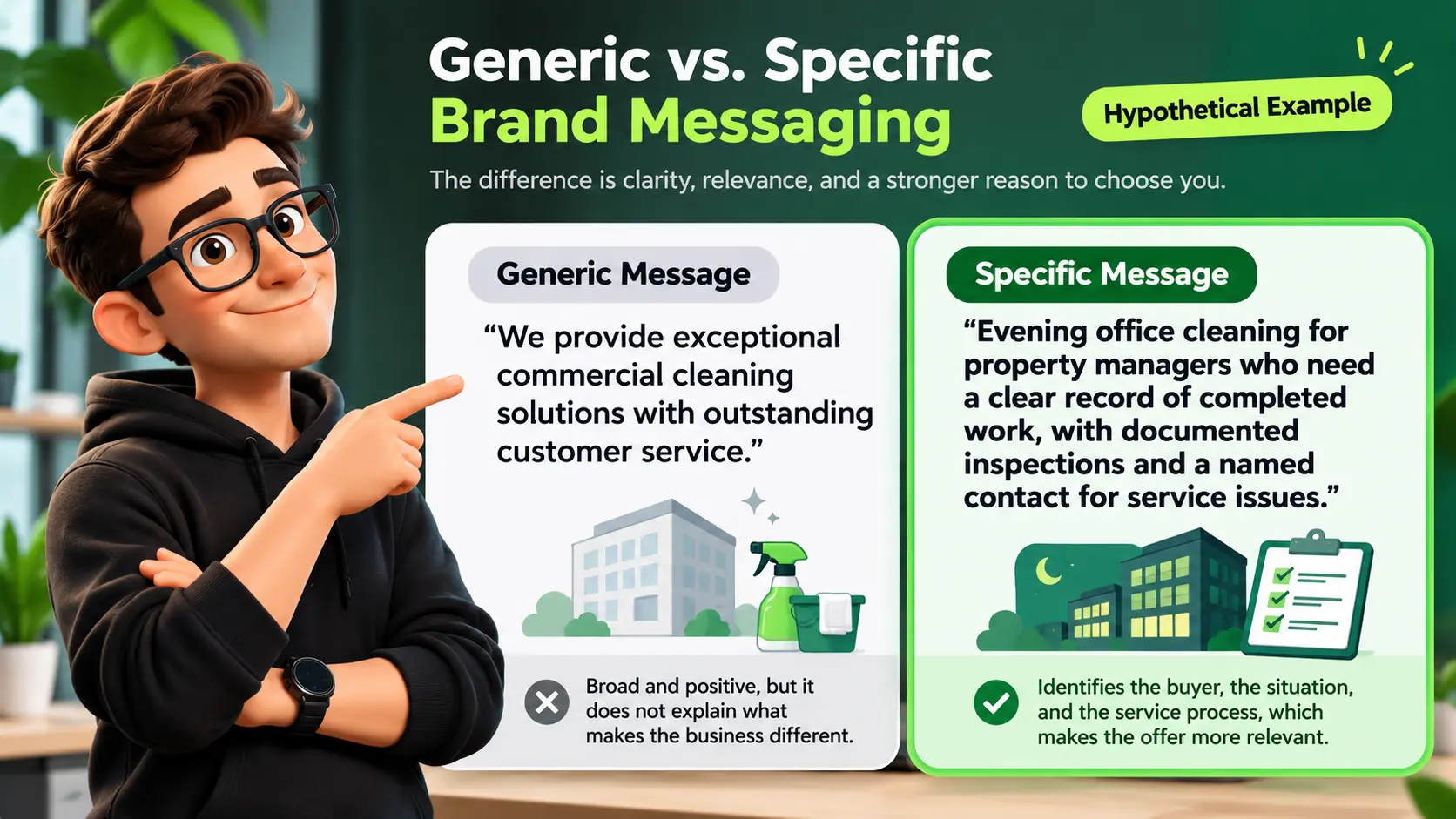
Generic message: We provide exceptional commercial cleaning solutions with outstanding customer service.
More specific message: Evening office cleaning for property managers who need a clear record of completed work, with documented inspections and a named contact for service issues.
The second message describes a buyer, an operating situation, and a practical delivery approach. It is not automatically the better choice for every customer. The revised sentence is only appropriate if the business actually follows and can document that process.
Proof could include a documented inspection procedure, a clearly described service agreement, or an appropriately anonymized example of a reporting record. Do not invent customer reviews, imply an unearned certification, or publish confidential client information to make a message sound credible.
The Federal Trade Commission’s advertising guidance for small businesses explains that objective advertising claims require an appropriate evidentiary basis. Businesses should review claims about outcomes, capabilities, comparative superiority, and guarantees before publishing them. Additional rules may apply to particular industries or locations.
Make Your Differentiation Visible Across the Customer Journey
A strong positioning statement should guide the information customers encounter, not remain hidden inside an internal brand document.
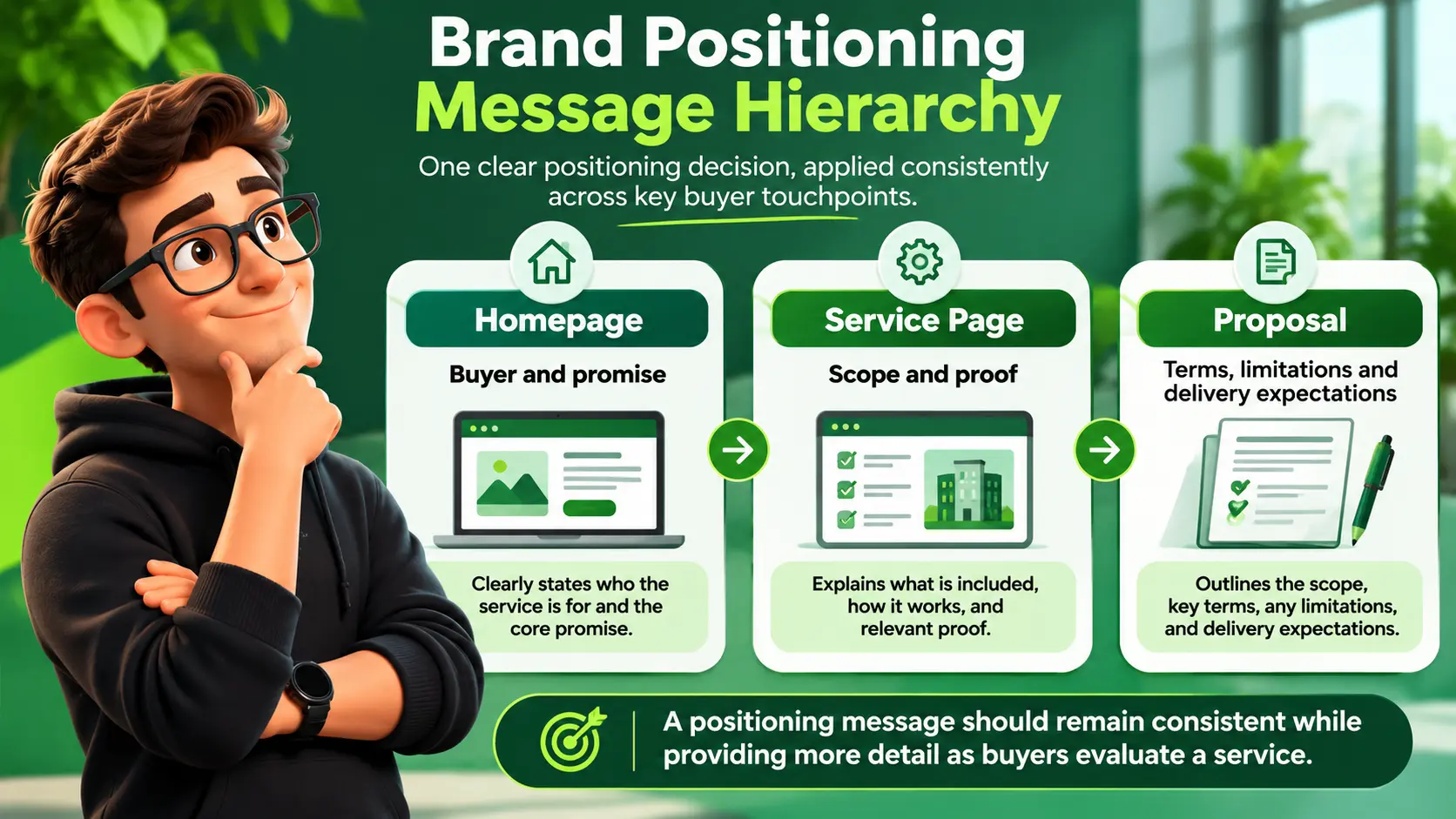
On the homepage, the main message should make the intended buyer, relevant problem, and offered service understandable. A supporting explanation can describe how the business works, while service pages provide deeper information about scope, conditions, limitations, and evidence.
Sales conversations and proposals should reinforce the same position. If a website promises a documented handoff process but the proposal provides no explanation of that process, the message becomes difficult to trust.
Brand recognition matters as well. Consistent naming, tone, visual elements, and service descriptions can help people recognize the business across websites, advertisements, email, and sales materials. Consistency does not require identical wording in every channel. The core promise should remain accurate while the level of detail changes with the buyer’s needs.
For businesses working to align search content with buyer intent, the ImiliCorp guide to organic SEO for lead generation provides additional context on matching information to different stages of service evaluation.
Check Whether the New Message Helps Buyers Decide
Do not judge a positioning change only by whether a new headline looks more creative. Evaluate whether the message helps the intended customer understand the offer and decide whether the business is relevant.
Before replacing all your marketing materials, test a draft with people who resemble the intended buyers. Show the message without providing an explanation, then ask what the business offers, who it serves, what makes the offer relevant, and what information they would still need before contacting the provider.
Collect their answers before showing explanations or coaching them. If participants repeatedly misunderstand the offer, revise the wording, clarify the service, or reconsider the position. Small informal reviews are diagnostic feedback, not statistical proof of improved conversion performance.
When valid analytics and CRM data are available, evaluate the revised message using clearly defined outcomes:
- Message comprehension: Whether research participants can accurately explain the offer and its intended audience.
- Service-page engagement: Whether relevant visitors continue to pages that explain the service, recognizing that visits alone do not prove purchasing interest.
- Qualified inquiries: Contact submissions or calls that meet documented buyer-fit criteria, when they can be measured reliably.
- Sales feedback: The objections, expectations, and misunderstandings reported during actual buying conversations.
Compare results over sensible periods and account for changes in traffic sources, campaigns, seasonality, and the offer itself. A controlled experiment may help isolate a message change when the sample and test design are adequate. An increase in clicks or inquiries alone does not establish that new positioning caused additional sales.
Recognize When Better Copy is Not Enough
Sometimes competing businesses sound similar because they genuinely offer similar services. In that situation, inventing a unique promise creates a credibility problem instead of solving the positioning problem.
The better business decision may be to improve delivery, define a more appropriate customer segment, clarify service boundaries, strengthen communication, or make an existing capability easier to verify.
A business does not need to claim that every aspect of its offer is unique. It needs to be recognizable, useful to the people it wants to serve, and truthful about the reasons a customer might choose it.
What Should Your Business Do Next?
Start with one buyer segment and one important service page. Compare relevant alternatives, identify what buyers actually value, select a supportable promise, and check whether prospective customers understand it. Expand the message to other channels only after confirming that the business can deliver what it says.
If your team needs help connecting brand messaging with campaign execution and measurement, review ImiliCorp’s performance branding service and discuss the specific research, messaging, and implementation work your business requires before choosing a provider.
Standing out does not mean sounding unlike everyone else at any cost. It means helping the right customer understand why your business deserves consideration and giving them credible reasons to believe you.