
Choosing an agency for social growth can feel straightforward until proposals start using the same words for very different work. Some teams specialize in buying attention through ads, while others focus on building an owned community and brand voice. Knowing the difference protects budget, expectations, and results.
This guide breaks down what each agency type does, what deliverables you should expect, and how to pick the right fit for your goals. It also covers reporting, skills, pricing, and common red flags that create wasted spend.
What a Paid Social Agency Does?
A paid social agency plans, launches, and optimizes advertising on social platforms. The work centers on paid media performance, budget management, and conversion-focused creative that is tested and improved over time.
Most paid social agencies manage platforms such as Meta Ads, TikTok Ads, LinkedIn Ads, Pinterest Ads, and YouTube. They focus on measurable outcomes like purchases, leads, app installs, bookings, and qualified traffic.
Core Responsibilities
The scope usually starts with account structure and campaign strategy. It extends into daily optimization, tracking quality, and creative testing to maintain efficient cost per result.
- Media strategy and planning across audiences, objectives, and budget allocation.
- Campaign build and management including targeting, placements, bidding, and pacing.
- Creative testing system for ads, formats, hooks, and landing page alignment.
- Conversion tracking and attribution using pixels, events, server-side tracking, and analytics.
- Performance reporting focused on efficiency, volume, and incrementality where possible.
With this foundation, paid social becomes a controlled experiment that compounds learning and improves return over time.
What a Social Media Marketing Agency Does?
A social media marketing agency focuses on organic presence and brand communication across social channels. The work typically includes content strategy, publishing, community engagement, and brand consistency.
Many teams also support influencer outreach, social listening, and collaboration with PR or customer support. The aim is sustained visibility, trust, and audience growth that does not rely on ad spend for every impression.
Core Responsibilities
The scope centers on what your audience sees and how they experience the brand day to day. Success is measured through engagement quality, follower growth, sentiment, and assisted conversions.
- Content planning and calendars based on pillars, themes, and platform-native formats.
- Copywriting and creative direction to keep tone, voice, and messaging consistent.
- Publishing and channel management including scheduling and basic optimization.
- Community management for comments, DMs, escalation paths, and moderation.
- Social listening to track mentions, trends, and customer feedback signals.
Organic social builds durable brand equity, which can lift ad performance and reduce dependency on direct-response targeting.
Key Differences In Strategy and Outcomes
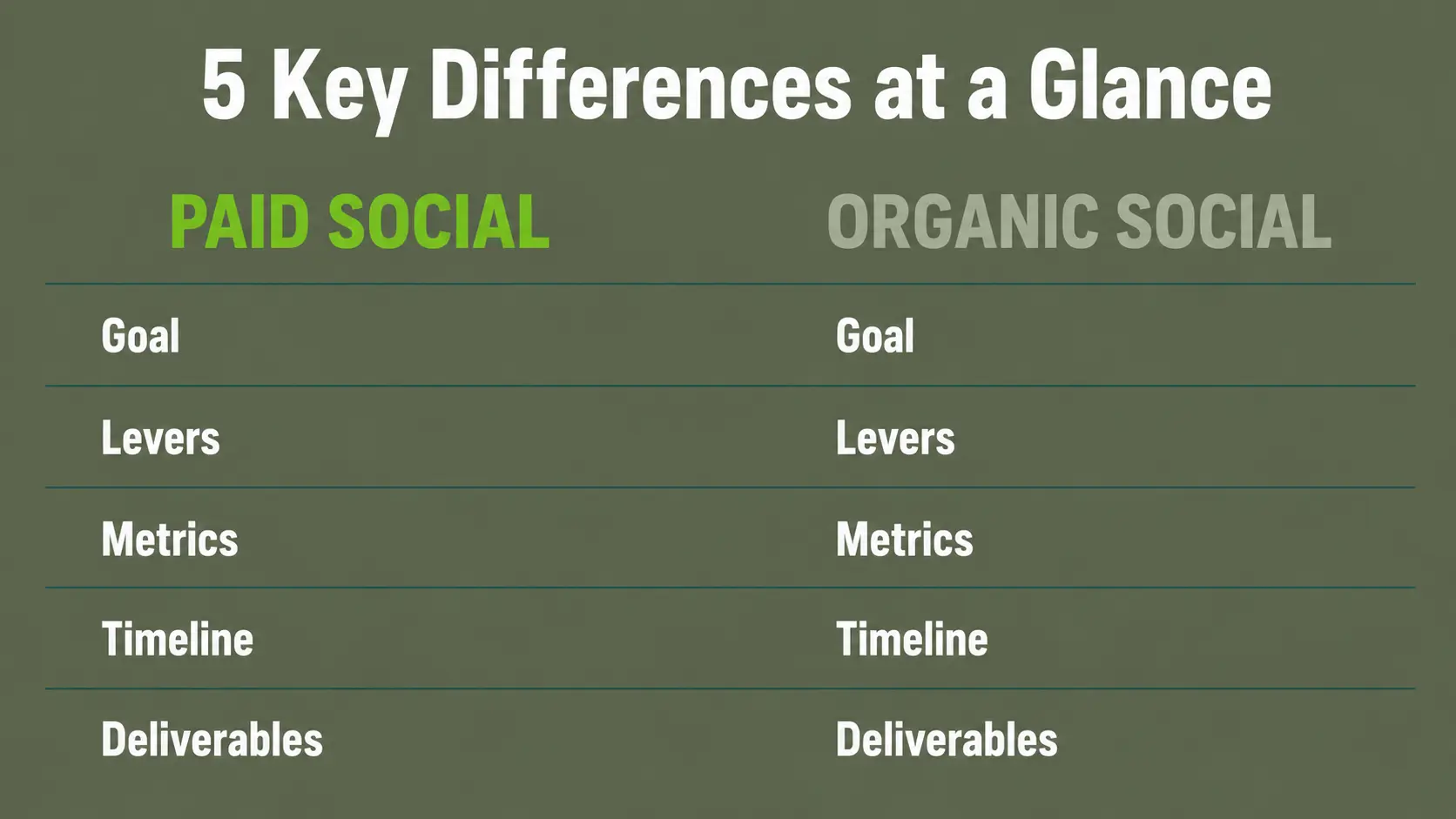
The biggest difference is the engine that drives reach. Paid social buys distribution and is limited mainly by budget and creative quality, while organic social earns distribution and is limited mainly by consistency and audience resonance.
The second difference is how success is evaluated. Paid social is typically judged by cost per acquisition, return on ad spend, lead quality, and conversion volume, while organic social is judged by engagement, share of voice, and long-term brand lift.
| Area | Paid Social Agency | Social Media Marketing Agency |
|---|---|---|
| Main goal | Efficient conversions and scalable revenue | Brand awareness, community, and trust |
| Primary levers | Budget, targeting, bidding, creative testing | Content quality, consistency, engagement |
| Core metrics | CPA, ROAS, CAC, CVR, LTV alignment | Reach, engagement rate, follower growth, sentiment |
| Typical timeline | Weeks to stable learnings, ongoing iteration | Months to compounding audience growth |
| Common deliverables | Campaign builds, ad creatives, testing roadmap | Content calendar, posts, replies, brand guidelines |
This comparison makes it easier to match an agency to the outcome you need most right now.
Skills and Roles You Should Expect
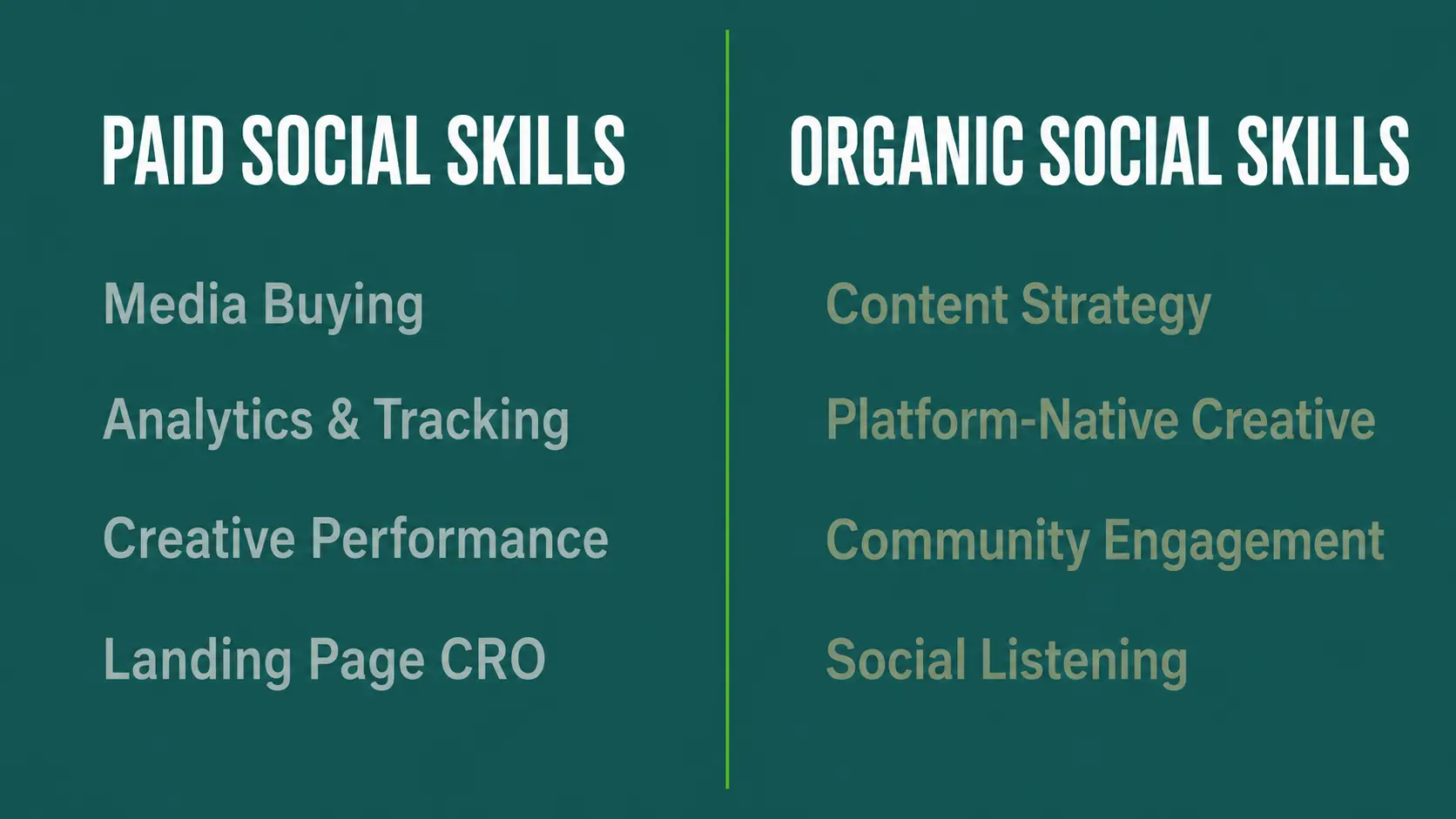
Team composition reveals whether an agency can execute what it sells. A paid social agency should have performance marketers who can diagnose auction dynamics, tracking integrity, and creative fatigue.
A social media marketing agency should have strategists, creators, and community managers who understand platform culture and brand storytelling.
Paid Social Skill Set
Look for depth in measurement and experimentation. Strong teams can explain testing methodology, attribution limits, and how they reduce wasted spend.
- Media buying and optimization with clear pacing and learning goals.
- Analytics and tracking including event setup and troubleshooting.
- Creative performance insight translating data into briefs and iterations.
- Landing page coordination to improve conversion rate and message match.
These skills matter most when budgets grow and small inefficiencies turn into large losses.
Organic Social Skill Set
Look for a system that keeps content aligned with brand, product, and audience needs. Strong teams can show how they build content pillars and maintain consistency without burning out production.
- Content strategy built on audience needs and brand positioning.
- Platform-native creative that fits feed behavior and formatting rules.
- Community engagement with moderation guidelines and escalation workflows.
- Social listening and reporting that turns feedback into action.
These capabilities shape perception, which influences conversion rates across every marketing channel.
How Deliverables and Reporting Differ?
Paid social deliverables are usually tied to campaigns and testing cycles. You should receive structured reporting that connects spend to outcomes, plus a record of what was tested and what changed.
Organic social deliverables are tied to publishing cadence and community management coverage. Reporting should explain what content performed, why it worked, and how insights will shape future posts.
What Good Paid Social Reporting Includes?
- Budget pacing showing spend vs plan and forecasted delivery.
- Performance by audience and creative with clear learnings.
- Funnel visibility from click to conversion where tracking allows.
- Testing log capturing hypotheses, results, and next actions.
This structure prevents random optimizations and keeps decision-making grounded in evidence.
What Good Organic Social Reporting Includes?
- Content performance across formats, themes, and posting times.
- Audience growth quality including saves, shares, and meaningful comments.
- Community insights highlighting recurring questions and sentiment shifts.
- Brand consistency checks ensuring voice and visuals stay aligned.
Clear reporting turns social activity into a feedback loop that improves messaging and product-market fit.
Budget and Pricing Models
Paid social agencies often charge a percentage of ad spend, a fixed monthly retainer, or a hybrid model. Some include creative production, while others require you to supply assets or pay extra for performance creative.
Social media marketing agencies usually charge retainers based on output volume and coverage. Pricing often scales with the number of platforms, posting frequency, community management hours, and whether video editing is included.
Regardless of model, clarity matters more than the rate. You should know what is included, how revisions work, who owns assets, and what happens if ad spend or content volume changes.
When To Choose Each Type?
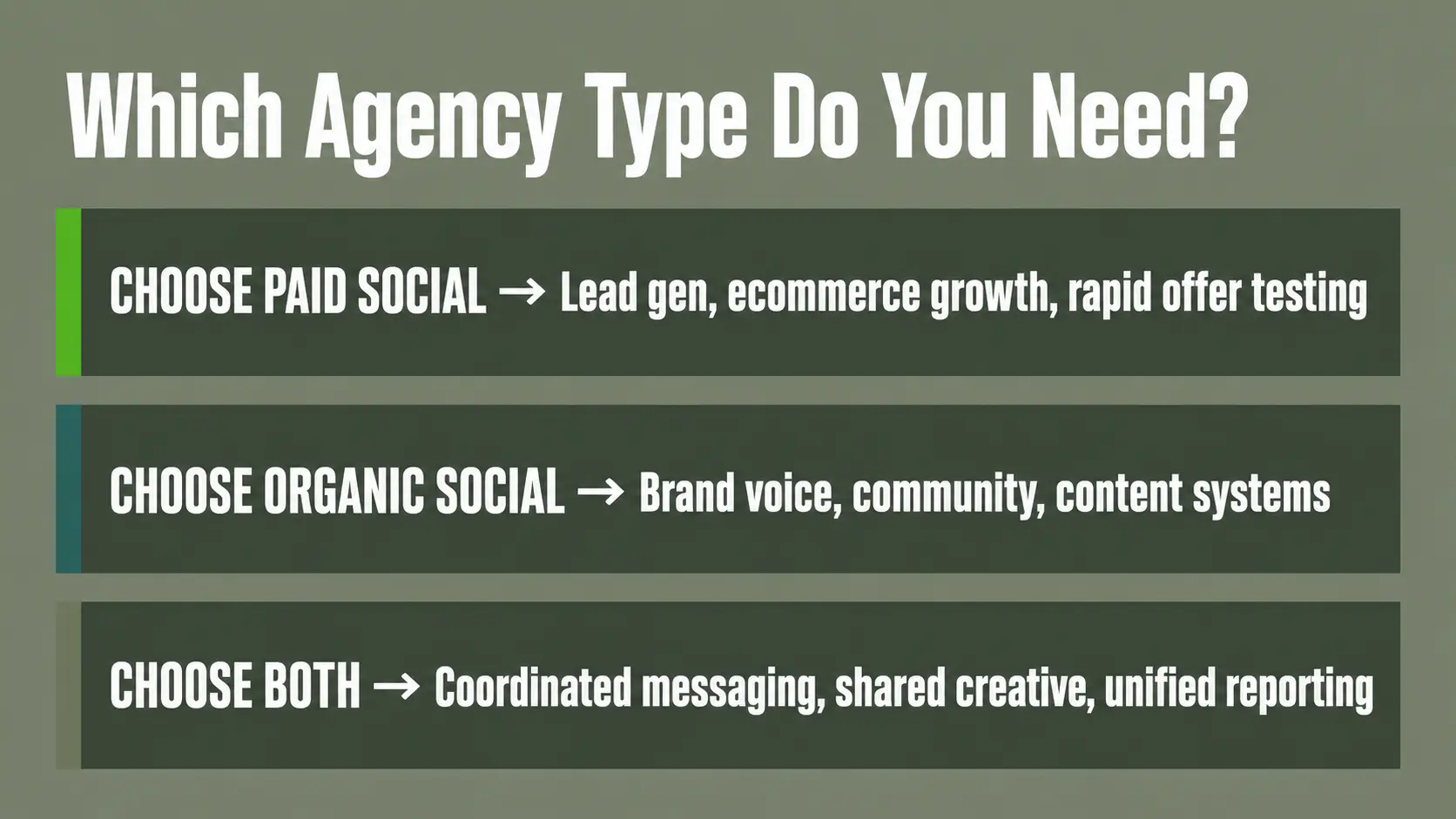
The right choice depends on where your bottleneck sits. If you need predictable customer acquisition and have a product or offer that can convert, paid social is usually the faster path.
If you need stronger positioning, a consistent brand voice, and a community that trusts you before buying, organic social support is usually the smarter first investment.
- Choose a paid social agency when you need lead generation, ecommerce growth, retargeting, or rapid testing of offers and audiences.
- Choose a social media marketing agency when you need content systems, community management, brand awareness, or ongoing engagement that supports customer retention.
- Choose a combined partner when you want coordinated messaging across ads and organic, with shared creative insights and unified reporting.
This decision becomes easier when you map goals to constraints such as time, creative bandwidth, and internal analytics maturity.
Questions To Ask Before You Sign
Good agencies welcome precise questions because it proves you care about outcomes. Your goal is to confirm process, accountability, and fit with your internal team.
- How do you define success and which metrics will you report weekly and monthly.
- Who does the work and what roles are assigned to strategy, execution, and QA.
- How do you handle creative including briefs, production, and iteration cycles.
- What tracking setup is required and who is responsible for implementation.
- How do you communicate including meeting cadence, response times, and escalation.
These questions surface whether an agency sells a service or runs a repeatable system.
Red Flags That Lead To Disappointment
Some issues show up early if you know what to look for. Avoid partners who rely on vague promises or who cannot explain how they make decisions.
- Guaranteed results without discussing offer quality, conversion rate, and tracking limits.
- Reporting that hides the basics such as spend, frequency, creative performance, or audience breakdowns.
- One-size-fits-all plans that ignore your sales cycle, margins, and capacity to fulfill demand.
- No documented process for testing, learning, and iterating.
- Asset and account ownership confusion that makes it hard to transition later.
When expectations and accountability are explicit, you reduce risk and speed up time to value.
Conclusion
A paid social agency is built to buy attention efficiently and convert it through testing, tracking, and budget control. A social media marketing agency is built to earn attention through content systems, community engagement, and consistent brand storytelling.
The best choice is the agency type that matches your current constraint and your next business milestone. Get clear on goals, deliverables, and measurement, then pick the partner whose process makes those outcomes realistic.
FAQ’s
1. What is the main difference between a paid social agency and a social media marketing agency?
A paid social agency focuses on running ads, managing budgets, testing creatives, and improving results like leads, sales, CPA, and ROAS. A social media marketing agency focuses on organic content, brand voice, community management, engagement, and long-term audience growth.
2. When should a business choose a paid social agency?
A business should choose a paid social agency when it wants faster lead generation, ecommerce sales, retargeting, or quick testing of offers and audiences. It works best when the business already has a clear product, offer, and conversion goal.
3. When is a social media marketing agency the better choice?
A social media marketing agency is better when a business needs consistent content, stronger brand awareness, community engagement, and trust-building. It is useful for brands that want long-term visibility without relying only on paid ads.