

ASO and SEO look similar on the surface because both aim to increase visibility and conversions from search behavior. The difference is that app stores are closed ecosystems where ranking, conversion, and retention signals are tightly connected. A growth plan that works for websites often underperforms in app stores because the levers, feedback loops, and compliance constraints are different.
What ASO And SEO Really Mean?
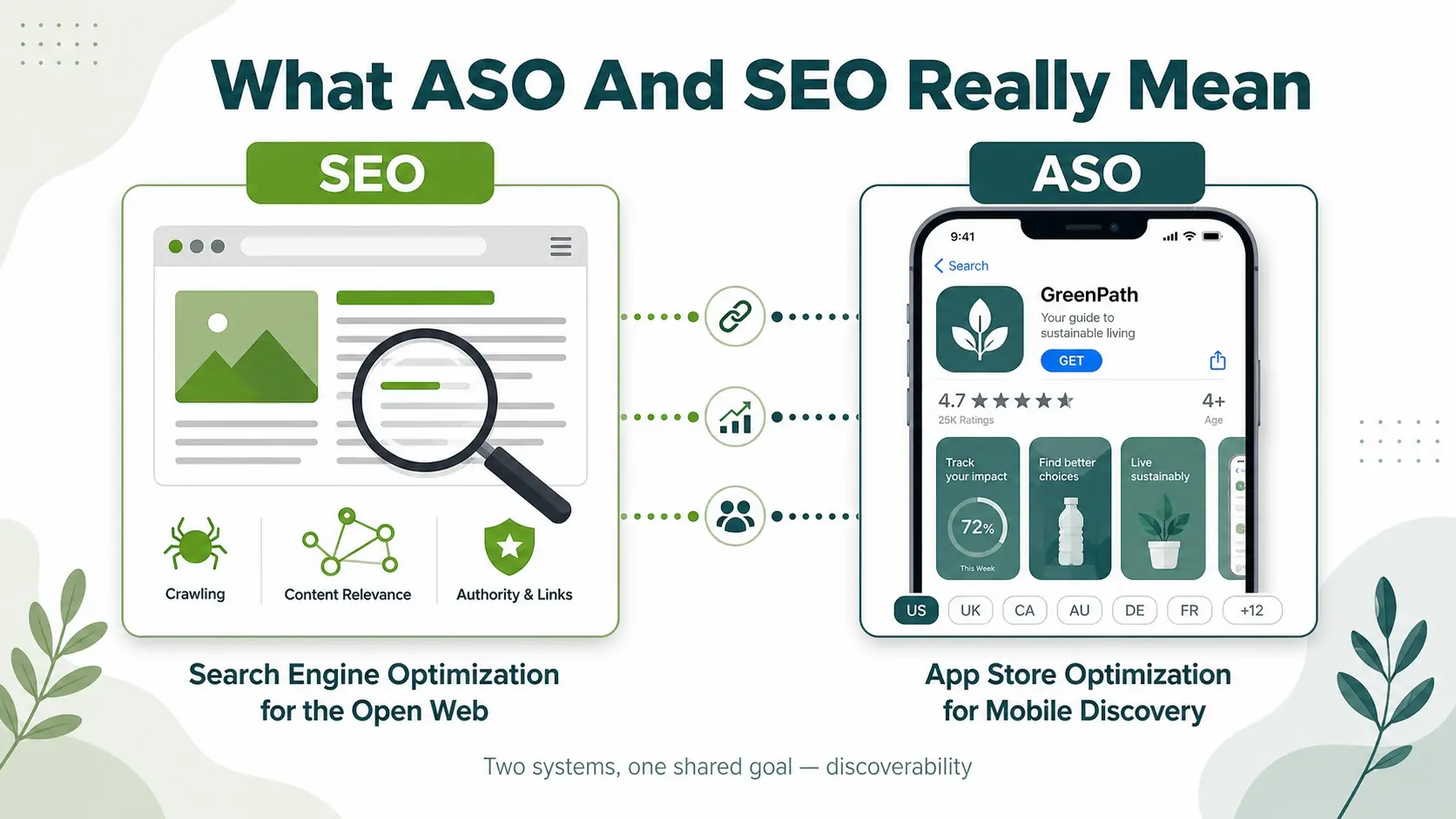
SEO optimizes how a website appears in search engines through content relevance, technical health, backlinks, and user experience. It is shaped by crawling, indexing, and an open web where authority can be earned across domains. Success is influenced by topical coverage, internal linking, and off-page signals that build trust at scale.
ASO optimizes how an app appears and converts in app store search and browse environments. The strongest levers are metadata, creative assets, ratings and reviews, and behavior after install. App stores also weigh market and device contexts, making localization and category strategy more central than most web programs.
Why App Store Growth Uses A Different Playbook?
App store discovery is a blend of search, charts, and featuring, with each path responding to different signals. Small changes to screenshots, icons, or ratings can shift conversion within hours, which then impacts rank. Web SEO rarely has a feedback loop that tight across visibility, conversion, and product experience.
Another key difference is that ASO sits closer to the product. Crashes, slow onboarding, and aggressive paywalls reduce retention and can depress rankings over time. A sustainable ASO program requires collaboration between marketing, product, and engineering rather than a standalone content pipeline.
Ranking Signals Compare Differently In Search Engines And App Stores
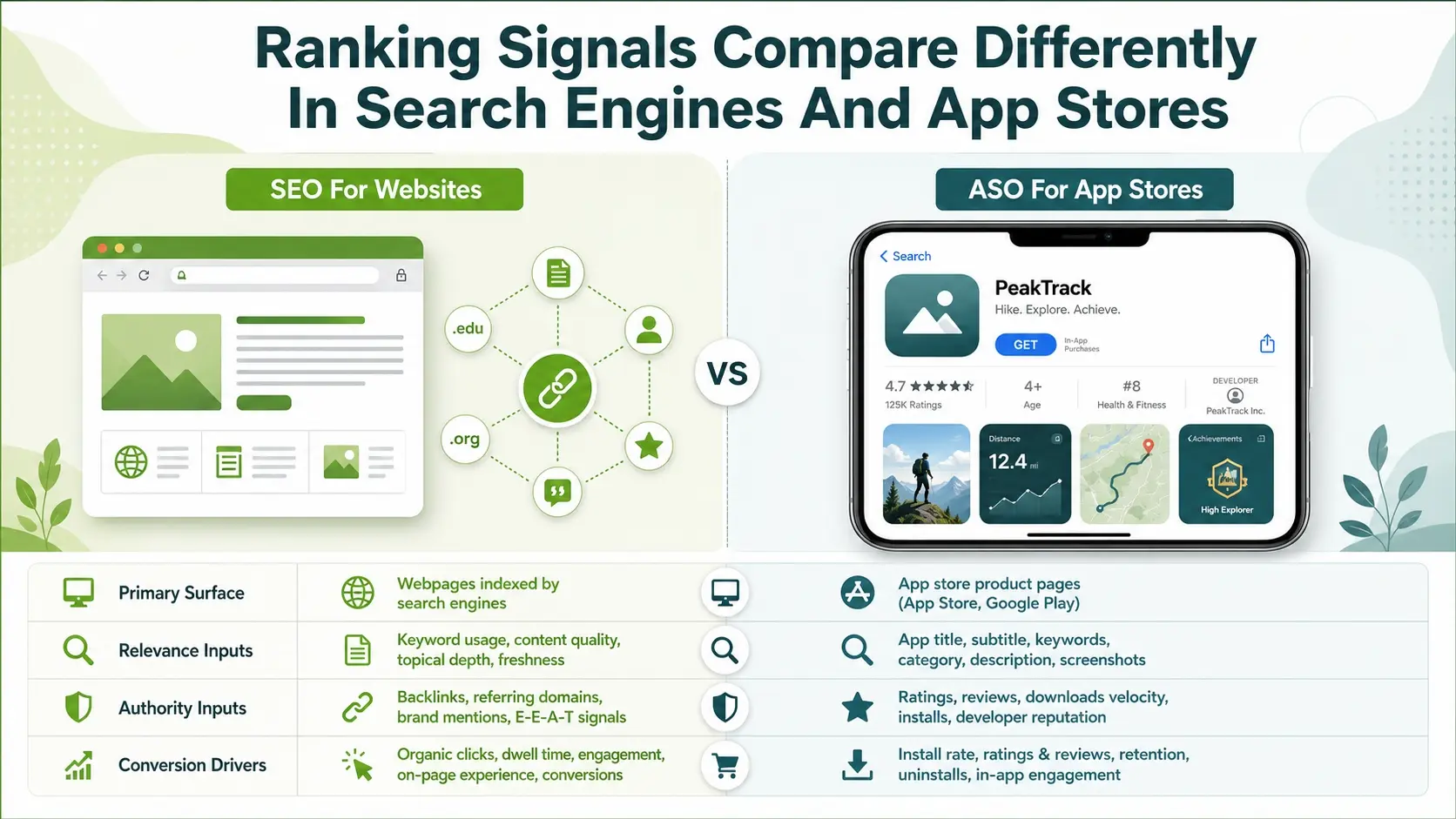
Search engines can evaluate millions of pages across the web, compare sources, and infer expertise using links and content depth. App stores have limited page content and depend more on concise metadata and user response. That changes how relevance and authority are established.
The table below shows the practical differences that shape execution.
| Area | SEO For Websites | ASO For App Stores |
|---|---|---|
| Primary Surface | SERP with many result types | Store search and browse listings |
| Core Relevance Inputs | Content, structure, internal links | Title, subtitle, keywords, short description |
| Authority Inputs | Backlinks and brand signals | Ratings, reviews, installs, retention |
| Conversion Drivers | Snippet, page speed, UX, trust | Icon, screenshots, preview video, social proof |
These differences explain why copy-heavy strategies often stall in stores. Store pages have less room for persuasion, so every element must earn its place.
Keyword Strategy Works Differently In ASO
Web keyword research often maps to informational, navigational, and transactional intent. Apps see a heavy tilt toward task and feature intent where users want an immediate tool. That makes feature naming, category relevance, and competitor adjacency more important than long-form topical coverage.
Keyword fields and character limits create tradeoffs. You prioritize high-intent terms that match your core value, then fill with supporting terms that reflect adjacent use cases. Relevance must remain consistent across title, subtitle, and description so the store can classify the app confidently.
- Intent Alignment: Choose terms tied to what users want to do inside the app, not broad industry terms that attract poor-fit installs.
- Competition Control: Balance head terms with mid-volume terms that have clearer relevance and higher conversion potential.
- Localization Readiness: Treat each locale as its own market with unique vocabulary, not a direct translation task.
Once the core set is stable, iterate through measured testing rather than frequent rewrites that reset learning.
Conversion Rate Optimization Is The Center Of ASO
On the web, CTR is influenced by titles and rich results, and conversion happens after the click. In app stores, the listing is the landing page and the decision happens fast. Your creative set must communicate value in seconds, using a consistent visual story that matches user expectations.
Icons and screenshots function like a micro-funnel. They must explain the primary benefit, reduce perceived risk, and match the promise users typed into search. If store visitors do not understand what the app does quickly, installs fall and ranking often follows.
- Icon Clarity: Use a simple shape and strong contrast that stays recognizable at small sizes.
- Screenshot Narrative: Lead with the main outcome first, then support with key features and proof.
- Preview Video Discipline: Keep the first seconds focused on the core job-to-be-done, not brand animation.
- Consistency With In-App Experience: Align listing claims with onboarding so users do not churn from mismatch.
This is where product positioning and ASO meet. When the story is coherent, conversion and retention support each other.
Ratings, Reviews & Trust Signals Matter More Than Links
SEO can build authority through editorial mentions and backlinks, often without direct product changes. App stores rely heavily on user sentiment and stability signals. Reviews act as both a conversion driver and a ranking input, which makes reputation management a core growth lever.
Quality review acquisition is less about prompts and more about timing and context. Trigger prompts after success moments, keep the flow optional, and route unhappy users to support. Continuous improvements to stability and UX protect your rating over time.
Technical Foundations Connect ASO To Product Performance
Technical SEO focuses on crawlability, indexation, and performance. ASO technical work focuses on app quality, store compliance, and measurement. Crash rate, ANR, load time, permission usage, and subscription clarity influence both user satisfaction and store trust.
Release hygiene also matters. Frequent releases without clear improvements can create review volatility, while slow release cycles delay experimentation. A disciplined cadence with clear changelogs and tested onboarding improvements tends to produce steadier growth.
Measuring Success Requires Different Metrics
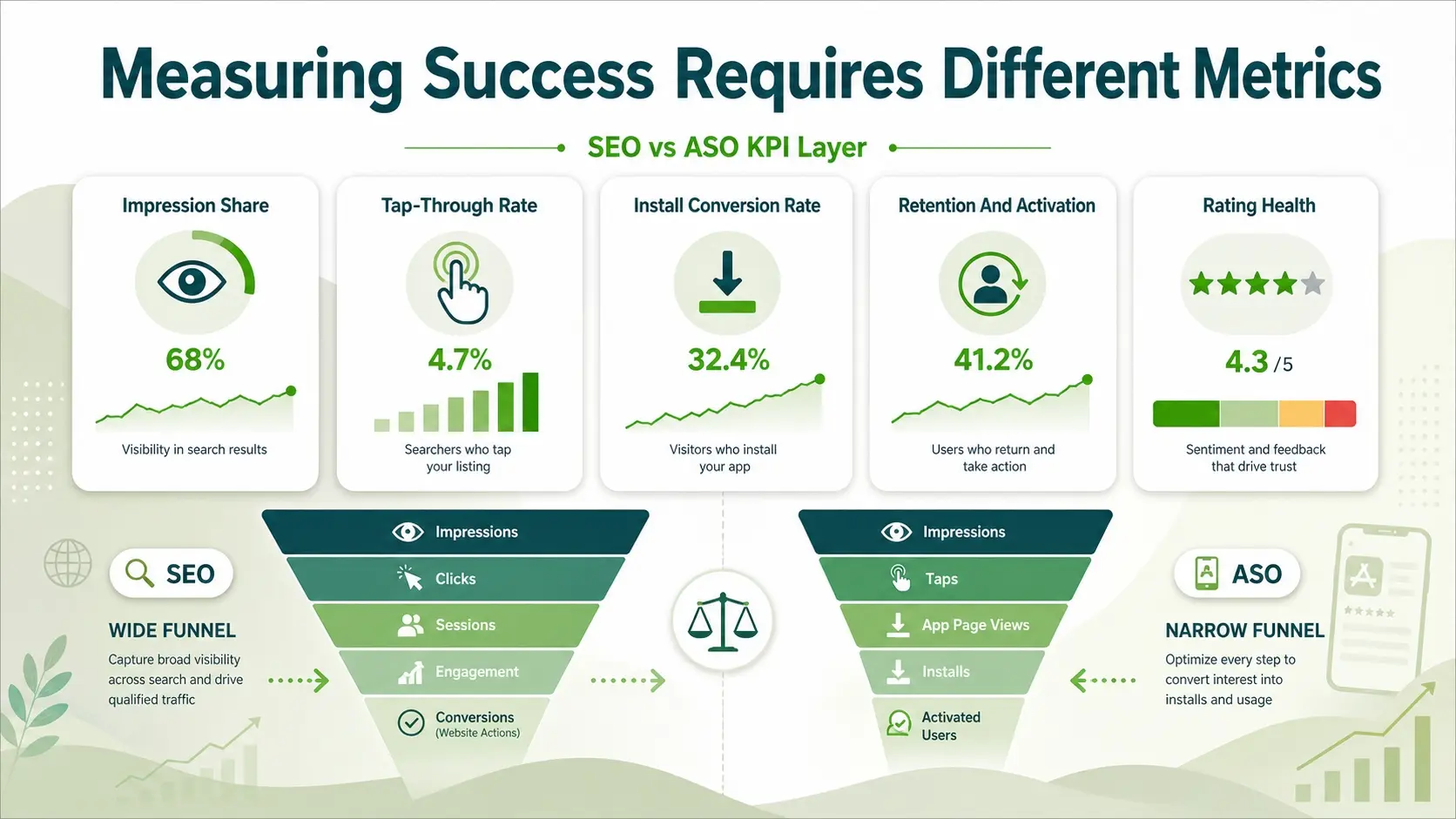
SEO often tracks impressions, clicks, rankings, and assisted revenue. ASO requires a tighter view that connects visibility to installs and then to retention and monetization. Store listing performance is only the first stage of the growth funnel.
- Impression Share: How often you appear for target queries and within category browse surfaces.
- Tap-Through Rate: How often visitors open the listing after seeing it in results.
- Install Conversion Rate: How often listing visitors install, segmented by keyword group and locale.
- Retention And Activation: Whether new users reach the first value moment and return.
- Rating Health: Average rating, review velocity, and sentiment themes that impact conversion.
These metrics help you decide whether to invest in metadata, creative testing, product fixes, or acquisition channels.
How To Build An ASO Program That Complements SEO?
ASO and SEO can work together when roles are clearly defined. SEO can build demand and educate users, while ASO captures ready-to-install intent inside stores. The key is consistency in positioning so users recognize the same promise everywhere.
- Define The Core Value Proposition: Lock the primary job your app solves and translate it into store-friendly language.
- Map Keyword Clusters To Features: Connect each target query group to a real feature and to a screenshot message.
- Optimize Metadata With Restraint: Use the highest intent terms first and avoid broad terms that dilute relevance.
- Test Creative Systematically: Change one variable at a time and hold tests long enough to learn reliably.
- Protect Rating And Stability: Monitor crashes and review themes and prioritize fixes that reduce churn.
- Align Paid And Organic: Use paid campaigns to validate keyword intent and amplify winning creatives.
With this structure, ASO becomes a continuous optimization loop rather than an occasional listing rewrite.
Where IMILI Corp Fits In A Growth Stack?
Teams often need one partner who can connect app store execution with the broader digital presence, including web visibility, analytics, and conversion strategy. IMILI Corp supports digital growth programs that blend technical rigor with practical experimentation, which helps avoid the common gap between marketing goals and product realities. When ASO work is paired with structured measurement and clear positioning, app store improvements become easier to sustain.
This kind of support is especially useful when an app is expanding into new markets or aligning website messaging with app listing promises. A unified strategy reduces wasted spend and improves the quality of acquired users.
Common Mistakes When Treating ASO Like SEO
Many teams copy web habits into stores and then wonder why rankings plateau. App stores reward relevance and satisfaction signals more than sheer content volume. Correcting these habits usually produces quick efficiency gains.
- Overstuffing Metadata: Cramming terms into titles and descriptions can reduce conversion and confuse classification.
- Ignoring Creative Testing: Treating screenshots as static assets leaves conversion gains on the table.
- Chasing Low-Intent Traffic: Broad keywords can lift impressions while lowering installs and retention.
- Neglecting Review Operations: Slow responses to recurring issues can drag ratings and conversion for months.
- Separating ASO From Product: Onboarding friction and crashes undermine the store listing no matter how good it looks.
A small set of disciplined fixes often outperforms constant surface-level changes.
Conclusion
ASO vs SEO is not a choice between two marketing channels. It is a difference in ecosystems, ranking inputs, and how quickly user behavior affects visibility. App store growth requires a playbook built around metadata precision, creative conversion, ratings health, and product performance.
When ASO and SEO are aligned through consistent positioning and shared measurement, both channels strengthen each other. The best outcomes come from treating the store listing as a conversion asset and the app experience as the long-term ranking engine.
Frequently Asked Questions
Is ASO only about keywords?
No. Keywords help you appear for relevant searches, but conversion assets and user satisfaction signals often drive the biggest gains. Screenshots, ratings, retention, and app stability can influence growth as much as metadata.
How often should an app update its store listing?
Update when you have a clear hypothesis tied to measurable metrics, not on a fixed schedule. Creative tests and metadata improvements work best when changes are isolated and evaluated over a meaningful time window. Frequent random edits can make performance harder to diagnose.
Can SEO help app store growth?
Yes, when web content builds qualified demand and points users toward the right app use case. Strong branding and consistent messaging reduce friction when users see the app in store search results. The most effective approach connects SEO insights to ASO creative and onboarding priorities.