
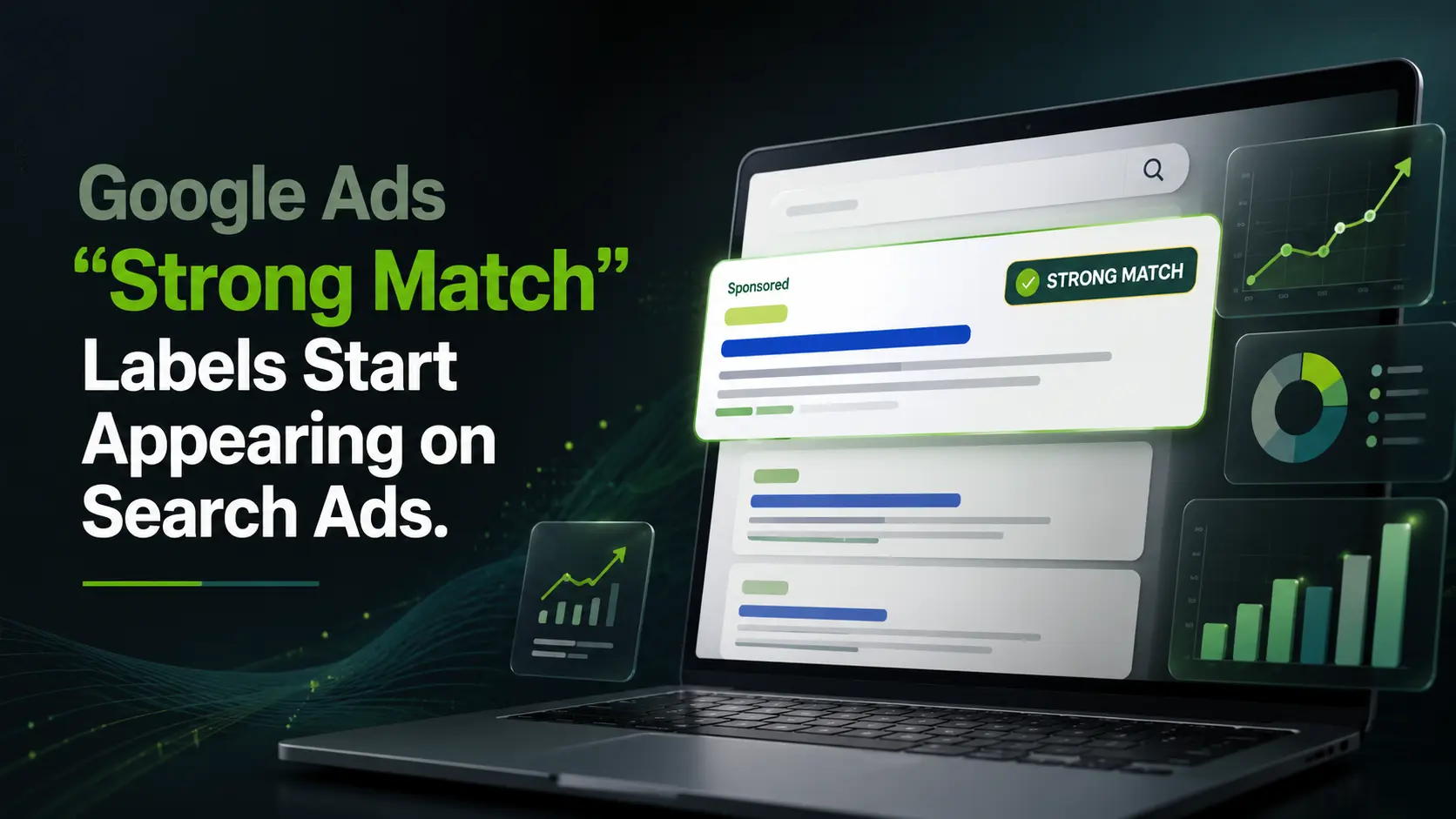
Google Ads has started showing new “Strongest match” and “Strong match” labels on some Search ads in the United States. The labels are part of a limited test designed to help users quickly identify ads that Google considers highly relevant to their searches.
The test was announced earlier this year, but the labels are now being seen on live Google Search results. This means some users may notice a small “Strongest match” or “Strong match” label attached to certain sponsored results.
Google is using its existing ad quality and relevance signals to decide which ads receive these labels. The company is not introducing a completely new advertising system. Instead, it is adding an extra visual signal to ads that its systems already consider closely connected to what a user is searching for.
“Strongest match” appears to represent the highest level of relevance in the test. “Strong match” is another label for ads that Google believes are highly relevant, but may not meet the same level as the strongest category.
For example, if someone searches for a specific product or service, Google may show one of these labels on an advertisement that closely matches the search terms, ad message and expected user needs.
The change could make relevance even more important for advertisers. An ad with a visible match label may attract more attention because users could see it as a sign that the sponsored result is closely related to their search.
However, the labels do not currently create a new type of Google Ads campaign. They are being tested on existing Search ads and use signals that are already part of Google’s advertising system.
There is also no clear indication that receiving a “Strongest match” or “Strong match” label automatically improves an ad’s position or lowers its advertising cost. The feature is mainly designed as a visible label for users during the experiment.
For advertisers, the test highlights the importance of keeping keywords, ad copy and landing pages closely connected. A campaign with clear messaging and a useful landing page has a better chance of providing the type of relevant experience Google is trying to identify.
Advertisers may also want to watch campaign performance while the experiment continues. Changes in click-through rates, conversions and user behavior could show whether people respond differently when they see these new labels.
Since the feature is still being tested with a limited number of users, Google could change how the labels look, how often they appear or whether they become a permanent part of Search advertising.
The experiment shows how Google continues to adjust the appearance of paid search results while trying to connect users with advertisements that better match their intent. If the labels perform well, “Strongest match” and “Strong match” could become another important signal for businesses competing for attention on Google Search.