

Long-term SEO contracts can be worth it when they match how search growth actually happens and when the agreement protects you on scope, accountability, and exit terms. They can also lock you into slow delivery, unclear work, or reports that look busy while results stay flat. The value is not in the length alone, but in whether the contract is built around outcomes, transparency, and a realistic plan.
Why SEO Often Benefits From Longer Commitments?
SEO is cumulative. Technical fixes, content improvements, and authority building tend to compound as search engines recrawl pages, users engage, and signals stabilize over time.
Longer engagements can reduce stop and start behavior that breaks momentum. When planning, implementation, and measurement run as one system, teams can prioritize the highest impact work without resetting every few weeks.
That said, a longer term should never be a substitute for performance management. A well-run SEO program proves progress through leading indicators early, even when revenue impact takes longer.
When Long-Term SEO Contracts Are Worth It?
 A longer contract earns its keep when the work requires coordination across marketing, development, content, and analytics. It also helps when your site has significant technical debt or when you compete in a crowded space where authority building is not instant.
Look for signs that the provider is planning around your business model, not a generic checklist. The contract should clearly connect deliverables to measurable targets like qualified organic traffic, non-branded visibility, and conversion performance.
- Complex websites: Ecommerce catalogs, multi-location sites, and large service sites often need months of structured fixes and content architecture work.
- Ongoing content development: Sustainable growth needs editorial planning, optimization, and refresh cycles that work best when managed continuously.
- Technical implementation support: If you need help coordinating with developers, longer terms allow for planning, QA, and release windows.
- Competitive markets: When competitors have years of content and backlinks, consistency is a practical advantage.
If these conditions match your situation, a long-term agreement can create stability and focus.
When You Should Avoid Being Locked In?
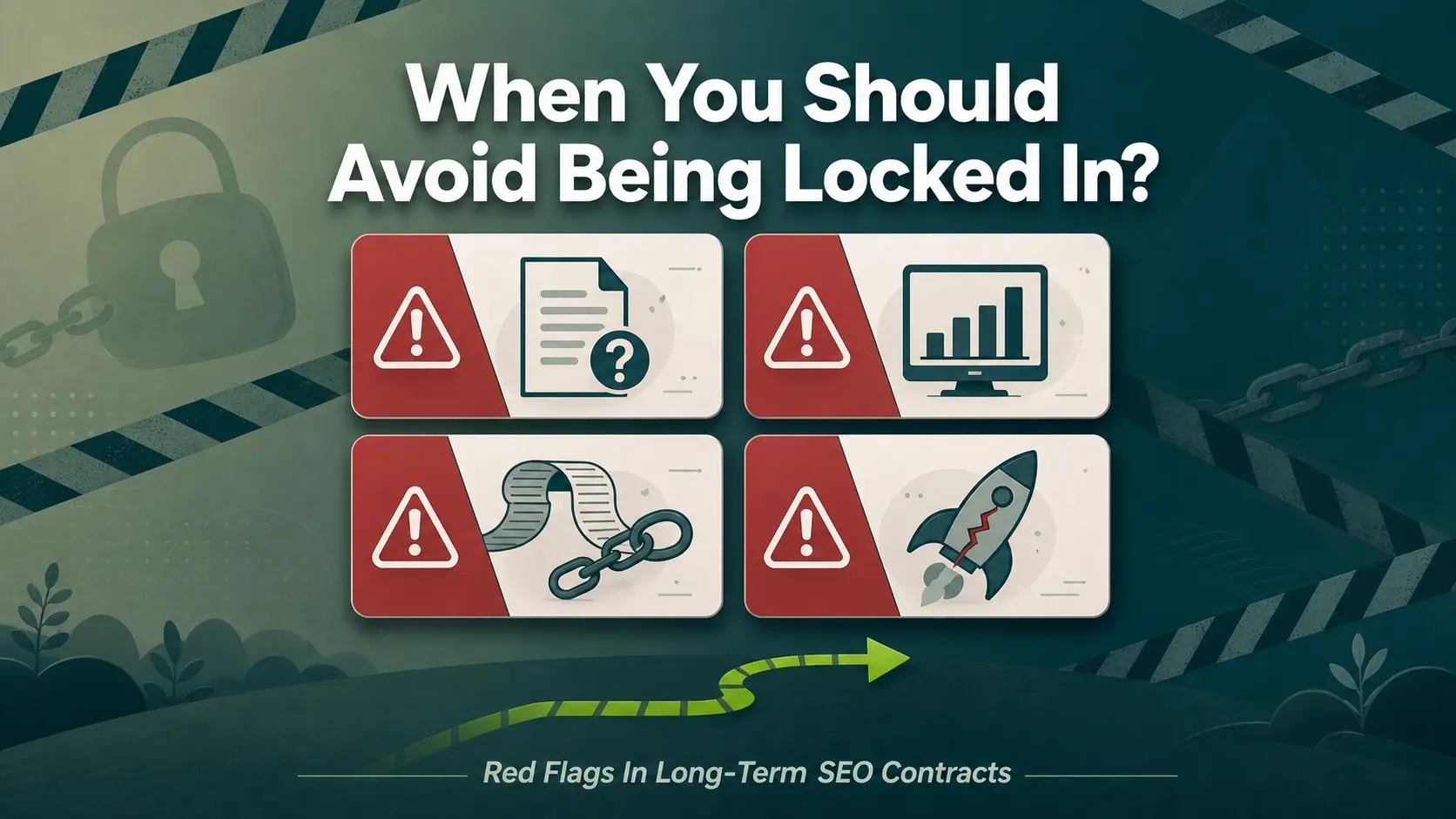 Long-term contracts are risky when the scope is vague or when the provider cannot explain what they will do in the first 30 to 90 days. If the proposal relies on secrecy, that usually signals weak process or low-quality tactics.
Be cautious if you are changing domains, replatforming, merging brands, or making major product shifts without a clear plan. Those transitions can be handled well, but only with a defined migration strategy and responsibilities.
- No clear scope: If deliverables are described as ongoing optimization without specifics, you may pay for activity rather than progress.
- Reporting without insight: Dashboards that show rankings alone can hide issues with intent match, conversions, or cannibalization.
- Unbalanced terms: Long minimum terms with high early cancellation fees can trap you even when work quality drops.
- Overpromises: Any guarantee of top rankings or instant results is a red flag.
These issues do not mean SEO is a bad channel. They mean the agreement is not designed to protect you.
What To Check Before Signing A Long-Term SEO Contract?
Before you sign, read the contract like an operations document. You should be able to answer what gets done, who does it, how it gets approved, and how performance is reviewed.
Scope And Deliverables
Scope should be written so a non-SEO stakeholder can understand what is included and what is not. You want deliverables tied to your site type, your funnel, and your resources.
- Technical SEO: Crawling, indexing, site speed, internal linking, structured data, and error resolution with clear output.
- On-Page SEO: Topic mapping, intent alignment, titles, headings, content improvements, and optimization standards.
- Content Production Or Guidance: Who writes, who edits, how briefs are created, and how quality is enforced.
- Off-Page Strategy: Digital PR or link earning approach with quality safeguards and zero reliance on link schemes.
Also check what is excluded. If development work is required, confirm whether the provider only recommends changes or also supports implementation.
KPIs And How Success Is Measured
Strong contracts define both leading and lagging indicators. Leading indicators show the program is moving in the right direction, while lagging indicators show business impact.
Ask for KPI definitions in writing. Organic sessions alone are not enough if they are not qualified, and rankings alone are not enough if they do not drive conversions.
- Visibility Indicators: Non-branded impressions, top-of-page presence for priority topics, and share of voice by category.
- Engagement Indicators: Click-through rate, time on page, and reduction in pogo-sticking behavior.
- Conversion Indicators: Leads, sales, sign-ups, or calls attributed to organic search with consistent tracking.
- Quality Indicators: Index coverage health, crawl efficiency, and content performance by intent segment.
These metrics should be reviewed on a schedule, with decisions made from the data, not just presented.
Reporting And Communication Cadence
SEO programs fail quietly when communication is weak. The contract should set expectations for reporting frequency, meeting cadence, and the depth of analysis.
Look for reporting that explains what changed, why it changed, what actions were taken, and what is planned next. A monthly report should include insights, risks, and a short priority backlog.
Ownership, Access, And Data Rights
You should own your analytics properties, ad accounts if used for testing, Search Console access, and any content produced. If the provider controls accounts and you cannot export your data, you risk losing continuity.
Confirm where files live, how documentation is shared, and what happens to tools and licenses at contract end. Clean handover terms are a sign of a mature provider.
Implementation Workflow And Approvals
Many SEO recommendations die in a queue. A good contract defines how changes move from audit to ticket to release, including who approves content and technical updates.
- Discovery And Baseline: Confirm tracking, identify technical barriers, and document current performance by segment.
- Prioritization: Build a backlog based on impact, effort, and dependency on developers or stakeholders.
- Execution: Deliver updates in sprints with clear acceptance criteria and QA checks.
- Measurement And Iteration: Review results, adjust the plan, and refresh content based on intent and performance.
This structure keeps SEO from becoming a list of tasks without measurable outcomes.
Pricing Models And What They Usually Mean?
Pricing affects behavior. Understand what the provider is incentivized to do based on how they get paid.
| Pricing Model | What You Typically Get | What To Watch |
|---|---|---|
| Monthly Retainer | Ongoing strategy, execution, and reporting with a steady workload | Vague deliverables, unclear hours, and recurring low-impact tasks |
| Project Based | Audits, migrations, content overhauls, or technical remediation with defined output | No continuity after delivery and limited accountability for long-term results |
| Hourly Or Block Hours | Flexible support for teams with internal direction and clear priorities | Time billed without measurable progress if priorities are not managed tightly |
| Performance Based | Payment tied to specific metrics when tracking and attribution are strong | Incentives to chase easy keywords or risky tactics to hit targets |
Choose the model that matches your internal capacity and need for accountability.
Contract Terms That Protect You
 Good SEO partners welcome reasonable protections. The contract should balance commitment with clear exit options if expectations are not met.
- Termination Terms: Reasonable notice periods and minimal penalties after an initial ramp-up window.
- Scope Change Process: A clear method to adjust deliverables when priorities shift or the site changes.
- Quality And Compliance: A statement that prohibits link schemes, private networks, and deceptive practices.
- Confidentiality And Security: Access control, credential handling, and clear responsibility for data protection.
These clauses reduce risk and set expectations for professional behavior.
Questions To Ask An SEO Agency Before You Sign
The right questions reveal how the team thinks and whether they can communicate clearly. You are evaluating process, not just promises.
- What will you deliver in the first 30 to 60 days: Look for a defined plan with baseline work, quick wins, and a prioritized backlog.
- How do you handle technical fixes that require developers: The answer should include ticketing, QA, and collaboration.
- How do you decide which pages and topics to prioritize: Expect intent research, conversion mapping, and gap analysis.
- How do you report results and tie them to business goals: The answer should include attribution, segmentation, and actionable insights.
Clear answers usually indicate a team that can execute without confusion.
How Imili Corp Approaches Longer-Term SEO Partnerships?
If you want a long-term contract to be worth it, the engagement should feel like a managed growth program rather than a recurring invoice. Imili Corp typically supports SEO through structured strategy, technical improvement plans, content direction, and performance reporting that stakeholders can use to make decisions.
For organizations that need consistency, a longer partnership can help maintain a reliable pipeline of technical fixes and content updates, while keeping analytics and KPIs aligned with business outcomes. That kind of continuity is especially useful when multiple teams need to coordinate releases and approvals.
Conclusion
Long-term SEO contracts are worth it when they create focus, consistency, and measurable progress, not when they simply extend billing cycles. Review scope, KPI definitions, reporting depth, and implementation workflow before committing.
Prioritize fair termination terms and full ownership of your data and assets. When the contract is written to support transparency and execution, a longer engagement can be a smart investment.
Frequently Asked Questions
How long should an SEO contract be to see meaningful results?
Many programs need several months to show strong movement in qualified traffic and conversions, especially in competitive spaces. A contract should still include early milestones such as technical fixes completed, content updates shipped, and improved indexing health.
What should be included in a monthly SEO report?
A useful report explains what work was completed, what changed in organic performance, and what actions are planned next. It should include segmented KPIs tied to goals, not only rankings, and it should highlight risks that need stakeholder support.
Can I switch SEO providers without losing progress?
Yes, if you own your analytics accounts, content, and documentation. Ask for a clear handover process, a list of completed work, and a prioritized roadmap so the next team can continue without repeating discovery.